

Ceiling fan and air purifier: Does better air circulation mean faster cleaning?
 Follow Us
A ceiling fan can improve air mixing and help more of the room’s air reach the purifier.
A 2025 study found a synergistic effect when ceiling-fan mixing and a room air cleaner were used together.
Better circulation cannot compensate for an air purifier with insufficient CADR for the room.
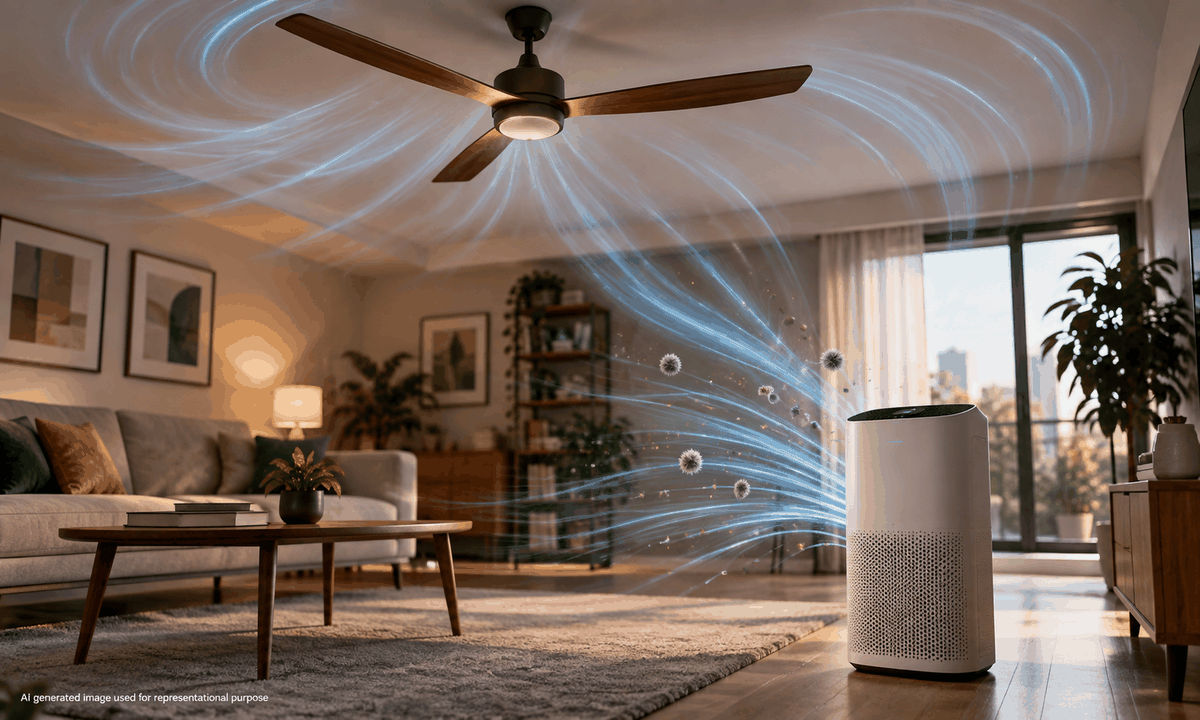

My air purifier reviews usually involve looking at how quickly a machine can bring down particle levels in a room. While doing one such test, I started wondering how much the room itself influences those results. A ceiling fan, for instance, can keep air moving continuously, changing how particles travel before they reach the purifier.
 Survey
That raised a simple question: if the air is circulating more, can the purifier clean the room faster? There is some research that has looked at exactly this, including a 2025 study involving a ceiling fan and a room air cleaner.
Here’s what I found.
What does the ceiling fan actually change?
An air purifier has its own airflow, determined largely by its fan speed and CADR. It pulls air in, sends it through the filters and pushes the cleaned air back into the room. But its airflow doesn’t necessarily reach every part of a room equally.
Also read: HEPA H13, H14, True HEPA: What these air purifier labels actually mean
A ceiling fan creates a much broader circulation pattern. Air from different parts of the room gets mixed together, which can bring particles that are farther away from the purifier into its airflow. The purifier still filters only the air that passes through it, but with more of the room’s air moving around, its intake gets a chance to draw from a larger portion of the space.
Whether the extra circulation actually translates into better particle removal is where the research gets interesting.
Research suggests the combination can help
A 2025 study published in Science and Technology for the Built Environment examined ceiling-fan mixing and room air cleaners in a multi-room test residence. Researchers released particles in the kitchen and tracked their behaviour under different combinations of fan and air-cleaner operation.
The study looked at particles ranging from the ultrafine range to 5 micrometres. When ceiling-fan mixing was used with the room air cleaner, particle removal increased compared with running the air cleaner without the additional mixing. The researchers also found a synergistic effect, with the combined setup producing a greater removal effect than simply adding the individual effects of the two systems.
In practical terms, better air mixing gave the purifier more opportunity to interact with air from different parts of the room.
But there is an important catch
A drop in airborne particle levels doesn’t automatically mean that the purifier’s filter captured every particle. The same study found that ceiling-fan operation affected particle deposition, including particles settling on the fan blades and other surfaces. Some particles can therefore leave the air because they deposit elsewhere rather than because they pass through the purifier.
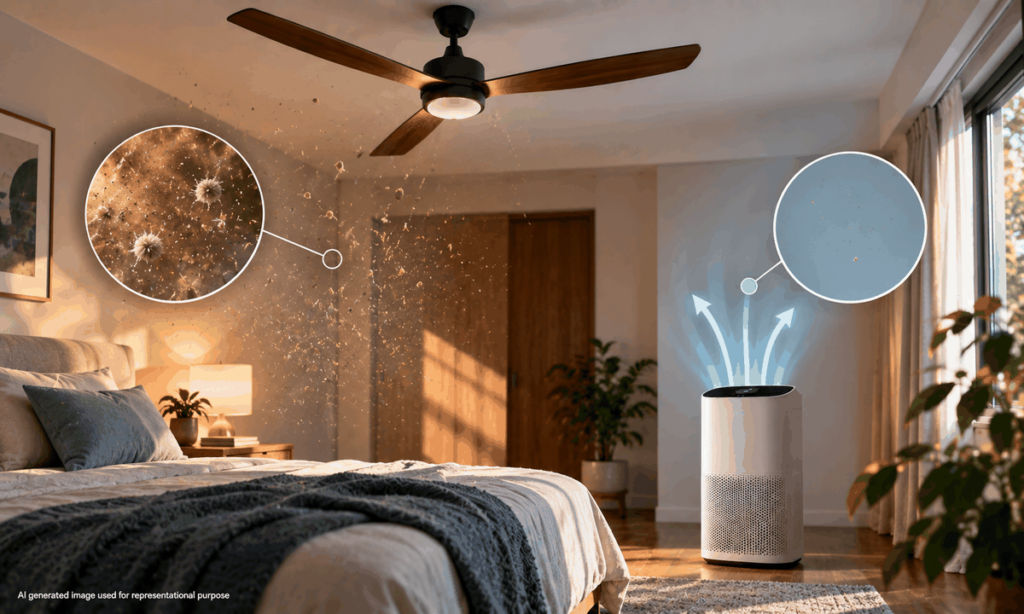
This is particularly relevant in a dusty room. A dirty ceiling fan can also contribute to the movement of particles when it starts running, which is another reason to keep the blades and surrounding surfaces clean.
Also read: Is a premium air purifier really better? Here’s what our testing found
Does fan speed or placement matter?
There isn’t a universal fan speed that will work best with every purifier. The effect depends on the room’s size, layout, furniture and the position of both appliances.
The goal is useful air circulation rather than simply moving as much air as possible. A fan that helps mix air throughout the room can be beneficial, while a purifier squeezed into a corner or blocked by furniture can still struggle to draw in air effectively.
The US Environmental Protection Agency recommends keeping portable air cleaners away from obstructions and placing them where people spend significant amounts of time. It also notes that higher purifier fan speeds generally allow more air to be filtered.
So, should you run both together?
Yes, provided the purifier is properly sized for the room. Running the ceiling fan alongside it can help keep air mixed, particularly in larger rooms where some areas may otherwise see less of the purifier’s airflow.
There is one important limitation: a ceiling fan cannot make up for an undersized purifier. If the purifier doesn’t have enough CADR for the room, better air circulation won’t change its actual cleaning capacity. For a correctly sized purifier with unobstructed airflow, though, there’s no reason to turn the ceiling fan off.
Also read: Your robot vacuum has a map of your home: Should you be worried?
FAQs
Where should you place an air purifier if a ceiling fan is running?
Keep the purifier in an open position with its intake and outlet unobstructed, rather than placing it directly under furniture or in a tight corner. The aim is to let the fan circulate room air without blocking the purifier’s own airflow.
Does a ceiling fan spread dust around the room?
t can move airborne particles around, but that doesn’t necessarily mean it makes air quality worse. The 2025 study found that fan-driven air mixing could increase particle removal when used with a room air cleaner, although some particles also deposited on surfaces and fan blades.
Will a ceiling fan help an air purifier clean a room with closed windows?
It can improve mixing within the room, but it does not increase the amount of fresh air entering the space. With windows closed, the purifier is still working with the air already inside the room.


