
OpenAI’s group chat feature explained: The bold step toward AI-assisted collaboration
 Follow Us
OpenAI introduces Group Chats, enabling multi-agent collaboration within ChatGPT
New ChatGPT feature transforms AI from solo assistant into collaborative workspace
Group Chats reshape productivity by uniting multiple AI experts in one conversation
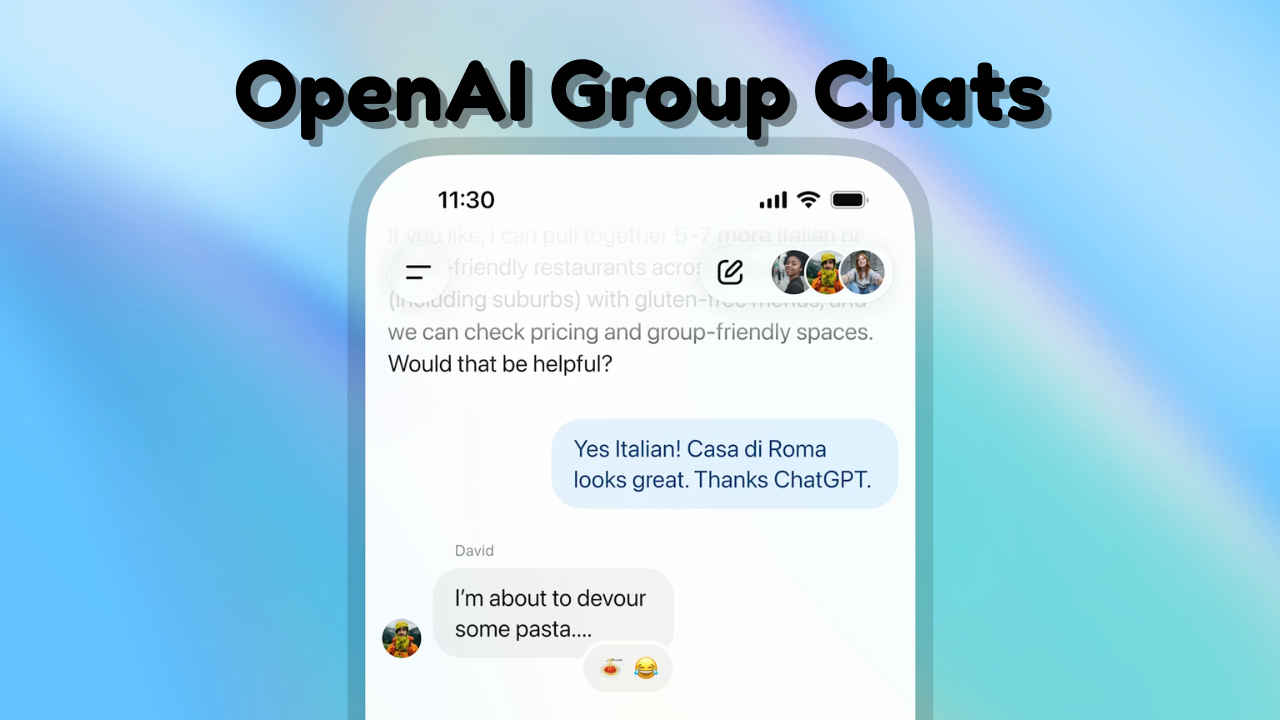

OpenAI’s new Group Chats feature isn’t just another product update, it’s a fundamental shift in how we interact with AI. For years, ChatGPT has existed as a one-on-one assistant: efficient, personal, and direct. With Group Chats, that model expands into something more ambitious. Now, multiple AI agents and humans can coexist in the same space, responding to each other, critiquing one another’s ideas, and working together toward a shared outcome. It pushes ChatGPT from being a single voice at the end of a prompt box to a digital team that collaborates.
 Survey
Also read: Qualcomm’s new chip for smart factories: Dragonwing IQ-X details explained
A New Kind of Collaboration Space
What makes Group Chats intriguing isn’t the idea of a shared room, it’s what happens inside it. Users can now bring in different AI profiles with different strengths. One model might be exceptional at creative thinking, another at analysis, another at code interpretation. Instead of switching tabs, copying responses, or prompting multiple times, the user can simply watch these models respond to each other in real time.
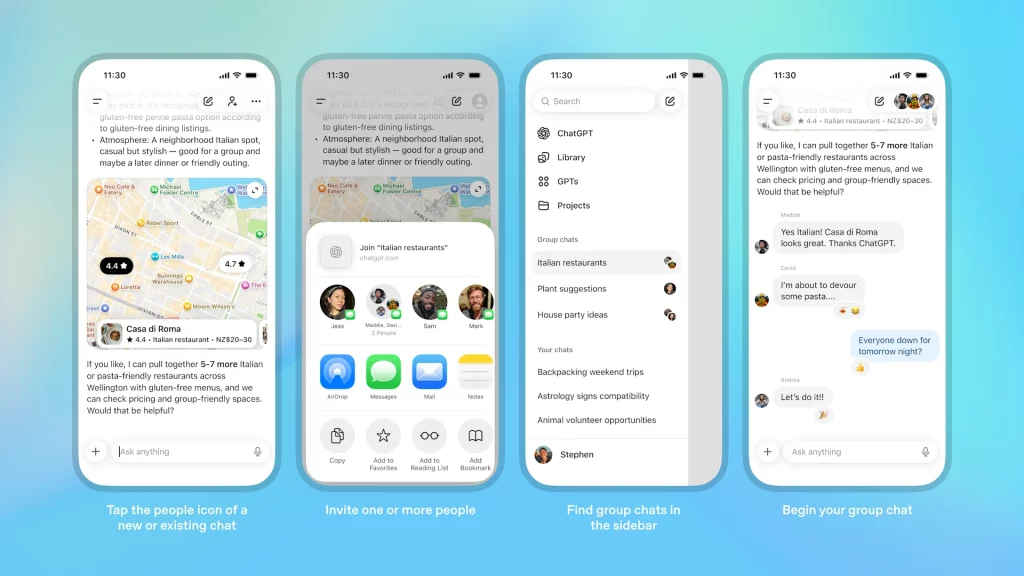
This changes the energy of the interaction. A brainstorming session becomes more alive. A design sprint becomes more fluid. A complex problem becomes easier to dissect because each AI tackles it from its assigned lens. Picture a product designer pulling in a visual designer AI, a technical reviewer AI, and a researcher AI. As one generates ideas, another evaluates feasibility, while the third fills gaps with context. It creates a conversation that feels closer to watching experts exchange ideas than typing into a chatbot.
In this way, ChatGPT becomes not just a tool but a creative environment, the digital equivalent of gathering teammates around a whiteboard.
From Solo Assistant to Multi-Agent Think Tank
Where Group Chats becomes even more interesting is in the structure it allows. Users can assign roles and personalities to each AI from the outset. One agent can be instructed to challenge ideas rigorously, another to refine the best ones, and another to verify facts. Instead of prompting every step manually, you set the ecosystem, and the agents take over the process together.
For a writer, this might mean drafting with one model while another judges clarity and a third suggests alternative angles. For engineers, a code model can propose solutions while a second model checks for vulnerabilities. Even students can benefit: one AI can walk through a maths solution methodically while another explains conceptual gaps.
Also read: What’s new in GPT-5.1: All differences compared to GPT-5 explained
The AIs don’t operate in silos; they interact. When one produces an answer, the others intervene with corrections, improvements, or warnings. What emerges is a multi-layered conversation where intelligence compounds rather than repeats.
This marks the beginning of something deeper, treating AI not as one mind, but as a cluster of minds working collectively.
The Promise and Tension of AI as a Team Member
The shift, of course, isn’t without concerns. Multiple AIs agreeing can create a false sense of correctness, consensus doesn’t equal truth. Models trained on similar data might echo each other instead of challenging assumptions. Users might find themselves deferring to a group of models that sound authoritative purely because they sound unified.
There’s also the question of how assertive these AIs should be. Human collaboration thrives on debate, disagreement, and occasionally even friction. Should AI agents challenge each other to that extent? Should a researcher AI be allowed to bluntly contradict a creative AI? OpenAI hasn’t framed Group Chats as a philosophical milestone, but it inevitably opens that door.
Still, the potential is powerful. Teams can collaborate in the same digital space without juggling documents and summaries. Creative workflows become faster. Decision-making cycles shrink. Individuals can harness specialised AI perspectives without ever leaving one room. This isn’t just convenience – it’s a rethinking of how work happens in an AI-driven era.
Group Chats may look like a simple feature at launch, but its implications are anything but simple. It nudges AI toward collective intelligence – toward systems that don’t just respond, but engage, question, and refine. It transforms ChatGPT from a solitary assistant into a collaborative hub where ideas evolve through interaction.
It’s a bold step toward AI-assisted collaboration, and it quietly marks the beginning of a world where we don’t just talk to machines, we work with them, as teams.
Also read: Microsoft’s AI Super Factory explained: The mega data center for the next generation of intelligence


