
OLED vs LCD vs Mini LED: What is the difference and which technology works better for smartphones?
 Follow Us
OLED panels can be as thin as 0.5mm–1mm, helping manufacturers fit larger batteries and slimmer bezels.
Unlike LCD and Mini LED, OLED can turn off individual pixels completely, delivering true blacks and lower power consumption.
Mini LED excels in TVs and laptops but remains impractical for smartphones due to its thicker design, higher power demands, and compatibility limitations.
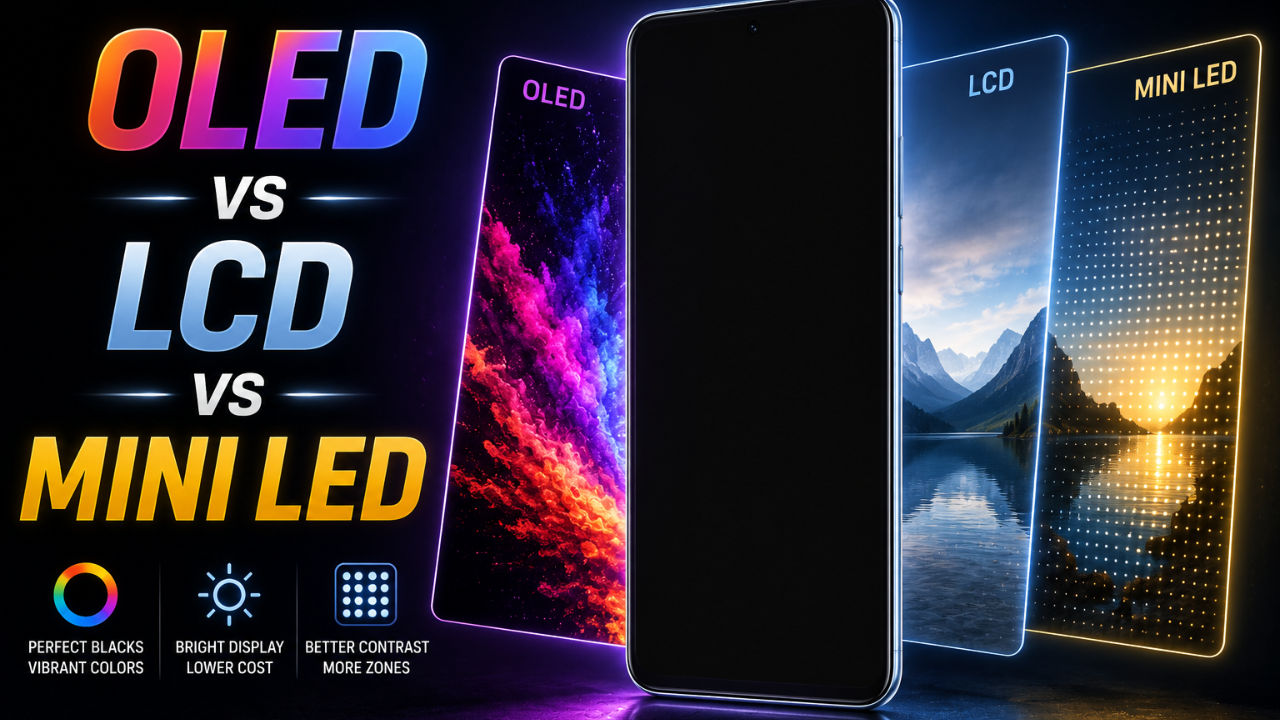

Smartphone displays have definitely evolved. Over a decade ago, LCD panels dominated almost every price segment while OLED was premium luxury. Now, the OLED is the default choice across the market, from the flagship devices to the increasingly affordable devices. On the other hand, Mini LED, despite thriving in televisions and laptops, has largely stayed out of the smartphone conversation. But if you are curious about how each technology works and what smartphones actually demand from a display, read along.
 Survey
How each tech works
The OLED or Organic Light Emitting Diode is a self-emissive technology where every pixel makes its own light. There is no separate backlight layer. Today, you must have already seen that every smartphone uses AMOLED panels which uses an active matrix variant that allows individual pixels to switch on and off independently. This helps in delivering perfect blacks, high contrast ratios and better power efficiency when displaying dark content.
Also read: From foldable iPhones to AI glasses, here is everything Apple may launch over the next two years
LCD works on different principles. A backlight sits behind the panel and a liquid crystal layer controls how much of that light reaches the viewer. As the backlight is always on, the LCD panels cannot fully turn off individual pixels, which is why black tends to look slightly grey. This technology is cheaper to produce and is why it survives in the budget segment.
Mini LED is often treated as something that is new but it is essentially an advanced form of LCD. Instead of a single backlight, it uses thousands of tiny LEDs grouped into local dimming zones that can brighten or darken independently. This gets closer to OLED in terms of contrast, but the underlying architecture is still LCD-based.
Why OLED fits smartphones
The dominance of OLED in smartphones is not just related to picture quality. It comes down to how well the technology fits the unique engineering constraints of a handheld device. Among the factors, thickness comes first. A modern OLED panel sits somewhere between 0.5mm and 1mm thin while the LCD panels typically need 2mm to 3mm to accommodate the backlight, diffuser and supporting layers. Mini LEDs need even more space because of the LED array and optical components. So, in a device where every fraction of millemetre matters, OLED frees up room for larger batteries, better cooling systems and more advanced camera hardware and is the ideal choice.
Secondly, many flagship phones use flexible OLED panels built on plastic substrates that can bend. This allows display driver components to sit behind the screen rather than alongside it, allowing the manufacturers to offer ultra-thin bezels. Meanwhile, LCD and Mini LED panels are rigid and require additional space at the bottom for drivers, making symmetrical, edge-to-edge designs far harder to achieve.
OLED also helps in battery efficiency. Black pixels on an OLED display are simply switched off, consuming virtually no power. Dark mode on an OLED device genuinely extends battery life, with power savings estimated at anywhere between 15 and 30 percent depending on usage. On the other hand, LCD panels keep the backlight running regardless of screen content and Mini LED, while more efficient than traditional LCD, still requires constant management of hundreds of dimming zones, adding processing overhead.
Lastly, optical fingerprint sensors, ultrasonic readers and under-display cameras all need light to pass through the panel. The thin, light-permeable structure of OLED makes this possible. The opaque backlight layers in LCD and Mini LED panels block that transmission which means under-display implementations are complicated and far less viable.
The drawbacks of OLED
However, OLED panels also have limitations. Many OLED displays use Pulse Width Modulation to control their brightness. Instead of reducing power directly, the display rapidly toggles pixels on and off. Most users never notice, but those sensitive to flickering may face eye strain or headaches.
Furthermore, OLED uses organic materials that degrade over time, and static interface elements such as navigation bars or notification icons may age at a different rate than the other parts of the screen.
Why Mini LED stayed out of smartphones
Mini LED has got its place in the large screen appliances. On a 65-inch television or a 14-inch laptop, there is enough physical space for local dimming zones to work. Smartphones offer none of that. The additional thickness, power demands, blooming artefacts from misaligned dimming zones and incompatibility with under-display sensors make Mini LED impractical for a device that needs to be thin, efficient and feature-rich all at once.
Verdict
So, what is the verdict? The OLED panel wins almost every count which matters including thinness, efficiency, contrast, brightness and design flexibility. The LCD on the other hand, holds its ground for the budget end. Lastly, Mini LED is a good choice for televisions and laptops but remains a poor choice for smartphones.
Until Micro LED becomes commercially viable at consumer scale, OLED will remain the technology that defines what a modern smartphone display looks and feels like.


