

Next-gen Xbox with AMD graphics: Key features to expect
 Follow Us

The gaming industry is officially on notice. During AMD’s Q4 2025 earnings call, CEO Dr. Lisa Su provided the most concrete evidence yet regarding the future of console hardware: a next-generation Xbox is in active development, targeting a 2027 launch. This timeline, backed by the development of a brand-new AMD semi-custom SoC (System on a Chip), suggests that Microsoft is looking to pivot away from the traditional eight-year console cycle to gain a strategic lead.
 Survey
Microsoft has already gone on record stating that its next hardware will deliver “the largest technical leap ever seen in a hardware generation.” While the current Xbox Series X was a masterclass in brute-force teraflops, the 2027 successor is shaping up to be a showcase of architectural efficiency and intelligence. Based on recent industry leaks and AMD’s own technological roadmap, here are the three key GPU-centric features that will define this next-gen leap.
Also read: Nvidia G-Sync comes to Samsung Odyssey monitors: What it is and how it works
The Jump to RDNA 5 ‘Navi 5’ Architecture
The core of the next Xbox will likely bypass the incremental improvements of RDNA 4 and leapfrog straight into RDNA 5 architecture, codenamed Navi 5. This isn’t just about a higher clock speed; it’s a fundamental redesign. Current rumors surrounding the “Magnus” SoC suggest that Microsoft and AMD are collaborating on a “clean-sheet” design.
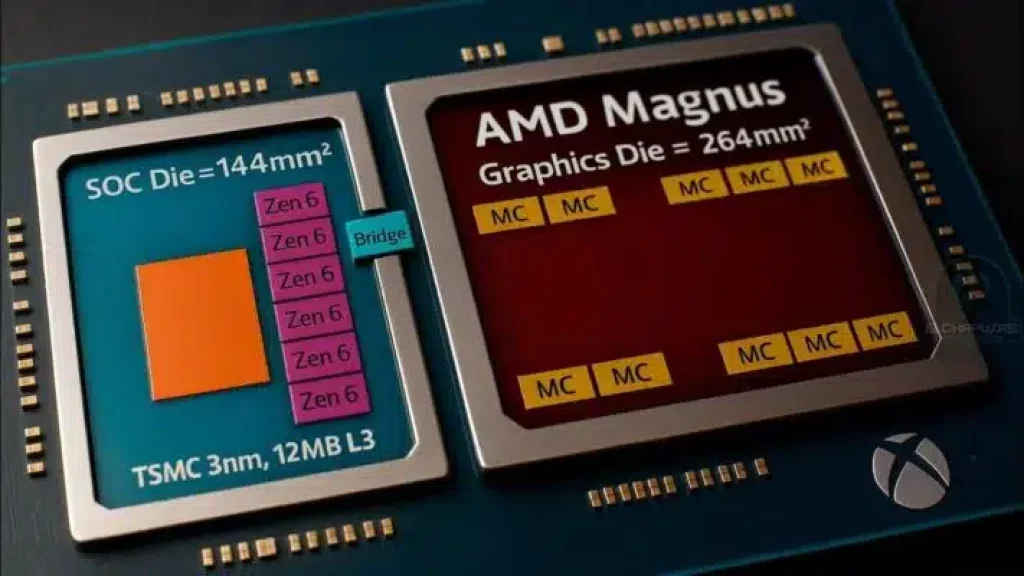
Unlike previous generations that felt like optimized desktop PCs, RDNA 5 is being built to handle “hybrid” gaming environments. This means the GPU will be optimized to handle massive throughput for high-resolution assets while maintaining the thermal efficiency required for a console form factor. We are looking at a target of native 4K performance at 120Hz as a baseline, rather than a “performance mode” compromise.
AI-Driven Upscaling: FSR ‘Redstone’ and Dedicated NPUs
In the current hardware landscape, Nvidia’s DLSS has set the gold standard for image reconstruction. Microsoft intends to bridge this gap by integrating dedicated AI Neural Arrays (NPUs) directly into the AMD GPU fabric. This hardware-level AI acceleration is expected to power FSR Redstone, the next evolution of AMD’s FidelityFX Super Resolution.
Also read: An RTX 5070 Ti GPU with a hole in it set a new world record: Here’s how
By using machine learning to analyze motion vectors and past frames, FSR Redstone will allow the console to render at lower internal resolutions (saving power and heat) while outputting a final 4K or even 8K image that is indistinguishable from native. This “AI-first” approach means that developers can push for more complex physics and geometry, knowing the AI will handle the heavy lifting of image clarity and frame generation.
‘Radiance’ Ray Tracing and Path Tracing
While the current generation introduced the world to Ray Tracing, it often forced gamers to choose between beautiful reflections or smooth 60 FPS gameplay. The 2027 Xbox aims to eliminate that choice through next-gen Ray Tracing hardware, rumored to be called Radiance Cores.
These dedicated units are designed for massive intersections and traversal acceleration, which are the primary bottlenecks of ray tracing. Beyond simple reflections, these cores will likely support full Path Tracing—a technique that simulates the physics of light for every single pixel in a scene. This would result in truly cinematic lighting, where shadows, global illumination, and light bounces behave exactly as they do in the real world, fundamentally changing the atmosphere of open-world games.
Also read: Check out all the games coming to Xbox Game Pass in February


