
Kosmos explained: The AI scientist that can read 1,500 papers
 Follow Us
AI system reads 1,500 papers to uncover new scientific insights
Edison Scientific’s Kosmos merges reasoning, coding, and literature analysis
Structured world models make Kosmos a transparent, traceable AI scientist

Edison Scientific has introduced Kosmos, an artificial intelligence system designed not to chat, but to conduct science. Unlike large language models that predict text token by token, Kosmos is built around what the company calls structured world models, a framework that lets it read, reason, and experiment across thousands of scientific papers, datasets, and code files at once.
 Survey
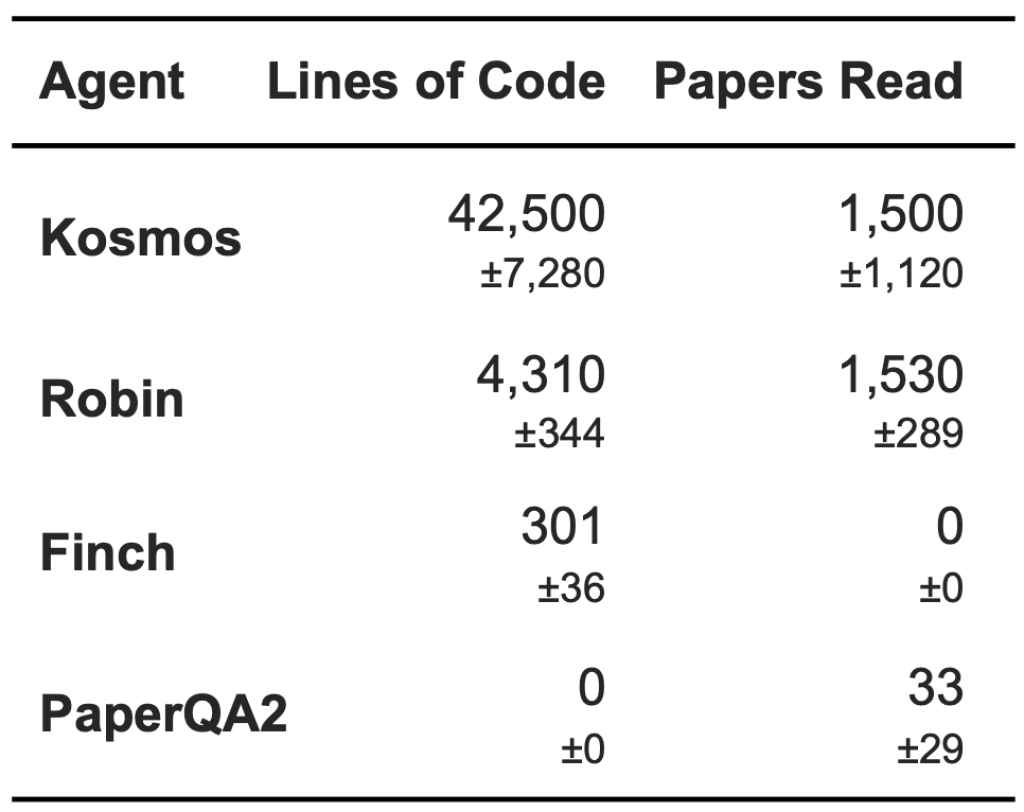
In its internal benchmarks, Kosmos reportedly digested over 1,500 research papers and executed more than 42,000 lines of analysis code in a single “run.” The result isn’t just summarized text – it’s a traceable research report with citations, code references, and statistical outputs. Edison Scientific calls it a “next-generation AI scientist,” one that can replicate human experiments and propose new hypotheses.
Also read: CALM: The model that thinks in ideas, not tokens
From Robin to Kosmos: scaling scientific reasoning
Kosmos follows Edison’s earlier AI platform, Robin, but takes a radical step forward in both scale and methodology. Instead of relying on conversational predictions, Kosmos uses a structured reasoning graph that organizes facts, assumptions, and data into a machine-interpretable model of the world. This lets it maintain context across complex, multi-step experiments – something that’s almost impossible for chat-based AI systems like GPT or Claude.
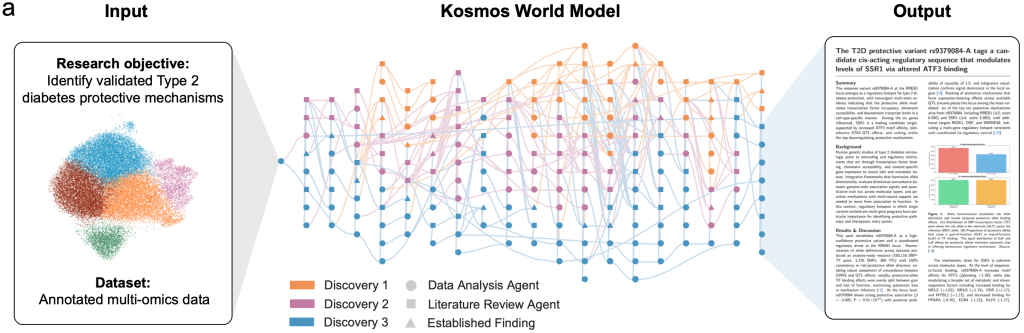
The company says Kosmos is meant for deep research workloads, not casual Q&A. It can run multi-week analysis pipelines, combining text mining, data processing, and statistical inference without losing track of what it’s doing. Every conclusion it draws can be traced back to its source, whether that’s a line of Python code or a paragraph from a published study. This emphasis on traceability aims to fix one of science’s biggest pain points with AI: the “black box” problem.
Real discoveries and reproducibility
To prove its potential, Edison Scientific highlighted seven discoveries made using Kosmos – spanning neuroscience, material science, and statistical genetics. Three of these reproduced existing human-led findings, while four were entirely novel hypotheses.
Among them: Kosmos suggested that high circulating levels of the SOD2 protein may reduce myocardial fibrosis in humans, and identified a possible mechanism linking a specific SNP (genetic variant) to reduced risk of Type 2 diabetes. These are early results, but they showcase the system’s ability to go beyond literature review into real hypothesis generation.
According to Edison’s beta users, a single Kosmos run can perform the equivalent of six months of research work, though the company cautions that the figure depends on how efficiently the system is configured and prompted.
Also read: Project Suncatcher: Google’s crazy plan to host an AI datacenter in space explained
Promise and pitfalls of machine scientists
Kosmos isn’t perfect. Edison’s team admits it can chase “statistically significant yet scientifically irrelevant” correlations, or get stuck in analytical rabbit holes. It also demands expert setup, prompting and defining experimental parameters require domain knowledge. And at $200 per run, it’s not a casual tool for the average student or hobbyist researcher.
Still, the implications are massive. If systems like Kosmos can truly reason, read, and document their scientific process, they could reshape how research is done – accelerating discovery while maintaining transparency.
Edison Scientific’s November 5, 2025 announcement feels less like another AI milestone and more like a glimpse into the next era of science: one where machines don’t just assist researchers, they join them in the lab.
Also read: Snowflake’s bold AI bet: Turn AI agents into your next colleagues


