
Inside online AI selfie boom: Hidden cost of viral AI image trends explained
 Follow Us
AI images are trending, but they come with hidden costs.
Sharing photos with AI tools raises privacy and scam concerns.
AI also consumes significant power and water.
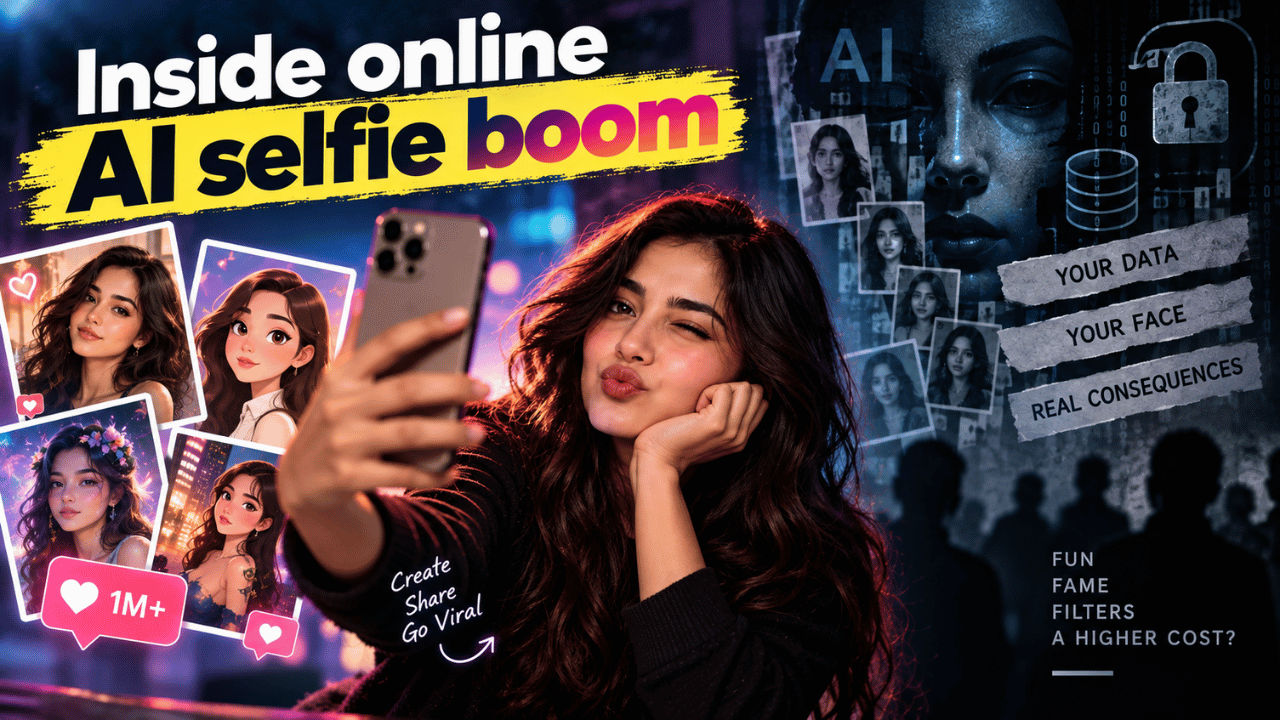

Social media has changed dramatically in the past few years, and India has been right in the middle of that transformation. Unlike old times when it was a place to share your moments of joy, viral image trends have taken over the place. What’s more interesting is that such trends spread like wildfire on social media platforms like Instagram, creating a quiet pressure to participate or a fear of missing out (FOMO). From retro 1980s portraits and Studio Ghibli-style makeovers to turning yourself into a plastic action figure sealed inside a toy box, AI-generated images have become the latest way to join the internet’s endless cycle of trends.
 Survey
If we roll back a few years, then the trend we had was an image filter that gave you dog ears and a wagging tongue on Snapchat. But today AI can reimagine your face, clothes, surroundings and even your identity with a few words. What’s more concerning is that the difference is not just technical but also a sign of how quickly consumers have adopted generative AI.
Just to give you a little bit of context on the situation, here are the numbers after a few days of OpenAI adding image generation to ChatGPT. Within days of OpenAI adding image generation to ChatGPT, more than 130 million people worldwide had reportedly used the feature to create over 700 million images. OpenAI’s COO has called India its fastest-growing market, while CEO Sam Altman has said demand for the company’s AI products has put enormous pressure on its computing infrastructure.
For users, many of these images appear to come at little or no monetary cost. But the term ‘FREE’ does not necessarily mean ‘cost-free’, as the price can take several forms. The data we as users hand over, the privacy implications of repeatedly uploading our faces, the psychological pressure of constantly presenting an AI-enhanced version of ourselves and the enormous amounts of computing power, electricity and water required to generate and store these images.
So, while the AI-generated selfies are becoming India’s latest social media obsession, a bigger question sits underneath the trend. Who is actually paying for it, and what? Let’s try to find out the answer to that.
From filters to face data: What you’re actually handing over
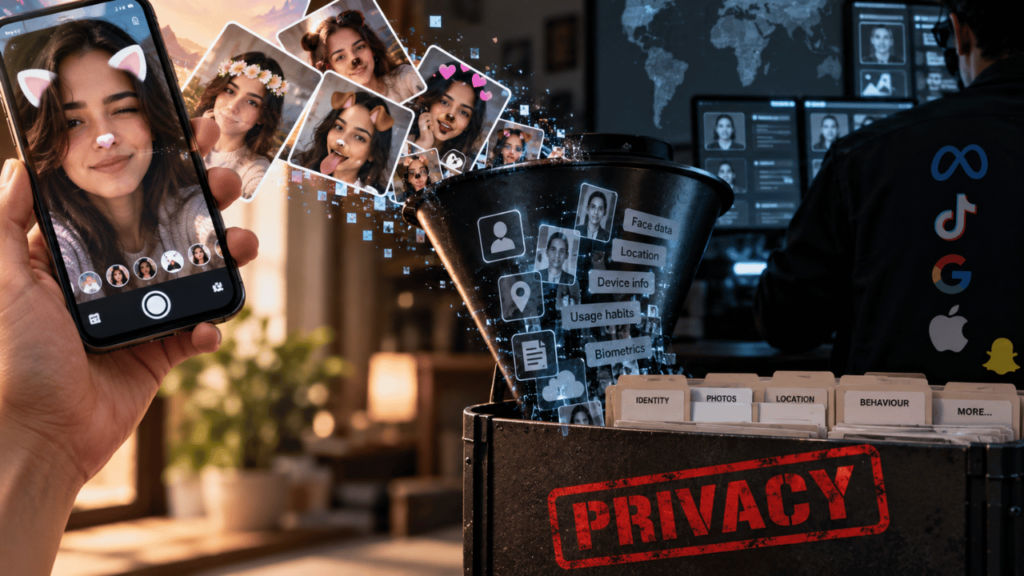
Every one of these viral trends we see today starts the same way. You need to upload a personal photo to an app whose terms you have almost certainly never opened. Then you go ahead and type a prompt to instruct the AI tool to make you look a certain way, and boom, you get your results.
While all this sounds easy, research from Pew Research found that 56 per cent of people skip privacy policies entirely before using an online service, and there is little reason to think Indian users behave any differently during a viral trend.
During the Ghibli wave in 2025, Arjun D’Souza, senior legal counsel at the digital rights group SFLC, warned that users were quietly handing over biometric information that could be used to train future AI models. As he put it, ‘much relating to AI outputs remains a black box,’ since once a company absorbs your face into its training data, there is no simple way to pull it back out.
Several Indian state cyber cells also issued similar public advisories during the same period. Reports also claim that Google Trends showed India among the top searching nations for Ghibli art, with Gujarat hitting the highest possible search score of 100.
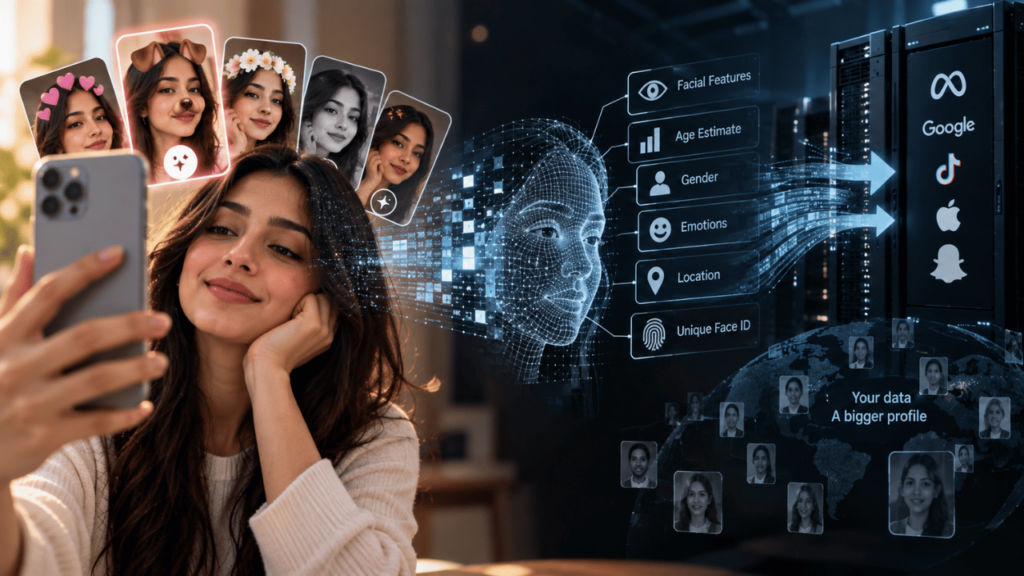
But did you ever think that the biggest attraction of AI image tools is also one of their biggest concerns? You need to upload an original photograph of yourself to get the desired output. What is important to note here is that, in many cases, the process is not done locally on your smartphone. The image is sent to a company’s servers, where what happens to it next depends on the service’s privacy policy, settings and data practices.
This isn’t just about a photograph leaving your device as you do when you make it public by uploading it on social media. Still, the things are more concerning than you realise, as a normal picture of you can reveal your face, location, surroundings, clothing, family members and sometimes other information stored in the original file. As we previously reported, photographs can contain metadata such as the time a picture was taken and GPS information, depending on the file and device.
While we do have a Digital Personal Data Protection Act protecting us, it says consent should be free, specific, informed and unambiguous, and users should be able to withdraw it. But do we have that liberty? The simple answer is NO.
And if that was not already enough, then there’s another copyright angle too. These tools recreate a distinct visual style built over decades by real animators at Studio Ghibli, without their consent or payment, and the studio’s own founder has publicly criticised AI-generated animation in the past.
India’s Copyright Act, 1957 recognises photographs as artistic works and generally identifies the photographer as the author of a photograph. Moreover, it also gives copyright owners rights over reproduction and adaptation of artistic works. But the law is still grey, especially when it comes to AI tools. The government is moving fast, as a dedicated committee is currently under the Department for Promotion of Industry and Internal Trade (DPIIT), but it may take some time.
Also read: Activated carbon filters: How much odour can an air purifier really remove?
Scams nobody warned you about

Deepfakes riding on this same technology have become a daily nuisance in India. McAfee’s 2026 Scamiverse report found Indians now encounter about 4 deepfakes a day and 13 scam messages overall, spending 102 hours a year, nearly three working weeks, just trying to separate the real from the fake.
Not only that, but fifty-one per cent of Indians said they had lost money to a scam, with the average loss at Rs 93,915. A separate 2025 McAfee survey found 90 per cent of Indians had seen fake celebrity endorsements, while an earlier study showed 75 per cent had come across some form of deepfake in a year, with a quarter of them seeing political deepfakes forwarded on WhatsApp and Telegram without anyone checking if they were true first.
AI images have also changed the relationship between a photograph and reality. For decades, people generally treated photographs as evidence that something happened, but that assumption is also becoming weaker now. An AI tool can now create a convincing picture of a person standing somewhere they have never been, wearing something they never wore or doing something they never did.
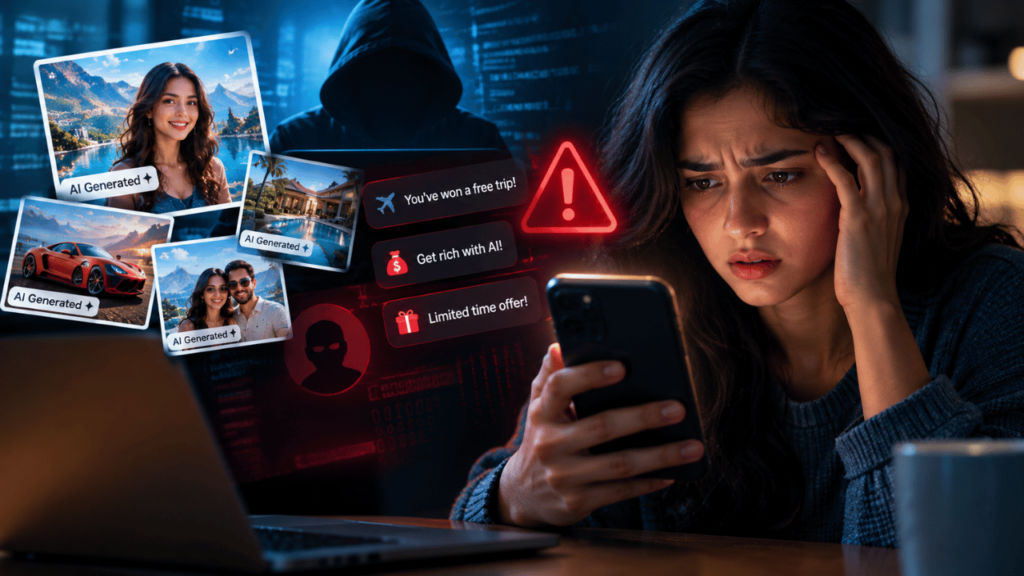
This becomes particularly serious in India, which is one of the world’s most populous countries, because images can spread rapidly through WhatsApp, Instagram, Facebook and other platforms. A misleading picture does not need to become a major news story to cause harm. It can circulate inside a family group, local community or school before anyone checks whether it is real.
The Indian government has recognised the problem, and back in February 2026, the government amended the IT Rules to address harms linked to synthetically generated information, including AI-generated content and deepfakes. Platforms are required to take reasonable technical measures against unlawful synthetic content and provide clear labelling and traceable information for permissible AI-generated material.
The psychological effect is another side of the problem, as AI image tools can make people look taller, thinner, younger, more muscular or conventionally attractive. When such images are repeatedly shared, the edited version can slowly become the version people feel they should look like.
This can create unrealistic expectations, particularly among younger users. A normal photograph may suddenly appear inadequate when compared with an AI-enhanced version that has perfect skin, lighting and facial features. There is also a risk of emotional confusion as people may start comparing their real appearance with an image that was never real in the first place.
Also read: Consumers today are not price sensitive; they are more value-centric: Cellecor CMO Jubin Rawal
The water and power bill behind every AI photo trend
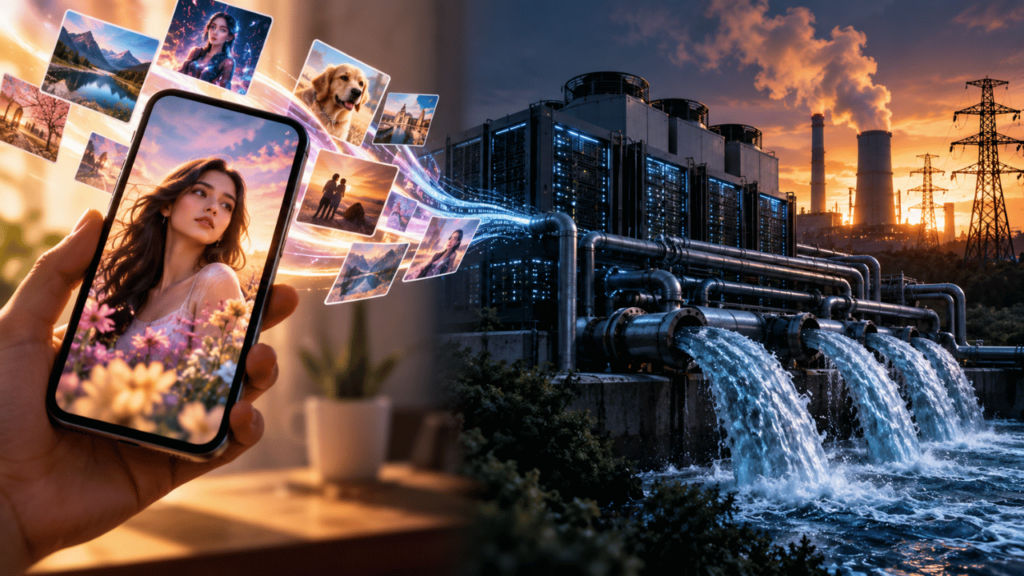
The environmental cost of an AI-generated image is easy to ignore because the process feels almost weightless. You type a prompt, wait a few seconds, and receive a picture. But no matter how effortless the experience feels, it carries an environmental impact. Behind that simple interaction, computers in data centres consume electricity and generate heat, which means they also need cooling. In many data centres, cooling can require significant amounts of water. The Government of India’s Economic Survey 2025–26 says that the growth of AI depends on physical infrastructure. Data centres, which support AI systems, need large amounts of electricity and water.
India’s data centre industry shows how quickly this infrastructure is growing. According to the Ministry of Electronics and Information Technology, India’s total data centre capacity grew from about 375 MW in 2020 to around 1,500 MW in 2025. A newer government update from August 2026 puts the country’s installed capacity at about 1,575 MW. The government has also estimated that electricity demand from data centres could reach 13.56 GW by 2031-32.
The 13.56 GW projection comes directly from a Rajya Sabha reply by the Ministry of Power. However, back in December 2025, responding to that, the ministry said that data centres currently required approximately 1 GW of power and that this could rise to 13.56 GW by FY 2031-32 because of upcoming data centres.
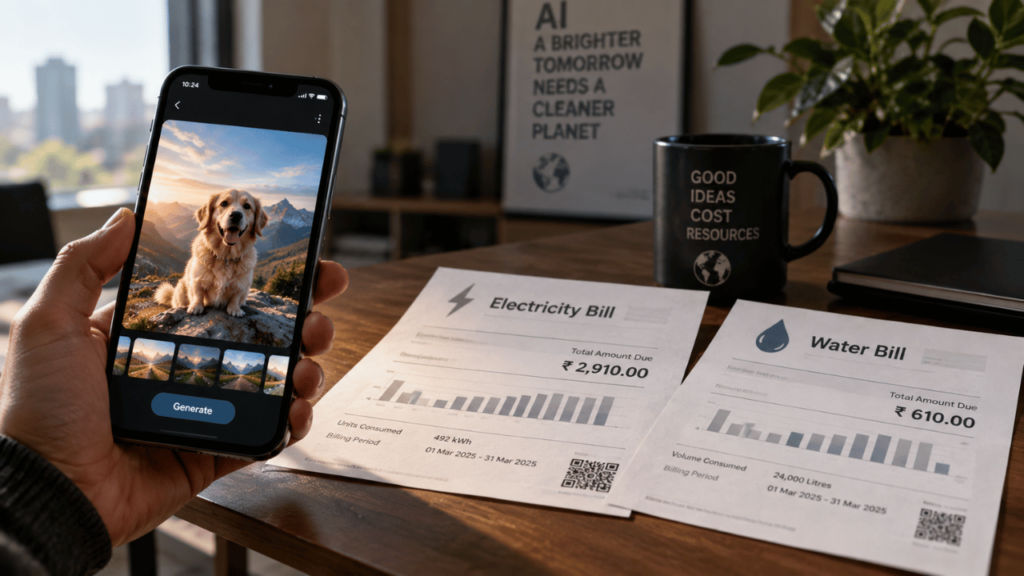
This was further backed by a report from Deloitte, in which they shared the scale of expected demand, estimating that India’s growing AI could require an additional 40 to 45 terawatt-hours of power for data centres by 2030.
The scale of the resources involved becomes clearer when we look at water use. The Economic Survey 2025-26 notes that AI data centres can consume up to 20 lakh litres of water per day. It also warns that India’s power, finance and especially water resources are binding constraints as the country scales its AI infrastructure. Meanwhile, a CEEW and SYSTEMIQ report estimates that India’s data centres used approximately 150 billion litres of water in 2024, with annual consumption expected to more than double by 2030.
However, it is important to note that not all of this demand comes from AI image generation. Data centres support banking, cloud services, streaming, websites and many other digital activities. Still, AI is becoming an increasingly important driver of new computing demand. The government itself has said that the rapid growth of AI and high-performance computing is driving increased demand for data centre capacity.
Viral AI image trend: Who actually pays for the trend?
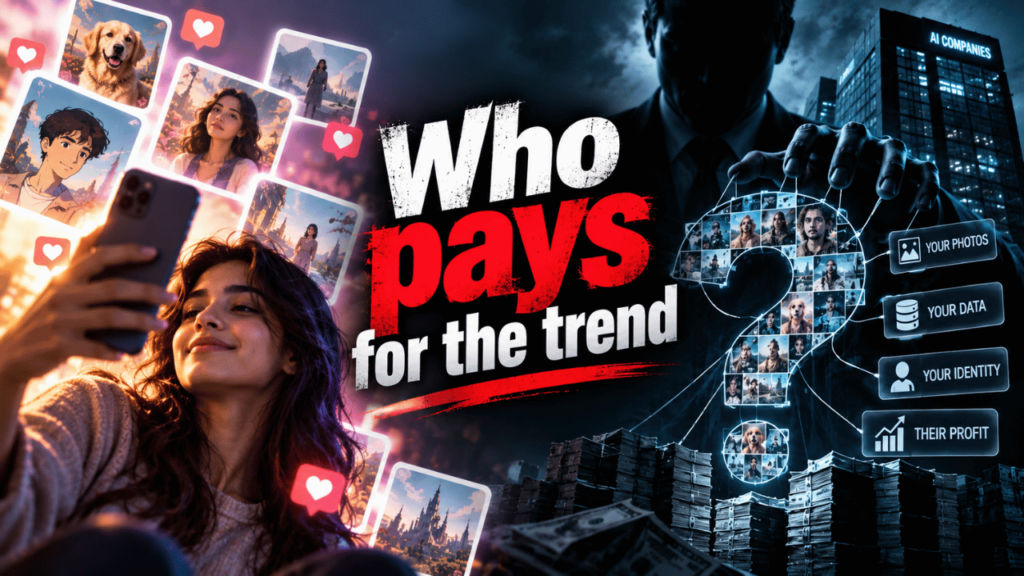
Coming back to the original question, who is actually footing the bill for these viral image trends? Well, in one way or another, it is the common man like you and me. While companies may market these features as ‘free’, the cost does not always come in the form of money. It can be our data, attention, computing resources, or sometimes, our cash. In other words, one way or another, we are paying for it.
So, does that mean you should stop using these AI trends? Not necessarily. The point is to be a little more conscious about what we are giving away in exchange for convenience and entertainment. After all, the choice is yours, but knowing the cost makes that choice a little more informed.


