
Demis Hassabis vs Yann LeCun: Is human intelligence general or specialized?
 Follow Us
Yann LeCun says human intelligence is narrowly specialized, not general
Demis Hassabis argues brains are general learners under theoretical computation
The debate hinges on definitions, efficiency, and bounded intelligence
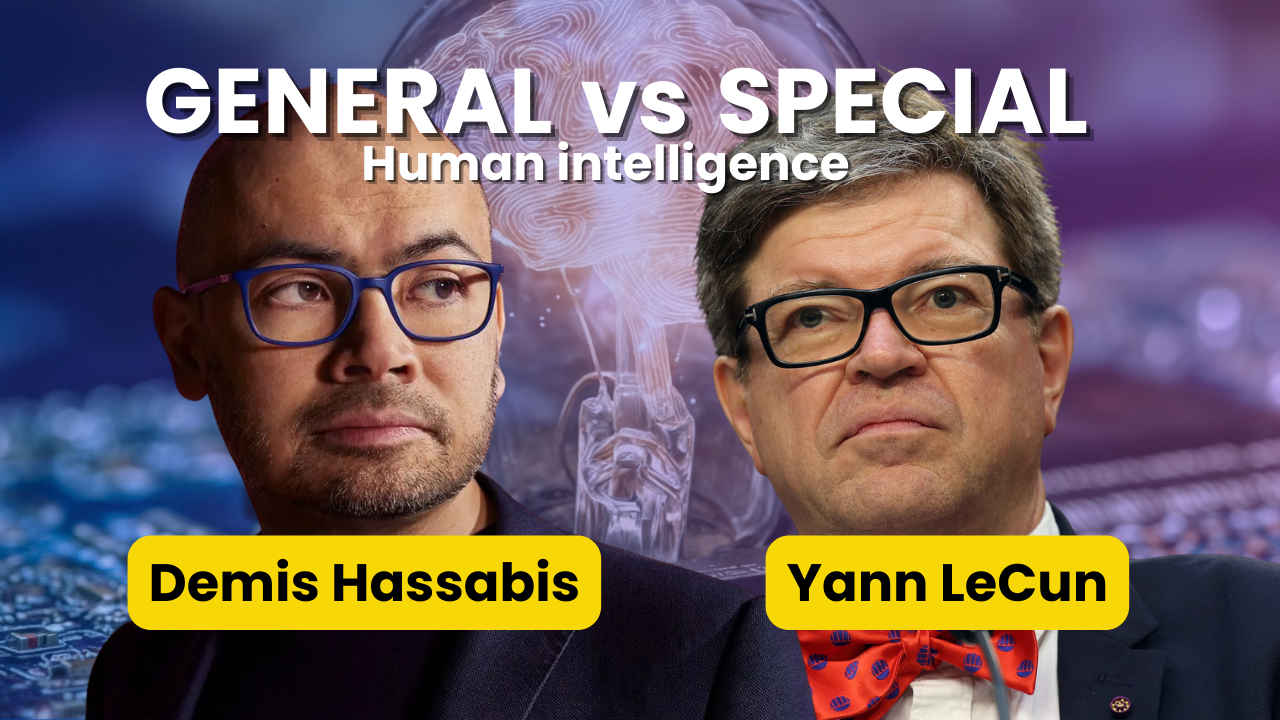

In the often abstract, occasionally esoteric world of artificial intelligence research, it’s rare to see a philosophical disagreement surface so publicly – and so bluntly. Yet that’s exactly what happened when Yann LeCun, Meta’s chief AI scientist, declared that “there is no such thing as general intelligence,” calling the concept “complete BS.” Within hours, Demis Hassabis, CEO of Google DeepMind, stepped in to disagree – politely, but firmly.
 Survey
What followed wasn’t a petty Twitter spat. It was a crystallized debate about how we define intelligence itself – and whether humans, often the implicit benchmark for “general intelligence,” are even worthy of that status in the first place.
In a short clip (of a longer interview) uploaded on X.com, which was barely one minute, Yann LeCun’s argument begins with an uncomfortable demotion of our own species. Humans, he says, only seem general because the world conveniently matches the problems we evolved to solve.
“Human intelligence is super specialized,” Yann LeCun argues. We’re good at navigating the physical world and reading other humans because evolution shaped us that way. “And chess we suck at,” he adds pointedly, noting that many animals outperform us in tasks we barely comprehend. The illusion of generality, LeCun claims, exists only because “all of the problems that we can apprehend are the ones that we can think of.”
Demis Hassabis disagrees with Yann LeCun
Demis Hassabis, who apart from being CEO of DeepMind is also a Nobel laureate, sees this as a category error. “Yann is just plain incorrect here,” he writes, accusing LeCun of confusing ‘general intelligence’ with ‘universal intelligence’. The distinction matters.
No finite system can be optimal at everything – Hassabis freely acknowledges the no free lunch theorem – but that doesn’t preclude generality. In theory, he says, systems like the human brain are capable of learning “anything computable given enough time and memory (and data).” In the Turing Machine sense, humans – and modern AI foundation models – are “approximate Turing Machines.”
That framing leads Hassabis to an almost poetic defense of human cognition. Yes, humans aren’t optimal chess engines. But “it’s amazing that humans could have invented chess in the first place,” let alone produce someone like Magnus Carlsen. The real marvel, Hassabis suggests, isn’t bounded performance – it’s the capacity to traverse domains at all, from science to aviation to abstract games, using brains evolved for hunting and gathering.
Yann LeCun explains to Demis Hassabis
In his rebuttal to Hassabis’ explanation and point of view, Yann LeCun doesn’t deny the theoretical power of human brains. He concedes that “a properly trained human brain with an infinite supply of pens and paper is Turing complete.” The problem, he insists, is efficiency.
Intelligence in the real world is always resource-bounded. Under those constraints, the human brain is wildly suboptimal for most conceivable tasks.
To make his case, LeCun turns mathematical – and devastatingly so. The optic nerve, he explains, carries roughly one million fibers. A vision task, simplified, is a Boolean function from one million bits to one bit. The number of such possible functions? 2^(2^1,000,000). The number of functions the human brain can actually represent, given its roughly 10^14 synapses? At most 2^(3.2×10^15). “This is a teeny-tiny number,” LeCun writes, “compared to 2^(1E301030).” His conclusion is blunt: “Not only are we not general, we are ridiculously specialized.”
Also read: LLMs worse than babies in field of AI: Yann LeCun ‘Godfather of AI’ explains why
This is where the debate zooms out from AI architecture to something more existential. LeCun quotes Einstein: “The most incomprehensible thing about the world is that the world is comprehensible.” We understand only a vanishingly small, highly structured slice of reality. The rest, LeCun argues, we call entropy – and ignore.
Human intelligence: Special or general?
So who’s right? Both, if you think about it. Hassabis is defending a theoretical notion of generality – the ability of a single architecture to span domains. While LeCun is defending a practical one – what systems can efficiently do under constraints. The disagreement, as LeCun himself concedes, is “largely one of vocabulary.”
But the stakes aren’t semantic. As AI systems inch closer to human-level performance across tasks, how we define “general intelligence” will shape what we build – and what we expect from it. Whether intelligence is broad or narrow may matter less than this shared realization that whatever it is, it’s rarer, stranger, and more constrained than our species has long liked to believe.
Also read: Google DeepMind chief Demis Hassabis says AI startup boom is overhyped and due for correction


