
ChatGPT co-creator launched an AI that can’t hallucinate: Here’s how it works
 Follow Us

Diogo Almeida had spent decades training machines to speak our language. But for him, speaking was never really the secret sauce. Almeida co-built the methods behind ChatGPT at OpenAI, the ones that made language models follow instructions and hold a conversation. On September 15, he and his team launched the first ever “System One Model” called Jev with his new startup TypeSafe AI. System One and System Two refer to Daniel Kahneman’s concept of fast and impulsive System 1 and slow and logical System 2 processing. So, why is it that while chat models are now superhuman, there isn’t any automation as promised? Because chat models don’t have to speak.
 Survey
Also read: Air fryer vs microwave: What’s better to reheat different foods?
No words, no problem
Each and every LLM, including ChatGPT, generates one word after another based on predictions from the preceding word. Perfectly fine in case of a chatbot. But for software, which is not interested in a paragraph but in a decision, it needs to interpret your paragraph in order to extract the decision you need.
Jev bypasses this step altogether. You give it structured data and a list of typed questions and it returns typed answers directly, marked with probabilities and confidence scores for each of them. There is no need for writing and interpretation of natural language responses because the software receives the output in the typed format, just as the model intended.
This is exactly how Jev manages to achieve the so-called hallucination resistance, which is more of a trick of the trade than a training breakthrough. In fact, all possible answers are specified before the model even starts working, so there is nothing to generate as such.
What it can’t do, and what that buys you
Also read: Slowing Down Frontier AI: Why Amodei, Altman, Musk are getting flak
Do not ask Jev to write your emails. It will not explain itself, build off a prompt, or generate content of any kind. This is not ChatGPT reduced in size. It was built to take care of the unglamorous things behind the scenes: score this, send that, mark this, classify that. The decisions your code has to make over and over and over again in a clumsy way because writing out your rules manually leads to brittleness quickly.
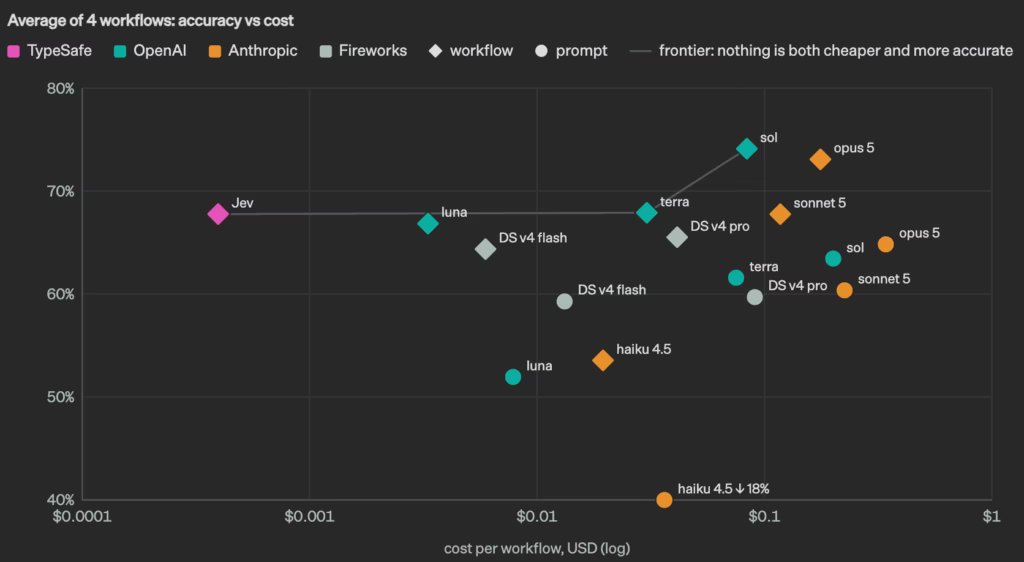
In return, you get speed and pricing that will make today’s LLMs seem quaint. TypeSafe claims that Jev is priced at $42 per billion input tokens compared to $0.20 to $10 per million for state-of-the-art models, while output tokens have zero cost. Response times are somewhere between 70ms and 500ms, compared to 3s and 329s for comparable state-of-the-art LLMs. TypeSafe’s own workflow benchmark shows up to 193x faster and 444x cheaper, but they admit these are ideal case numbers, not real-world ones.
The bet on knowing what you don’t know
It is all powered by a novel approach to training, which is called Reinforcement Learning for Calibrated Decisions or RLCD. The training here is not focused on human preferences or mathematical perfection but teaches the model precisely how confident it needs to be about its conclusions. It is completely irrelevant for the model to correctly perform tasks 95 percent of the time when it cannot mark those other 5 percent. It is exactly this problem that chatbots have never solved before.
Also read: Asus Zenbook A16 (2026) first impressions: Style meets portability


