
CES 2026: AMD Ryzen AI 400 chip revealed, 5 key features explained
 Follow Us
AMD Ryzen AI 400 unveiled at CES 2026 60 TOPS NPU
Ryzen AI 400 brings Copilot plus desktops Zen5 RDNA3.5 efficiency
CES 2026 AMD Ryzen AI chips promise multi day battery

At CES 2026 in Las Vegas, AMD officially took the wraps off its latest generation of mobile and desktop processors: the Ryzen AI 400 Series. Building on the foundation of the Ryzen AI 300 “Strix Point” chips, the new 400 series (codenamed “Gorgon Point”) doubles down on the AI PC trend, pushing NPU performance even higher while refining power efficiency to battle Intel’s latest Core Ultra offerings.
 Survey
Here are the confirmed specifications and the 5 key features that define AMD’s new silicon.
Also read: Nvidia DLSS 4.5 is here to enhance your gaming sessions: What it does and all you should know
The Specs: Ryzen AI 400 Series at a Glance
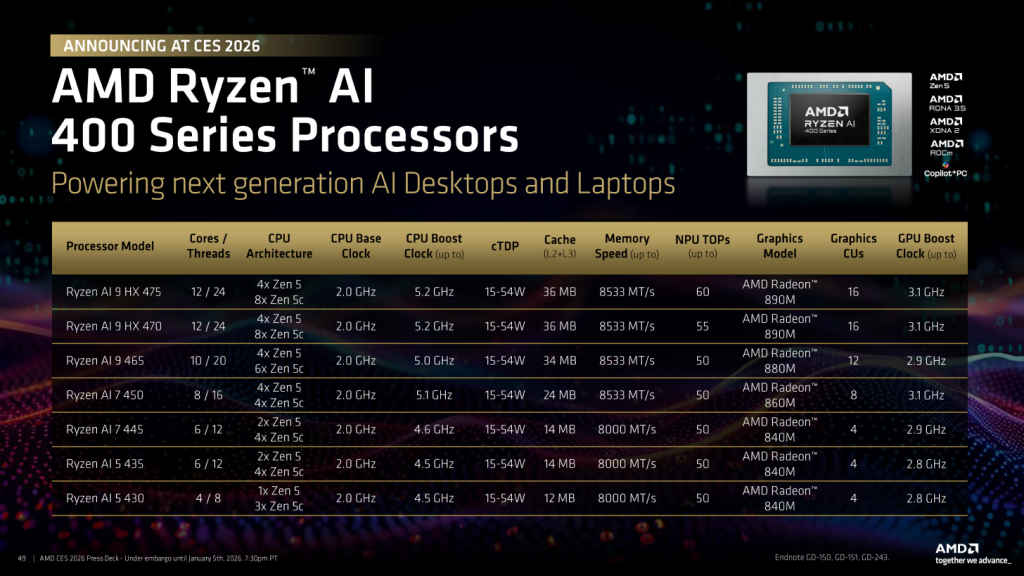
The flagship of the new lineup is the Ryzen AI 9 HX 475, which leads a stack of seven new APUs.
| Feature | Specification |
| Architecture | Zen 5 (Performance) + Zen 5c (Efficiency) |
| NPU | XDNA 2 architecture, up to 60 TOPS |
| GPU | RDNA 3.5 (Radeon 890M / 800M Series) |
| Top SKU | Ryzen AI 9 HX 475 (12 Cores / 24 Threads) |
| Max Boost | Up to 5.2 GHz |
| Memory Support | LPDDR5X-8533 MT/s |
| Process | TSMC 4nm |
A 60 TOPS NPU for the Copilot+ era
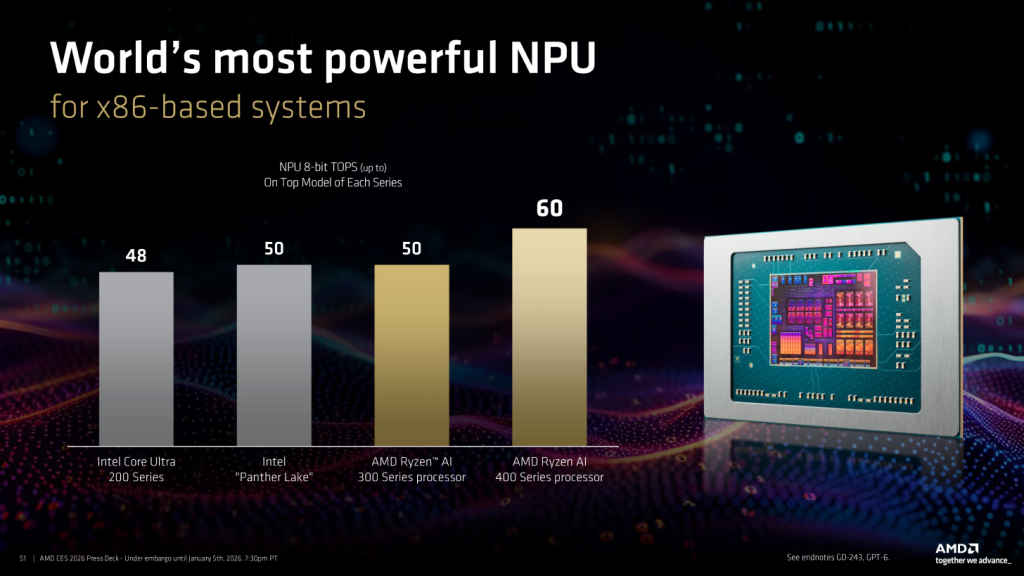
The headlining feature of the Ryzen AI 400 series is the upgraded XDNA 2 NPU, which now delivers up to 60 TOPS (Trillion Operations Per Second) of AI performance. This is a roughly 20% increase over the previous generation’s 50 TOPS.
This bump is significant because it comfortably exceeds Microsoft’s 40 TOPS requirement for the Copilot+ PC certification. While the previous generation also met this standard, the extra headroom allows for faster local inferencing on tasks like live translation, image generation, and context-aware assistants without bogging down the main CPU or draining the battery.
Refined Zen 5 architecture & RDNA 3.5 graphics
While not a complete architectural overhaul, the 400 series refines the Zen 5 and Zen 5c core design. The top-tier Ryzen AI 9 HX 475 features a hybrid configuration of 4 Zen 5 cores and 8 Zen 5c cores.
Also read: AMD Ryzen AI 300 Series: How Zen 5 Architecture Boosts CPU Performance
On the graphics side, AMD continues to use the RDNA 3.5 architecture but has optimized clock speeds and efficiency. The integrated Radeon 890M iGPU now boosts up to 3.1 GHz. AMD claims this results in 10% faster gaming performance and 30% faster multitasking compared to the previous generation, positioning these chips as viable options for 1080p gaming on thin-and-light laptops.
“Multi-Day” battery efficiency
Efficiency was a major talking point at the CES keynote. AMD claims the Ryzen AI 400 series offers “multi-day” battery life, specifically citing up to 24 hours of local video playback on a single charge.
This efficiency gain comes from the optimized 4nm process and better power management between the high-performance Zen 5 cores and the compact Zen 5c cores. AMD also touted a 70% improvement in “unplugged connectivity” performance, suggesting that the laptop won’t throttle as aggressively when running on battery power compared to competitors.
First Copilot+ processors for desktop
In a strategic shift, AMD confirmed that the Ryzen AI 400 series will not be limited to laptops. The company announced that these will be the first Copilot+ processors available for desktop PCs.
This brings the dedicated NPU capability to the desktop form factor, allowing users to run heavy local AI workloads on their main rigs. It signals a move to standardize “AI PC” features across all form factors, not just mobile devices.
Faster memory support (LPDDR5X-8533)
AI and integrated graphics are hungry for memory bandwidth, and AMD has responded by upgrading the memory controller. The Ryzen AI 400 series supports LPDDR5X memory at speeds up to 8533 MT/s, up from the 8000 MT/s limit of the Ryzen AI 300 series.
This bandwidth increase directly benefits the RDNA 3.5 iGPU and the NPU, as both rely on system memory to function. The faster RAM allows for quicker data shuttling during gaming and AI token generation, reducing latency in bandwidth-heavy applications.
The Ryzen AI 400 series is scheduled to launch in laptops in Q1 2026, with major OEMs like ASUS, Lenovo, and HP already confirming upcoming models. With Intel’s Panther Lake also making waves at CES, 2026 is shaping up to be a fierce battleground for the AI PC.
Also read: AMD Introduces Ryzen AI 300 and 9000 Series Processors at Computex 2024


