
Video games and cognitive ability: Research says they boost memory and attention
 Follow Us

“Video games are rotting your brain.” This is a statement every gamer has heard atleast once in their life – maybe from a teacher, a parent or just an elderly stranger at a park. However, the data says otherwise. Kind of. In a recently published meta-analysis in the journal Acta Psychologica which used data from 133 studies, 269 effect sizes, and over 14,000 participants from two decades of research, the results are unexpectedly bland for those who were hoping for an exciting outcome one way or the other. Video games can make you smarter. Slightly.
 Survey
Also read: Slowing Down Frontier AI: Why Amodei, Altman, Musk are getting flak
The study in brief
Meta-analyses were conducted at the Shanghai Normal University by three separate groups based on correlational studies (are gamers smarter), between-group comparisons (gamers versus non-gamers), and experiments (what happens when non-gamers are presented with a controller and ordered to play). They all lead to the same conclusion – playing video games is associated with modest, but significant increase in cognitive skills including memory, spatial perception, attention, cognitive control, and intelligence.
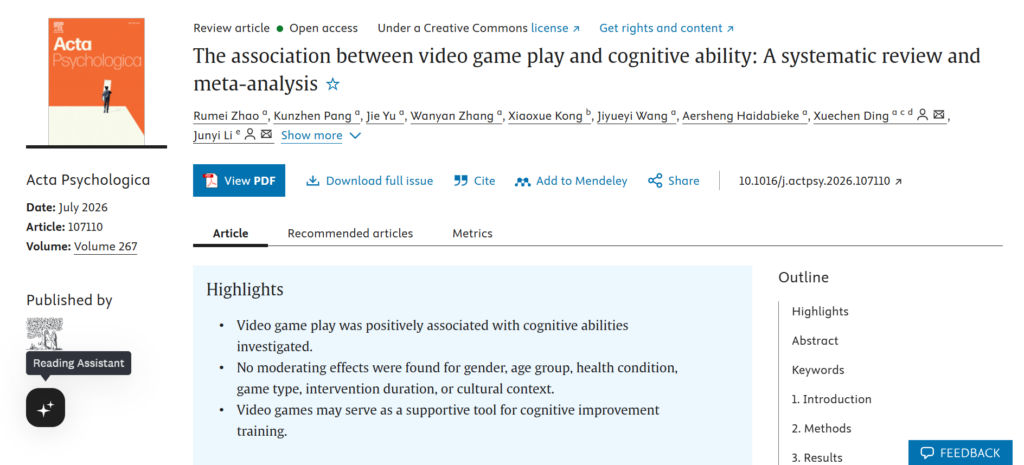
Between group comparisons produced the most significant results meaning that gamers outperformed non-gamers in cognitive tasks. Experiments which are the closest to proving causality rather than just correlation demonstrated smaller, but still significant results.
Memory is the real winner
Also read: Before Control Resonant arrives, here is a look back at Jesse Faden’s story
But here comes the interesting aspect: in all three types of studies, only memory improvement was found in each of the three categories. Here’s an easy-to-understand reason. Modern computer games, especially those of an open world type, act as an enriched environment for your brain, which is like a laboratory test for a rat – where there is a whole set of toys in the cage to improve memory. All the more if you add the release of dopamine when you achieve certain milestones.
Fitting, really. Memory is the one thing gamers can never have enough of, whether it’s VRAM, RAM or the in-game kind researchers just found a boost for. And with AI data centres hoovering up every DDR5 chip on the planet, actual RAM is getting harder to find than a legendary drop. At least you get a small upgrade to your memory.
Other areas of improvement were visual attention, cognitive control and intelligence, mostly in between-groups experiments. Spatial ability improvement is not surprising at all if you remember your Tetris experience.
There is a catch
Now that you want to print out this article and stick it to your parents’ fridge, a few clarifications. The effect size in this case is small, with the correlations ranging from 0.08 to 0.24. This is far from being “video games turn you into Einstein” level of significance. There was also a high heterogeneity of the results found in different studies, which means results were dependent on the game, population, and tests used. Age, gender, genre of the game, and time spent playing did not affect the result, which means that effect is wide and weak.
In addition, serious games, such as Lumosity, were excluded from this study, since this paper focuses on commercial video games.
It is impossible for video games to make you more intelligent immediately. However, no number of Valorant can take the place of education. There is enough science out there for us to lay our fear aside. Between “games rot your brain” and “games are cognitive superfoods,” is the reality that they help improve your memory, attention, and reasoning skills – simply as a by-product of playing the game well. In the context of the rapidly expanding gaming culture in India, it is a good deal in exchange for something that never claimed to be educative.
Also read: Developers need to build projects resilient to AI slop: AWS’ Darko Mesaros explains how


