To pay or not to pay is the question in the modern streaming world. Even YouTube, the biggest platform in this space and also the world’s largest media company by revenue, is increasingly nudging users into paying up for the premium subscription. On one hand, there have been growing reports of more ads in the free YouTube tier. On the other hand, the company has just added background play and offline downloading to the YouTube Premium Lite plan in India. Together, these moves suggest a clear shift in YouTube’s strategy: Free viewing is becoming more restrictive while the premium plans are becoming more tempting. Here, we will take you through all these changes, what they could mean for you and by the end, you will have a clear idea of whether YouTube Premium makes more sense now.
 Survey
YouTube Premium Lite gets more useful
YouTube has recently upgraded the cheaper Premium Lite subscription with features that were earlier limited to full Premium plans. It is still priced at Rs 89 per month, while full YouTube Premium costs around Rs 149 per month.


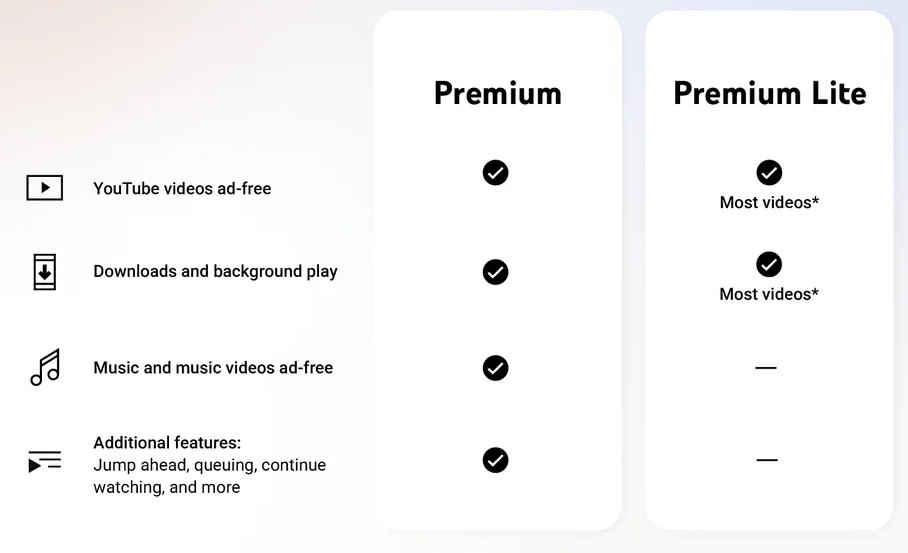
YouTube Premium Lite now offers:
- Ad-free viewing: This offers uninterrupted video viewing across the majority of the content on YouTube
- Background playback: It allows users to continue listening to a video while using other apps or when the phone screen is locked.
- Offline downloads: It lets users save videos for viewing without an internet connection.
Background play is especially useful for people who treat YouTube as a podcast or long-form audio platform. You can listen to interviews, lectures, tutorials and commentary videos as they will now continue playing even when the phone is locked. Offline downloads, meanwhile, are helpful in situations with unstable connectivity, such as train commutes or travel.
With these additions, the Rs 89 plan is no longer just about reducing ads. For many users, these two features dramatically increase the practical value of this subscription.
Is full YouTube Premium still worth paying for
Even though Premium Lite has become more useful, it still comes with restrictions, and if you want to avoid them, the higher-priced Premium plan would make more sense to you. YouTube itself says the Lite plan ‘offers fewer interruptions so you can watch most YouTube and YouTube Kids videos ad-free, offline, and in the background.’
So, fewer ads, and it is not completely ad-free. Ads can still appear in certain areas like ‘music content, Shorts, and when you search or browse’, and if you are not fond of interruptions, your option is the full Premium plan.
In case of background playback and downloads on the Lite plan, the same restriction applies. You don’t get these features with music videos or content classified as music.
That means users who primarily want ad-free music streaming or background music playback still need to upgrade to the full Premium subscription.
This distinction allows YouTube to protect its YouTube Music service, which competes with platforms such as Spotify and Apple Music. By limiting music features on Premium Lite, the company prevents large numbers of users from downgrading from the full Premium plan.
In effect, YouTube has a tiered approach for Premium:
- The free version is heavily ad-supported
- Premium Lite removes many interruptions and adds basic playback features
- Full Premium offers everything, including YouTube Music.
Why free YouTube is becoming more frustrating
One of the most visible changes has been the rise of longer and unskippable ads, particularly on smart TVs and connected TV devices. Many of us rely on YouTube as the main source of entertainment and news out of our living room TVs.
And instead of short skippable ads, viewers are now seeing longer unskippable ads, including 30-second spots on TV apps. This is like the commercial breaks in traditional TV programming. The option to skip ads makes modern streaming feel less intrusive than watching cable or dish TV.
Well, it makes sense why YouTube is doing this. The key revenue driver for Alphabet, which owns YouTube, is ads. This new format will be attractive to advertisers as it guarantees full attention.
Furthermore, another ad format that has expanded in recent years is the ad that shows up when you pause video content. This means even the moment you pause, the content can now be monetised.
Making things harder is the intensified crackdown on ad-blocking tools. Earlier, one could use an ad-blocker plugin/extension like Ublock or a browser like Brave, which comes with built-in adblocking, to have an uninterrupted, ad-free experience. But now, users are increasingly facing warnings, playback restrictions, or messages asking them to disable the extension or subscribe to Premium.
Granted, ads underpin the internet economy as we know it, but unskippable ads and other stricter measures increase friction for people who rely on the free version of YouTube. The service is still free, but the experience now includes more interruptions and fewer workarounds.
This is particularly true for users in price-sensitive markets like India. In a developing country like ours, not everyone may have the entertainment budget to pay for YouTube as well as every other OTT platform that has the content they like to watch. That said, those who can afford it would appreciate the value the premium plans, especially the Premium Lite, bring to their everyday life.
These changes reflect a broader shift in the digital media industry. For years, online platforms relied mainly on advertising to support free services. But as competition increases and content costs rise, many companies are pushing users towards subscriptions.
Today, YouTube reportedly has over 2.7 billion users, and about 125 million of them are paid subscribers. So, the company must be trying to convert a much larger share of its massive user base into paying customers.
As a result, YouTube as we once knew it is gradually changing. The platform built its success on a simple idea: watch almost anything for free with minimal interruptions. Now, that experience is slowly shifting towards a business model where convenience and fewer ads increasingly come at a price.
Keep reading Digit.in for similar stories.
Also Read: AI content and deepfakes are spreading online: Here’s how streaming platforms are tackling them
 Follow Us
G. S. Vasan
G.S. Vasan is the chief copy editor at Digit, where he leads coverage of TVs and audio. His work spans reviews, news, features, and maintaining key content pages. Before joining Digit, he worked with publications like Smartprix and 91mobiles, bringing over six years of experience in tech journalism. His articles reflect both his expertise and passion for technology. View Full Profile


