
BenQ’s ScreenBar has grown into one of the most recognisable monitor-lighting products, valued for eye comfort and desk ergonomics. With the second-generation ScreenBar Halo 2 now in India, we sat down with Mr JC Pan, Director, Digital Lifestyle Products, Business Unit, BenQ Corporation and Mr Rajeev Singh, Managing Director, BenQ India and South Asia. Mr Pan, in particular, has spent years shaping the company’s lighting strategy. The conversation covers how user feedback drove major upgrades in Halo 2, in terms of brightness control, usability and clamp design, why BenQ refuses to compromise on experience despite rising ‘me-too’ products, and how the brand sees lighting playing a wider role in tackling issues like digital eye strain and even myopia.
 Survey
This was an insightful interaction, and I started it off by asking Mr Pan about the driving force behind innovating lighting products at BenQ. Here’s how it went:


Vasan: You have been with BenQ for decades now, so what keeps you excited about leading innovation in lighting? What drives you?
JC Pan: What drives me? I have been at BenQ for 20 years. It’s my first job. BenQ’s name means bringing enjoyment and quality to life. I joined as an engineer, then became a product manager, and now I’m the business director.
In every role, I have been able to contribute my knowledge and experience to bring quality to people. That still drives me. Maybe not enjoyment, because you don’t always say a lamp gives you enjoyment, but a good lamp or a good monitor can improve your quality of life, whether that means better productivity or eye comfort. No matter what role I play, I feel I can contribute my passion, knowledge, and experience to bring enjoyment and quality to life.
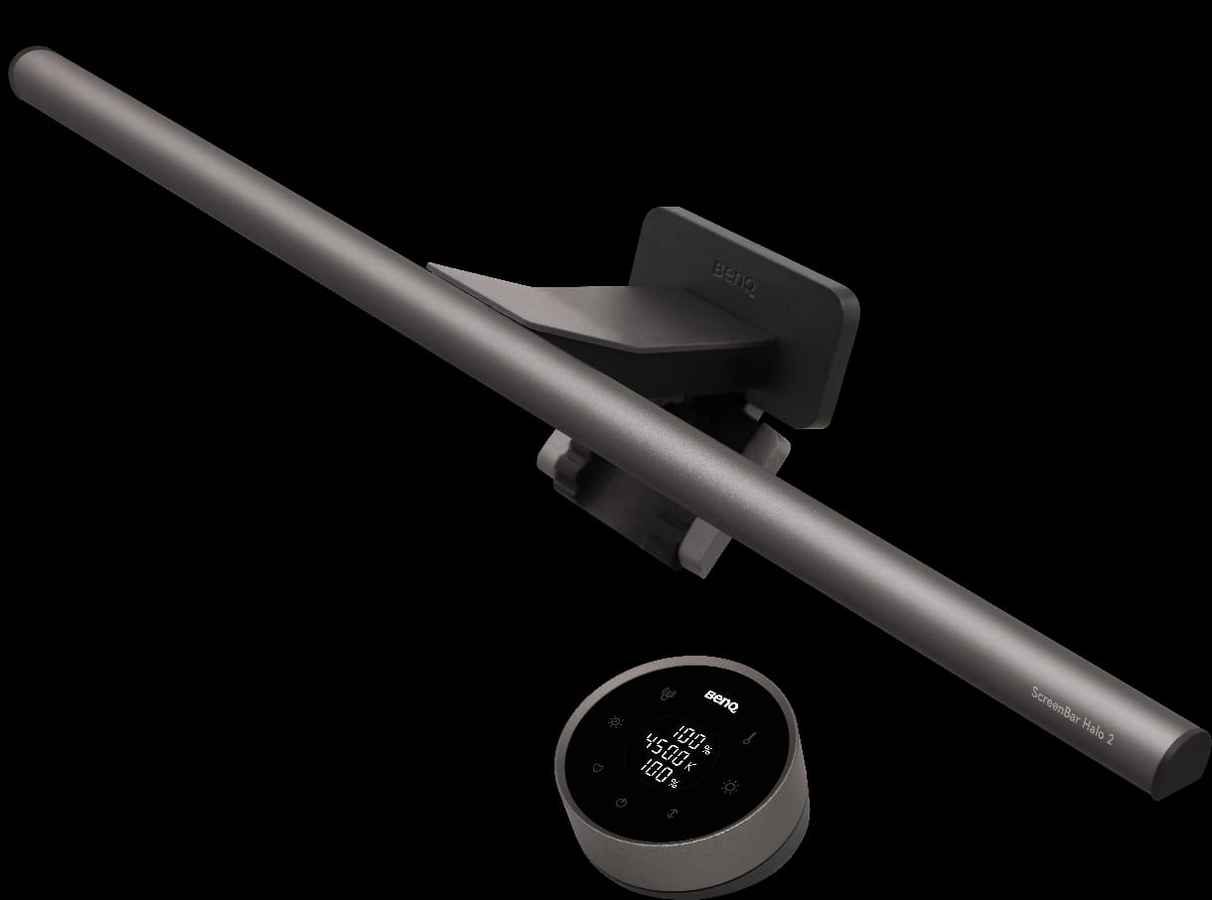
Vasan: The first-gen ScreenBar Halo has been a successful product. What kind of user feedback pushed you to bring Halo 2 to market?
JC Pan: We improved several things, and all of them came from user feedback. Today, we can access feedback from reviews, real customers, influencers, Reddit, and our own online research. So we know what we have to improve.
The biggest improvement is the lighting experience. It’s not just about specs, but the experience, which can translate into specs. For example, Halo 2 is brighter than the previous generation and can also go dimmer. In some countries, especially in Europe, around 10 percent of users felt the lowest brightness of the first-gen Halo was still too bright. So now the new model gets brighter and also gets much dimmer. We also improved lighting uniformity. So the main upgrade is the nighttime experience.
Then we solved some practical issues. We improved the power source for the dial, moving from dry batteries to rechargeable batteries. We improved the clamp. We improved the dial with a display. All of this is about usability.
Vasan: I tried the product, and about the clamp, it hangs on the monitor, but is there a screw mechanism to tighten it for different monitor thicknesses?
JC Pan: Back in 2017, our engineers spent a lot of time inventing a clamp system that does not use force. A panel should not have extra pressure on it because even small pressure can cause colour shift or long-term damage. The challenge was to fit different sizes and shapes of monitors without using a screw. That’s why we designed a special clamp system and received patents in many countries. We use a counterweight idea, which creates almost zero pressure on the panel.
Vasan: Different types of users have different use cases. A gamer, a student, a programmer… their needs differ. How do you decide which features to focus on?
JC Pan: Different users have different preferences, and even people in the same target group can vary. So we try to make the lamp versatile, within the scope of monitor use. For example, we offer a wide brightness range, colour temperature controls, and now, in the second generation, users can set different brightness levels for the front and back lights.
If you don’t like much backlight, you can set it to 20 percent, while keeping the front at 100 percent for reading paper documents. Users can create combinations. So for different use cases, we make the lamp flexible.
And once users find their preference, we have a ‘My Favourite’ mode. They can record it using the heart button. This was not available in the first generation. So if someone likes a warm tone, say 2700K, with 100 percent front light and 20 percent back light, they can save it.
Vasan: How do they access that saved (My Favourite) setting later?
JC Pan: They can preset one favourite setting with the heart. Some users told us they want two hearts, for morning and evening. But there are layout limitations. In our upcoming products, we will have an app on the computer, so there will be no limitation on how many favourites you can store.
Also Read: The demand for bigger TV sizes is increasing: Arjun Bajaj, Director, Videotex International
Vasan: BenQ is known for quality, which comes with a certain price. But on Amazon and other platforms, users find cheaper alternatives. How do you plan to compete or differentiate?
Rajeev Singh: First, product evolution. We must keep evolving the product with improvements that matter to customers. That is the best way to counter ‘me-too’ products. They will copy, but by the time they do, we should already have the next improvement ready.
Second, we don’t want to compromise customer experience for cost. Many companies cut costs and reduce user experience. We don’t want that. We have our own set of customers who appreciate these details. Not everyone will, and that’s fine. There is a big market in India that wants this level of product and feature set. We want to reach those customers.
Vasan: Students were on my mind during the presentation. Schools have computer labs with monitors. Are you planning to reach out to institutions or corporates?
Rajeev Singh: Not directly in that way. Among students, we will focus on those who code or game. They use monitors more heavily, so they will appreciate a device like this because it adds value to their long days at the screen.
For corporates, we are starting from the top level, targeting CXOs and department heads first. Then it can go further down the organisation.
Vasan: Are there any challenges in the current monitor light market?
Rajeev Singh: Awareness is the main challenge. People still associate BenQ light bars only with BenQ monitors, which is not correct. Our light bars support all kinds of monitors. So awareness is our biggest challenge.
Vasan: While trying the product, I saw another circular backlight behind one of the monitors, apart from the Halo 2. I wondered if both could be controlled with one device. Since everything is getting smarter and connected, is the brand planning something?
Rajeev Singh: That circular backlight is specific to a certain monitor range meant for programmers. Programmers often work in complete darkness, so they need stronger back lighting. That’s why the coding monitor has a large circular backlight, and you can set whether the full circle lights up or only a part of it.
The built-in backlight on the Halo 2 has a different purpose. It’s for gentle, uniform background light, but cannot match the level of that large circular model. So each product serves a different use case. Halo 2 is suitable for everyone, while the circular one is for programmers.
Vasan: What is one idea or innovation you would like to see in the future of monitor lighting? Something that might be limited by today’s technology, but you hope will happen?
JC Pan: For monitor lighting specifically, I think our product is close to perfect. The next generation will have improvements, but they will be incremental, not a huge jump like ScreenBar was in 2017.
But for lighting in general, we want to address problems like myopia. It’s a big issue. I wear contact lenses; you wear glasses. We use screens all day, and weather conditions add to it. Lighting can improve quality of life beyond just productivity. In some northern European countries, winters are long and people face seasonal unhappiness. We hope to develop products that can help with these issues.
For myopia, we already work with top universities in Taipei to study causes and create better lighting for children. For screen lighting, improvements will continue, but not dramatic leaps.
That’s all for this interaction, and you can find similar conversations like it on Digit.in.
Also Read: We want to deliver a Rs 20,000 experience at one-third the cost: Noise co-founder Amit Khatri
 Follow Us
G. S. Vasan
G.S. Vasan is the chief copy editor at Digit, where he leads coverage of TVs and audio. His work spans reviews, news, features, and maintaining key content pages. Before joining Digit, he worked with publications like Smartprix and 91mobiles, bringing over six years of experience in tech journalism. His articles reflect both his expertise and passion for technology. View Full Profile


