
AMD Ryzen 7 7700X3D Desktop Processor Review
 Follow Us

It’s been three years since AMD’s Ryzen 7 7800X3D established a straightforward formula for gaming-focused desktop processors by combining eight Zen 4 cores with a large pool of vertically stacked cache along with slightly lower clock speeds in exchange for stronger performance in latency-sensitive games. Knock off a few multipliers off the base and boost clocks, and you’ve got the Ryzen 7 7700X3D which follows that same basic template. It goes without saying that the 7700X3D does not feature a fundamentally new processor design. Like the 7800X3D, the Ryzen 7 7700X3D uses a single eight-core Zen 4 compute die equipped with first-generation AMD 3D V-Cache. It consequently offers eight cores, 16 threads and 96 MB of L3 cache. The principal difference, like we mentioned, is with the frequencies. Its 4.0 GHz base clock is 200 MHz below that of the 7800X3D, while its maximum boost clock falls from 5.0 GHz to 4.5 GHz.
The resulting product is positioned as a more accessible route into AMD’s cache-heavy gaming line-up. It also gives existing AM5 owners another potential drop-in upgrade, subject to motherboard BIOS support. AMD describes the processor as a way to broaden the choices available to builders upgrading within AM5 or entering the platform for the first time. That positioning creates an interesting balancing act. The Ryzen 7 7700X3D needs to provide a meaningful gaming advantage over the ordinary Ryzen 7 7700X, while remaining sufficiently differentiated from the faster 7800X3D. It must also compete with newer processors that may offer stronger general-purpose performance, even when they cannot consistently match the benefits of 3D V-Cache in games.
AMD Ryzen 7 7700X3D Specifications
The Ryzen 7 7700X3D is built around AMD’s Zen 4 architecture and uses the AM5 socket. It has eight physical CPU cores with SMT (Simultaneous Multi Threading), giving it 16 processing threads. This core configuration places it alongside the Ryzen 7 7700X and 7800X3D, although the processors behave quite differently because of their cache and frequency configurations. We’ve already talked about the differences in frequencies, so that sums up the differences between the older 7800X3D and this new 7700X3D. As for cache, the processor carries 8 MB of L2 cache, divided into 1 MB per core. More importantly, it has 96 MB of L3 cache. A conventional Zen 4 eight-core compute die contains 32 MB of L3 cache, with AMD’s vertically stacked cache die adding a further 64 MB. Even though AMD has the second gen 3D V-caching in their top tier 9000-series processors, the implementation used here is AMD’s first-generation 3D V-Cache design. The cache die is layered over the processor cores.
| AMD Ryzen 7 7700X3D Specifications | |||||
| AMD | AMD | AMD | AM5 | AM5 | |
| Model | Ryzen 9 7950X3D | Ryzen 7 9700X | Ryzen 9 9800X3D | AMD Ryzen 7 7800X3D | AMD Ryzen 7 7700X3D |
| Price | 65699 | 35999 | 47900 | ||
| Socket | AM5 | AM5 | AM5 | AM5 | AM5 |
| Codename | Raphael | Granite Ridge | Granite Ridge | Raphael | Raphael |
| Foundry | TSMC | TSMC | TSMC | TSMC | TSMC |
| Core Process | 5 nm | 4 nm | 4 nm | 5 nm | 5 nm |
| Core Architecture | Zen 4 | Zen 5 | Zen 5 | Zen 4 | Zen 4 |
| Die Size | 71 mm2 | 70.6 mm² | 70.6 mm² | 71 mm2 | 71 mm2 |
| I/O Process | 6 nm | 6 nm | 6 nm | 6 nm | 6 nm |
| I/O Die Size | 122 mm2 | 122 mm² | 122 mm² | 122 mm2 | 122 mm2 |
| tCaseMax | 89°C | 95°C | 95°C | 89°C | 89°C |
| Launch Date | 28-Feb-2023 | 8-Aug-2024 | 7-Nov-2024 | 16-Jul-2026 | 16-Jul-2026 |
| Cores | 16 | 8 | 8 | 8 | 8 |
| – Big Cores | 16 | 8 | 8 | 8 | 8 |
| – Small Cores | 0 | 0 | 0 | 0 | 0 |
| Threads | 32 | 16 | 16 | 16 | 16 |
| Integrated Graphics | 1 | 1 | 1 | 1 | 1 |
| Integrated Graphics | RDNA2 | RDNA2 | RDNA2 | RDNA2 | RDNA2 |
| Integrated Graphics Cores | 2 | 2 | 2 | 2 | 2 |
| IG Base Frequency | 400 MHz | 400 MHz | 400 MHz | 400 MHz | 400 MHz |
| IG Turbo Frequency | 2200 MHz | 2200 MHz | 2200 MHz | 2200 MHz | 2200 MHz |
| Cache L1 | 64 | 80 | 80 | 64 | 64 |
| Cache L2 | 1 | 1 | 1 | 1 | 1 |
| Cache L3 | 128 | 32 | 96 | 96 | 96 |
| Big Core Base Frequency | 4.2 | 3.8 | 4.7 | 4.2 | 4 |
| Big Core Turbo Clock | 5.7 | 5.5 | 5.2 | 5 | 4.5 |
| Small Core Base Frequency | NA | NA | NA | NA | NA |
| Small Core Turbo Clock | NA | NA | NA | NA | NA |
| Max Memory Capacity | 128 | 192 | 192 | 128 | 128 |
| Rated Memory Clock Speed | 5200 | 5600 | 5600 | 5200 | 5200 |
| TDP | 120 | 65 | 120 | 120 | 120 |
AMD gives the Ryzen 7 7700X3D a 120 W thermal design power rating and a default package power tracking limit of 162 W. Also, the maximum junction temperature is 89°C. These limits are identical to those listed for the Ryzen 7 7800X3D. Like other desktop Ryzen 7000 processors, the 7700X3D also includes basic integrated Radeon graphics. These are not intended to replace a gaming GPU, but remain useful for display output, troubleshooting and systems that temporarily operate without a discrete graphics card.
The single-CCD design is another practical advantage. AMD’s higher-end dual-CCD X3D processors require software and operating-system scheduling mechanisms to direct games towards the compute die carrying the additional cache. The 7700X3D has only one compute die, so every CPU core has access to the same 96MB L3 configuration. It avoids the scheduling complexity and core-parking behaviour associated with asymmetric dual-CCD designs.
Test Rig
We’ve tested the Ryzen 7 7700X3D with the NVIDIA GeForce RTX 5090 as well as the Radeon RX 9070 to check out the Rebar performance impact. Aside from that, the platform used was the Colorful iGAME X870E Vulcan OC 14, 32 GB of G.Skill Trident Z5 Neo DDR5-6000 memory in a 2x 16 GB configuration, and Samsung’s 9100 Pro NVMe SSD. Cooling is handled by the Corsair H150i, while a Seasonic Focus Gold 850W PSU powers the system. This is a suitably high-end platform for a processor of this class, and it also aligns closely with AMD’s own recommendation of DDR5-6000 memory and a 360 mm liquid cooler for best results and stable behaviour.
AMD Ryzen 7 7700X3D Performance
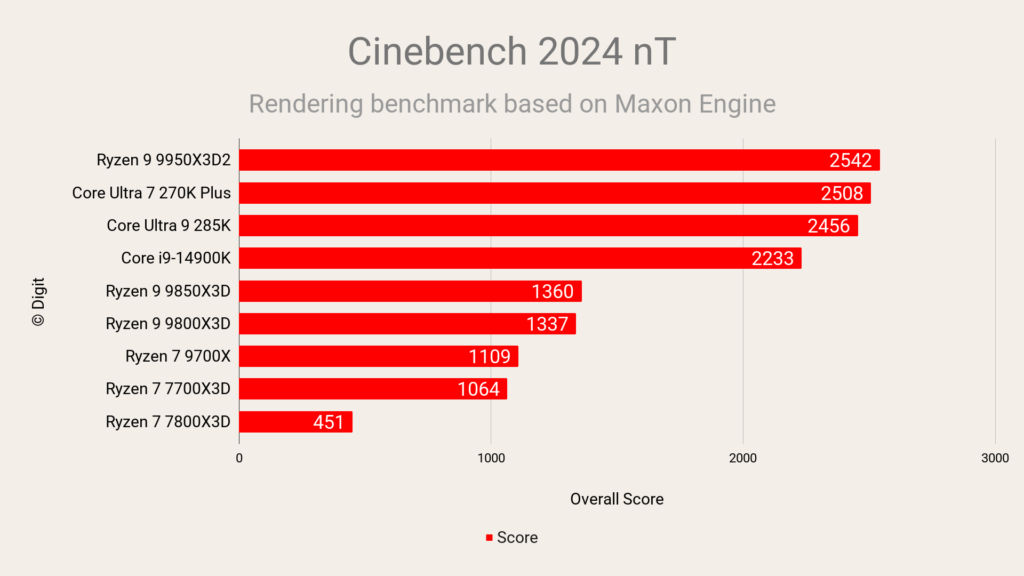
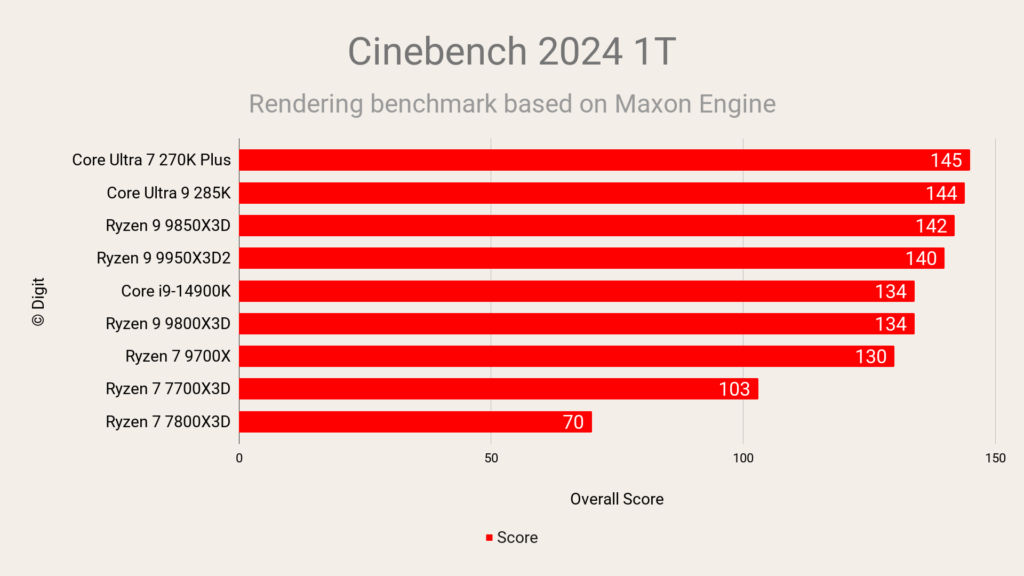
Cinebench 2024
Cinebench 2024 is based on Maxon’s Cinema 4D software, designed to evaluate a processor’s performance in rendering complex 3D scenes. It tests both single-core and multi-core capabilities, highlighting how efficiently a CPU handles multi-threaded tasks common in professional rendering workflows. The benchmark utilizes modern instruction sets and large datasets, providing an up-to-date assessment of CPU performance in contemporary applications.
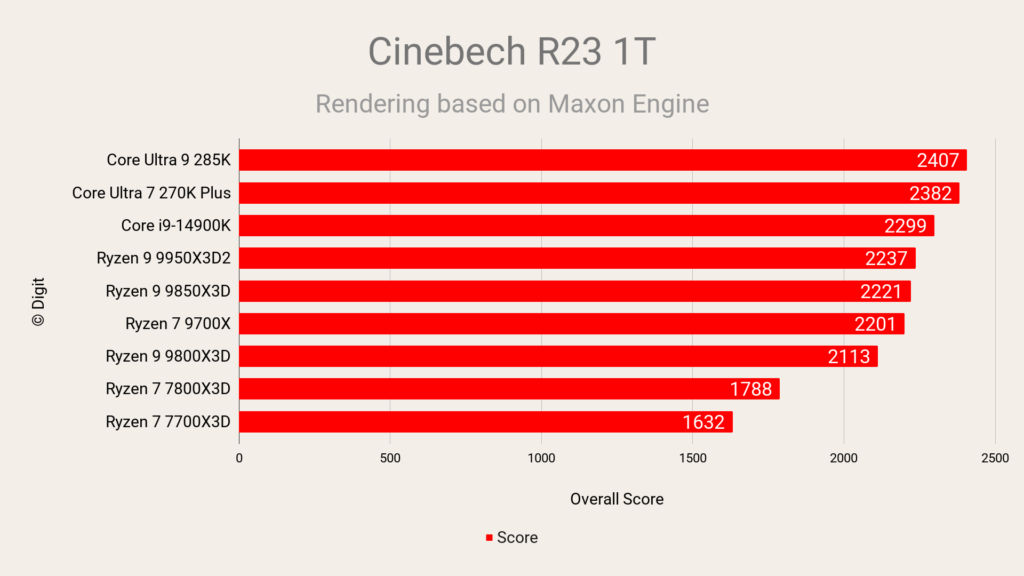
Cinebench R23
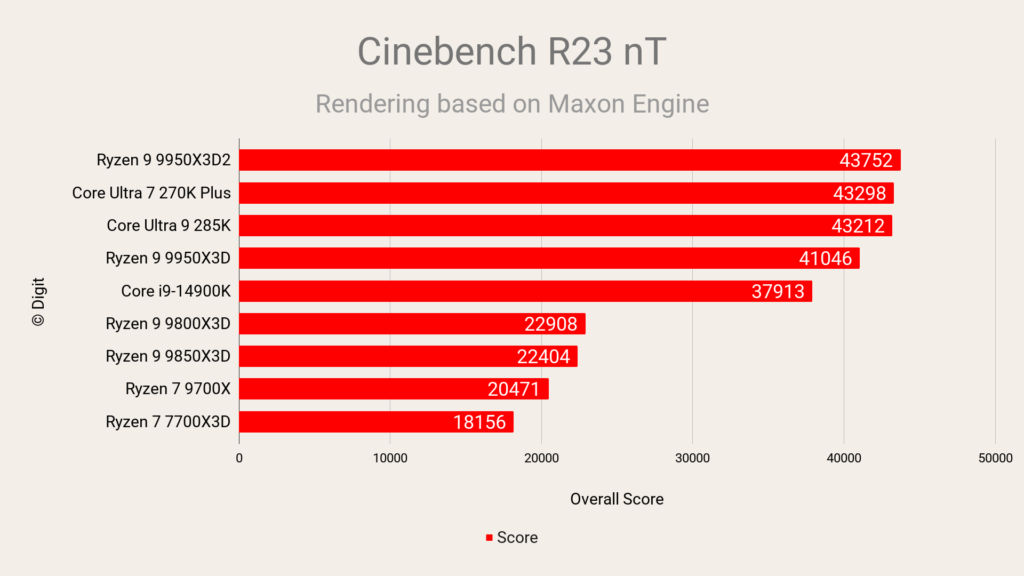
Cinebench R23 is the older version based on the same Cinema 4D engine and it too measures a processor’s ability to render photorealistic 3D scenes. Though replaced by Cinebench 2024, we retain it to compare against processors launched a few years prior. It also focuses on both single-threaded and multi-threaded performance, simulating real-world tasks relevant to content creators and professionals in 3D rendering.
Blender
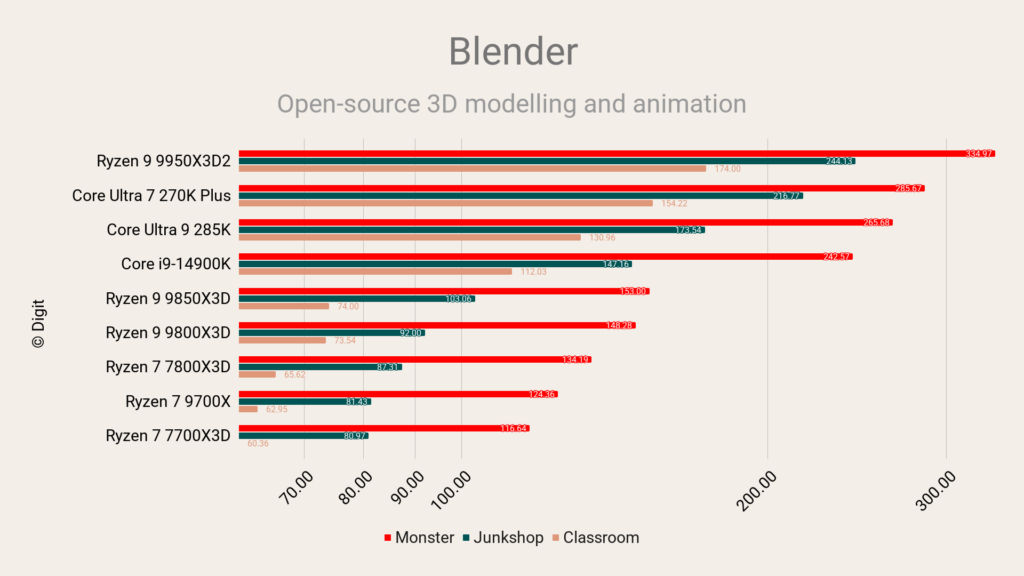
The Blender Benchmark assesses a processor’s performance by rendering scenes using Blender, a popular open-source 3D creation suite. It evaluates both CPU and GPU capabilities in handling complex rendering tasks. This benchmark provides insights into how well a processor performs in real-world 3D modeling, animation, and rendering scenarios. An interesting aspect is that it highlights the efficiency of different CPU architectures in multi-threaded workloads, as Blender can effectively utilize multiple cores. It’s particularly useful for professionals and enthusiasts relying on Blender, indicating how hardware upgrades might impact workflow efficiency and rendering times.
V-Ray
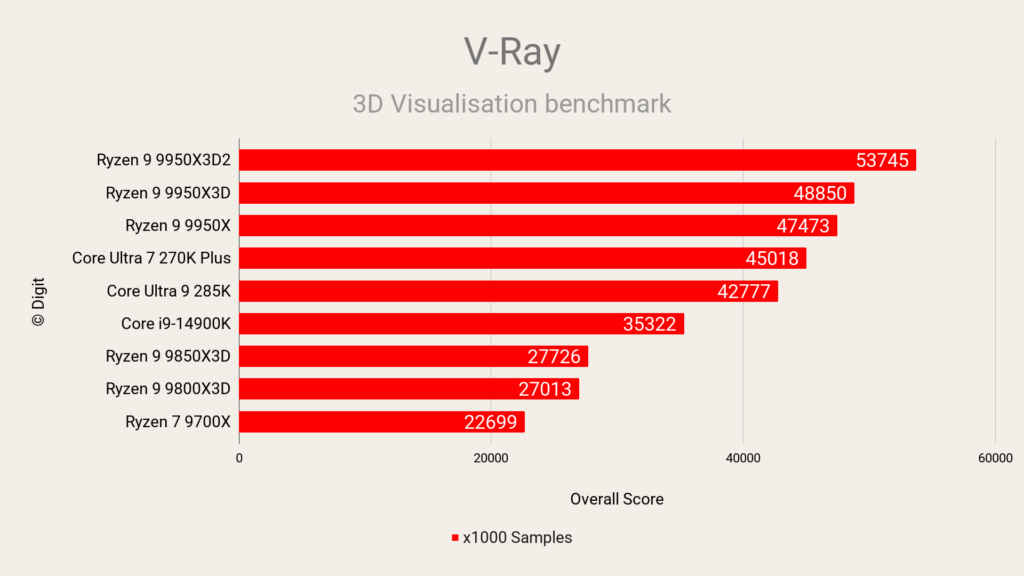
V-Ray is another benchmark that measures a processor’s performance in rendering but it uses the V-Ray engine, widely used in visual effects, architecture, and design industries. It tests both CPU and GPU rendering capabilities, focusing on multi-threaded performance and handling complex calculations involved in ray tracing. CPUs with higher core counts and multi-threading technology tend to excel here as V-Ray efficiently utilises available threads.
Procyon Office
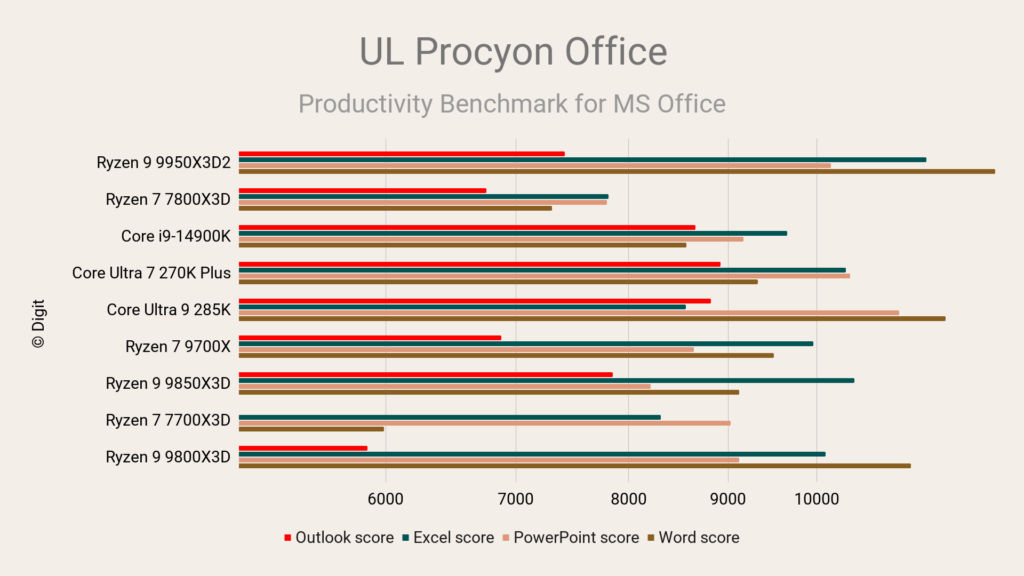
The Procyon Office Benchmark measures a processor’s performance in real-world office applications like the Microsoft Office suite, testing tasks such as document editing, spreadsheet calculations, and presentation creation. It focuses on both single-threaded and multi-threaded performance, providing insights into how a CPU handles everyday productivity tasks.
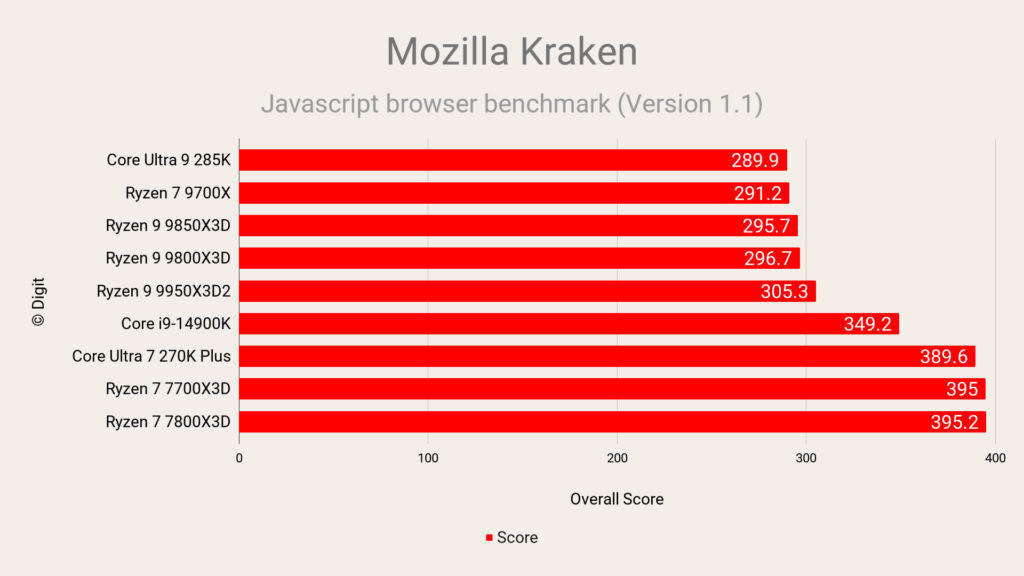
Mozilla Kraken
Mozilla Kraken is a JavaScript benchmarks evaluating a processor’s performance in executing complex web-based scripts, reflecting real-world web application usage. It tests single-threaded performance and the efficiency of a CPU’s instruction pipelines in handling dynamic scripting languages.
7 Game Average
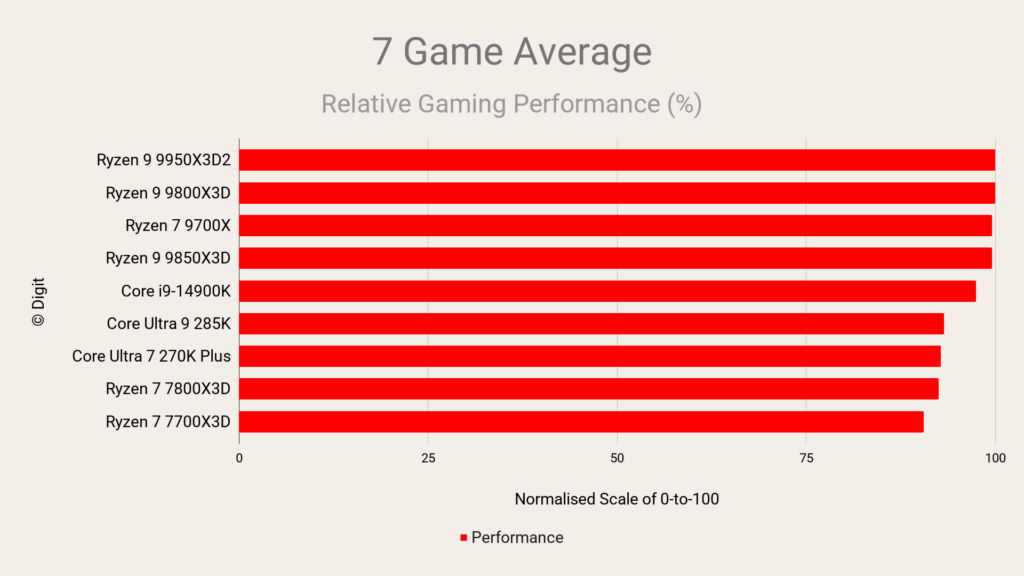
While 3DMark is an excellent synthetic benchmark, it’s not really indicative of real-world gaming performance and that’s why we have to rely on popular AAA video games to assess how well the processor deals with contemporary video game engines. We revise the video games once every two years based on what’s most popular as per Steam and we also maintain a mix between different game engines.
Thermals and power
On paper, the Ryzen 7 7700X3D has a 120 W TDP and a 162 W default PPT limit. AMD lists an 89°C maximum junction temperature and recommends a 240-to-280 mm liquid cooler or an equivalent high-performance air cooler. These limits match those of the Ryzen 7 7800X3D. The lower frequency ceiling may allow the 7700X3D to consume less power than the 7800X3D in some lightly threaded and gaming workloads. We saw the processor hit about 124 Watts at peak load.
The stacked-cache design also imposes different thermal constraints from an ordinary Ryzen 7000 processor. Heat generated by the cores must travel through the additional cache structure before reaching the integrated heat spreader. This is one reason X3D processors operate with tighter voltage and temperature management rather than simply pursuing the highest possible clocks.
Verdict
The Ryzen 7 7700X3D is a focused response to a fairly specific buying question i.e. how much of the 7800X3D’s gaming performance can be retained at a lower price? From the results, the answer is most of it. The processor was approximately 4 per cent slower than the 7800X3D in gaming whereas against the regular Ryzen 7 7700X, it produced an average gaming improvement of roughly 8-9 per cent and delivered gains exceeding 15 per cent in certain cache-sensitive titles. That makes the 7700X3D a substantial gaming upgrade over the 7700X in the right circumstances. The compromise is equally clear. A maximum boost frequency of 4.5 GHz leaves the processor behind the 7700X in most productivity benchmarks. It also trails the 7800X3D outside gaming, despite sharing the same core and cache configuration.
Its final value proposition rests heavily on pricing. A Ryzen 7 7800X3D retails for about Rs 42K in India and there’s a Ryzen 5 7500X3D available at Rs 25K. A modest discount over the 7800X3D would not be enough, because the older processor is consistently faster and avoids some of the 7700X3D’s productivity limitations. A meaningful price gap, however, would make the new model an appealing entry point into eight-core 3D V-Cache gaming. Internationally, AMD is pricing the unit at USD 329 so if the 7700X3D were to sell around Rs 32-33K, then that would be actually make the processor a great buy for folks looking to build gaming PCs.


