
Oppo Find X9 Review:The flagship that chooses balance over excess
 Follow Us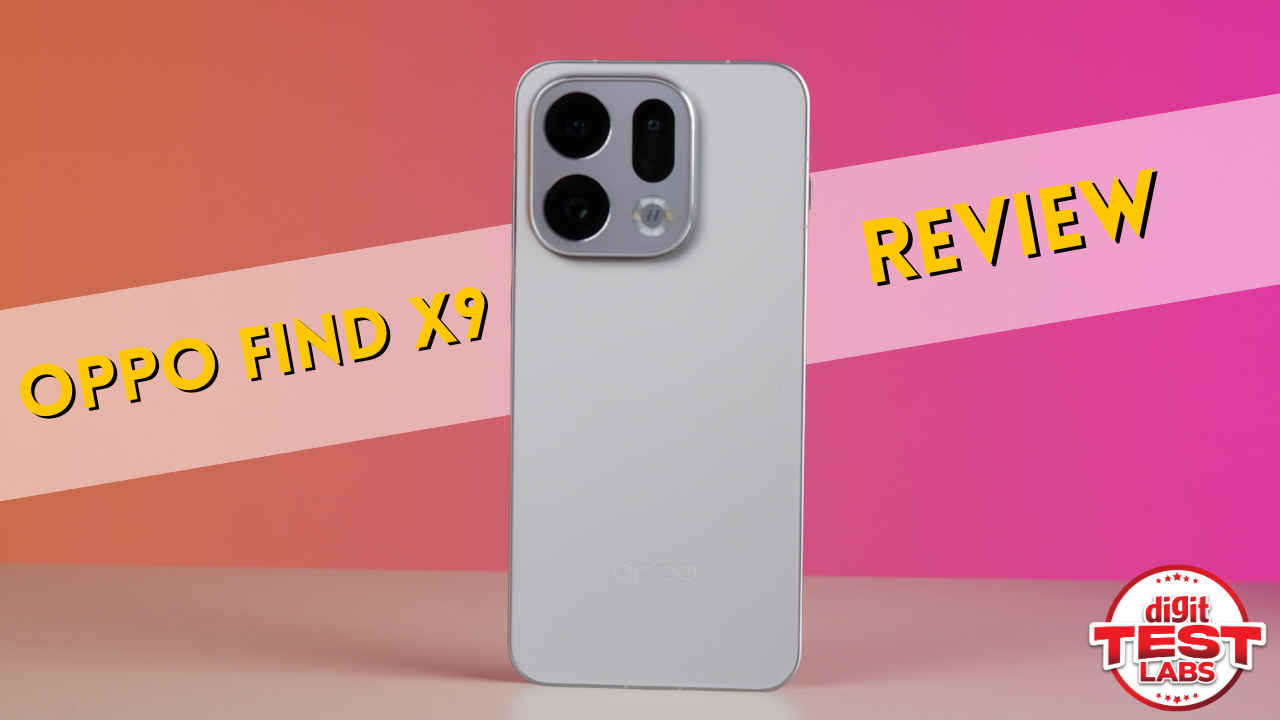

I have been saying this for some time now that 2025 was all about AI and cameras, with far less attention given to on-paper specifications. At the same time, the market has seen strong demand yet feels oddly fragmented. On one end, there’s no shortage of compact phones, many of which arrive with clear compromises. On the other hand, there are Ultra models with large screens, bold designs and equally large price tags delivering excess where restraint might have been welcome. What’s missing are options in between, phones that don’t go overboard, yet refuse to cut corners on performance, display quality, features and, most importantly, the camera experience. That’s exactly why I decided to review the Oppo Find X9.
 Survey
Among the many big-name launches this year, the Find X9 has already managed to grab attention for its camera capabilities and its promise of being an all-rounder. But beyond the spec sheet and the initial hype, I wanted to understand something more specific: how Oppo has actually tuned this phone, especially after the success of the Find X8. Has the brand played it safe, or has it refined its formula in ways that matter for everyday use?
So this time around, instead of rushing to conclusions, I spent time with the Find X9 to see how it fits into this oddly neglected space in the market. And here’s my take.
Design:
Starting with the obvious, Oppo has clearly reset its design thinking with the Find X9. If the Find X8 leaned a bit too hard on visual flair with that circular camera bump, this one takes a calmer, more confident route. The rear panel now gets a squarish camera island that doesn’t draw attention. No dramatic curves, no flashy finishes, just a clean look. It feels like Oppo is more interested in getting the basics right than chasing the instant wow factor.
The moment you pick the phone up, the flat edges, softened just enough around the corners, make the Find X9 comfortable to hold for long periods. At under 8mm thick, it also feels slimmer than you would expect from a full-fledged flagship. It’s slightly lighter and thinner than the Find X8, and that genuinely helps with one-handed use, something that’s becoming increasingly rare in this segment.

The switch to a matte glass back is another sensible move. It doesn’t attract fingerprints as easily and offers better grip than the glossy finish on the previous model. More importantly, the phone feels well-balanced.
Oppo has also refined the camera bump in a way that actually matters. Placed neatly in the top-left corner and aligned with the frame, it stays out of the way when you’re holding the phone vertically and doesn’t dig into your fingers during landscape use. It’s a small change, but one you notice over weeks of use.
The biggest change, I think, is the removal of the alert slider. In its place is a customisable Snap Key. Longtime Oppo users may need time to adjust, but the added flexibility- camera shortcuts, sound profiles, even AI functions- does make practical sense.
It features IP66, IP68 and IP69 ratings along with tougher Gorilla Glass, which makes it a durable option. And speaking of the colours, you can get Find X9 in Space Black, Titanium Grey and Velvet Red.
Display
At this price point, you will find many phones that promise a great display, and for me, the Oppo Find X9 comfortably sits near the top of that list. It comes with a 6.59-inch AMOLED panel featuring a 120Hz refresh rate and HDR10+ support. On paper, it looks interesting, but in real life, it has more to offer.
First off, the 6.59-inch panel hits a sweet spot that’s becoming increasingly rare in the flagship segment. It’s large enough to feel immersive while watching videos or browsing, yet compact enough to remain manageable for everyday use. Oppo has opted for a flat AMOLED panel with ultra-slim, symmetrical bezels, and it’s a decision that pays off.
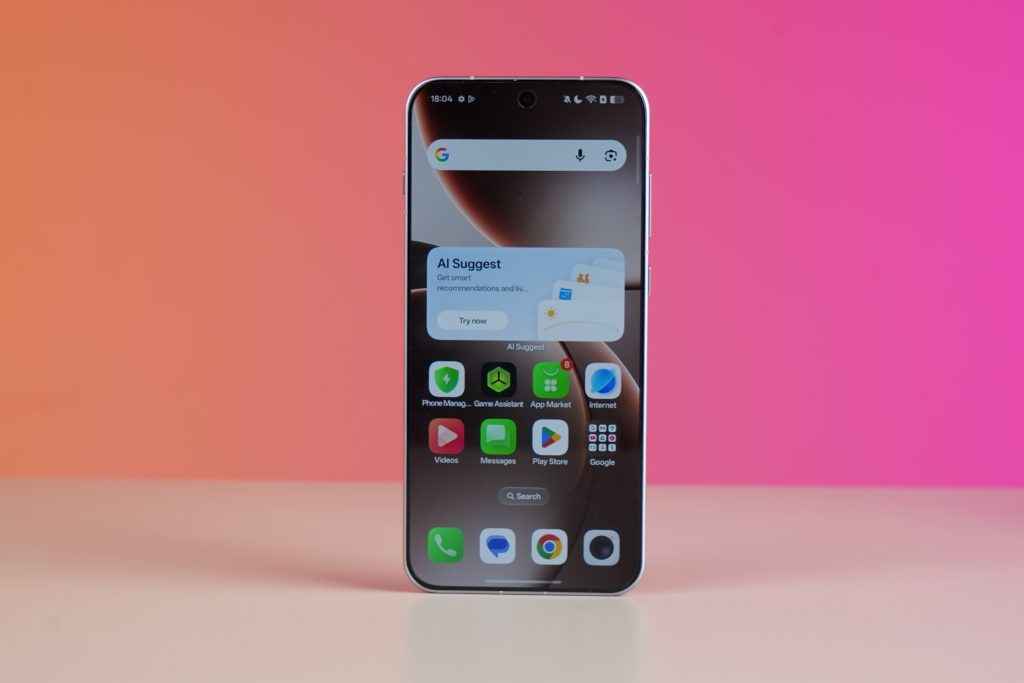
Brightness levels are strong too, offering excellent visibility indoors and outdoors, while OLED’s deep blacks ensure excellent contrast for HDR content. In our testing, in manual mode, it comfortably crosses 1,300 nits, while adaptive brightness can push well past that when needed (at 3,000 nits).
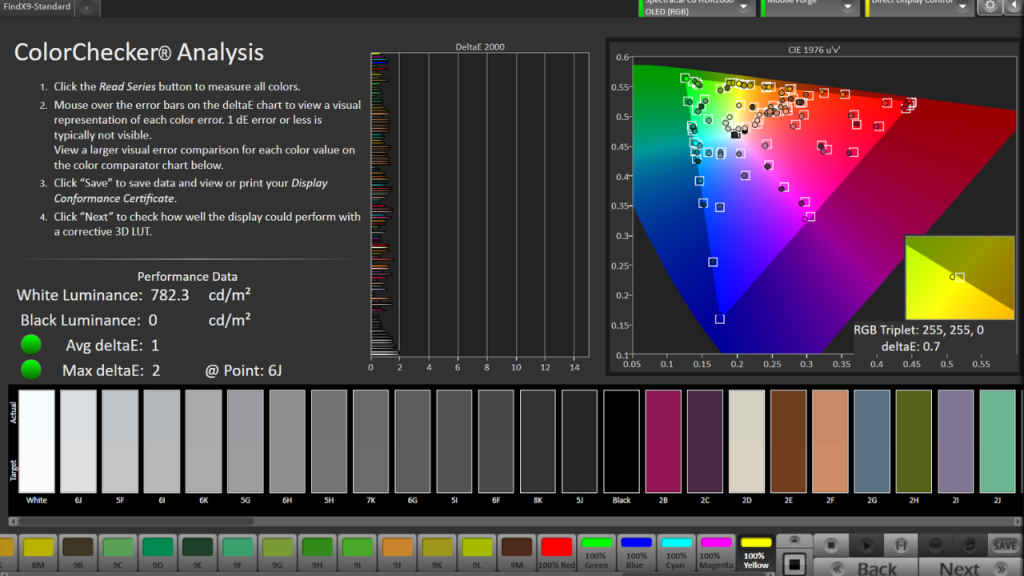
And what impressed me was how well the display is tuned. In our Calman test using the SpectraCal C6 colourimeter, we got an average Delta E of around 1, which is outstanding by smartphone standards. In real-world terms, colours look accurate, restrained, and mature. Skin tones appear natural, whites don’t drift, and there’s no artificial oversaturation trying to impress you in the first five seconds. Simply put, this display is built for people who care about photography, video and visual consistency.
Performance
On paper, the Find X9 is clearly positioned as a serious performance flagship, and in day-to-day use, it largely delivers on that promise. Powered by MediaTek’s Dimensity 9500, built on an advanced 3nm process, this is one of those phones that feels fast without constantly trying to prove it. Everyday tasks like scrolling through social media, jumping between apps, and editing photos on the go are handled with an ease that feels almost boring, and that’s a compliment. Nothing stutters, nothing hesitates.
Where things get more interesting is in gaming. Camera-centric phones often compromise here, but the Find X9 doesn’t. In our testing, it managed consistent 120FPS gameplay in BGMI, even during extended and intense sessions. Yes, the phone does warm up, as any performance-focused device will, but thermal management is clearly well optimised.
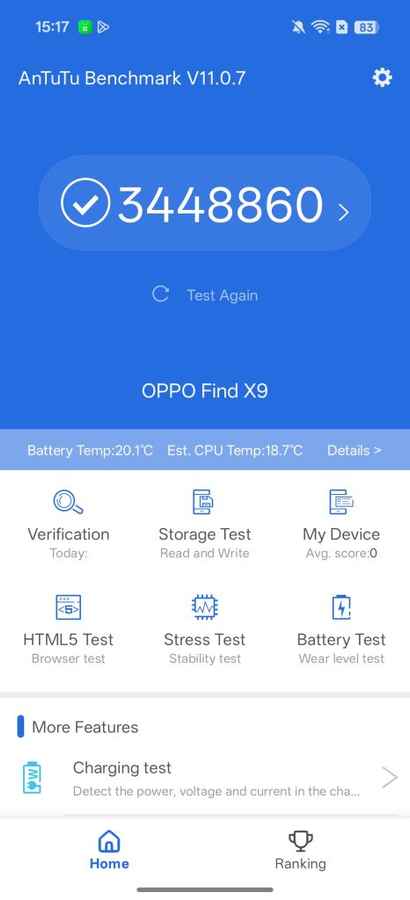
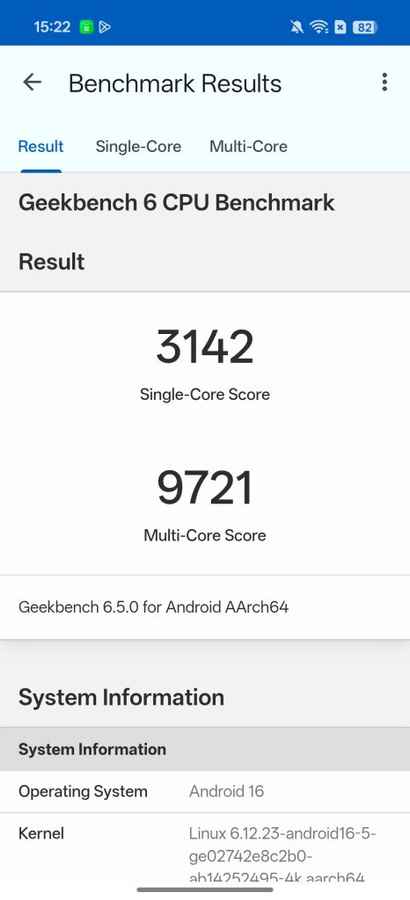
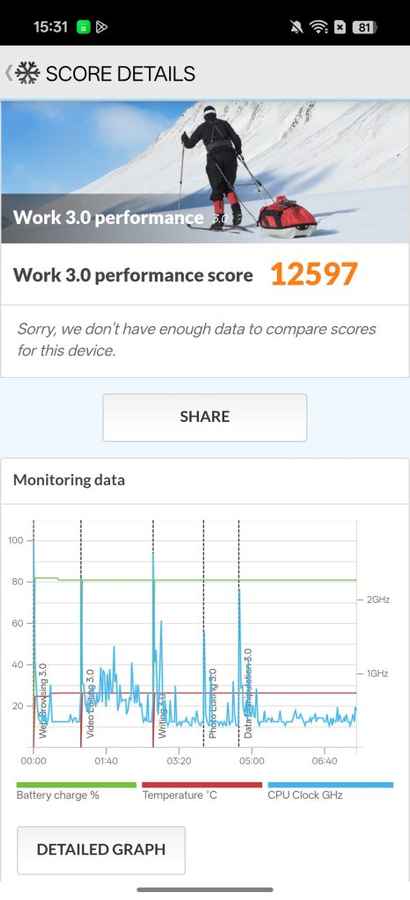
Benchmark numbers back this real-world experience. The device scored an AnTuTu score of around 3.44 million, slightly ahead of the Vivo X300. In Geekbench 6, we got 3142 (single-core) and 9721 (multi-core), while in the PCMark’s Work 3.0 test, the device scored 12,597.
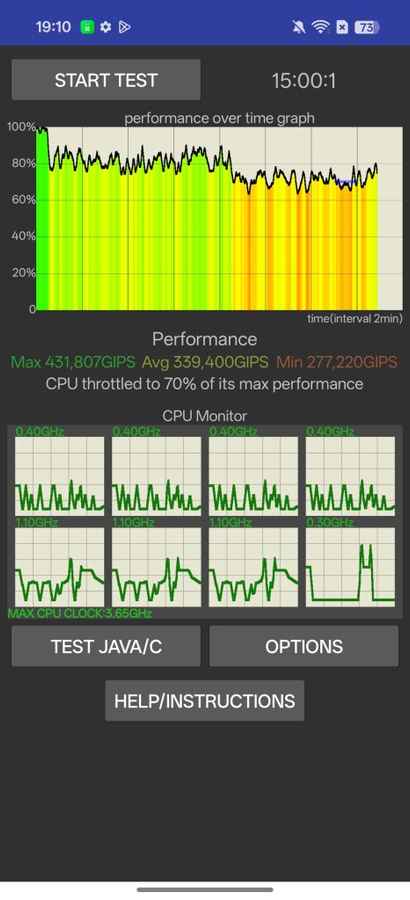
That said, it’s not flawless. During CPU throttling tests, the phone retained about 70 percent of its peak performance, which is decent but not class-leading. I expected a bit more stability given the hardware on offer. Still, the bigger picture remains positive: the Find X9 feels faster, cooler, and more refined than its predecessor, with optimisation doing as much heavy lifting as raw power. For most users, this is performance you’ll appreciate every single day, not just in benchmarks.
Camera
Oppo has always treated the Find X series as a showcase for its imaging ambitions, and with the Find X9, that philosophy is very much intact. On paper, the Hasselblad Master Camera System sounds ambitious, but what matters is how it behaves once you step outside the spec sheet, and this is where the Find X9 largely earns its reputation.
The triple 50MP rear camera setup feels well thought out rather than excessive. The main camera, with its large 1/1.4-inch sensor and wide f/1.6 aperture, consistently delivers sharp, high-contrast images without drifting into the over-processed look that has become common in flagship phones. Daylight shots are particularly strong: colours are vibrant but controlled, skin tones look natural, and edge detection in portraits is clean enough to pass casual scrutiny without artifacts. Bokeh rendering feels realistic rather than artificial, which is something Oppo seems to have prioritised.









The 3x periscope telephoto is another highlight. It holds detail well and remains usable beyond its optical range, especially in good lighting. During my time taking photos in Goa, the telephoto proved reliable for candid shots and distant subjects, capturing images that looked crisp without aggressive sharpening. The ultra-wide camera is impressive too, maintaining consistent colour science across lenses, which is still something many brands struggle to get right.




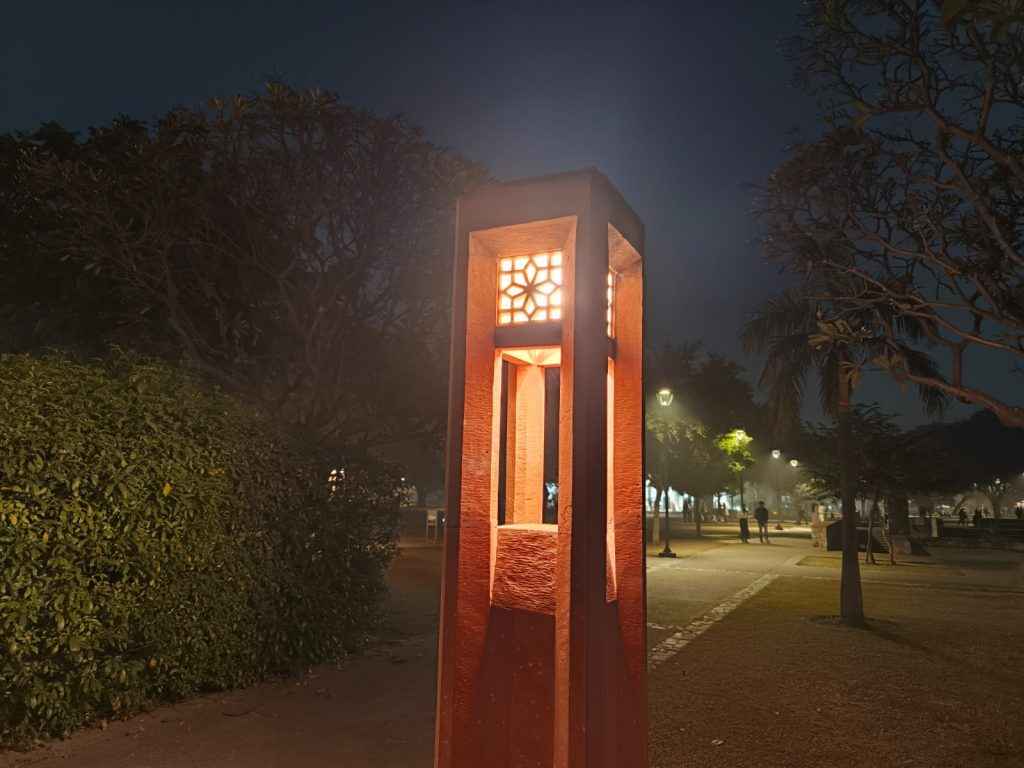
Low-light photography is where the Find X9 quietly impresses. The combination of optical stabilisation and Oppo’s LUMO Image Engine allows the camera to pull in plenty of light while keeping noise under control. Night shots retain texture and colour accuracy, instead of smearing details for the sake of brightness. The results look balanced and believable, not artificially bright.



Battery
Battery life is where the Oppo Find X9 really earns its keep, and it does so in a way that actually matters in daily use. While most flagships are still playing it safe around the 5,000mAh mark, Oppo has gone all in with a 7,025mAh silicon-carbon battery. What’s impressive is not just the number, but the execution. Even after a bigger battery, it does not feel chunky. Instead, it remains slim, well-balanced and comfortable to hold.
In our PCMark battery test, we got 21 hours and 2 minutes, which means with a typical mix of social media scrolling, photography, navigation, video streaming and some casual gaming, the Find X9 easily gets through a full day and still has enough left for the next morning. And on less usage, it can stretch to over two days.
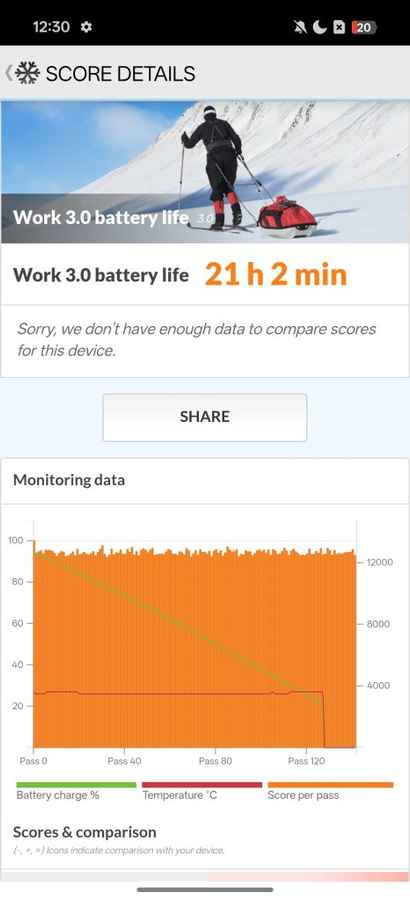
Even the charging speeds remain in the flagship territory. The 80W wired charging can help you charge from 0 to 100 per cent in around 86 minutes, which is good given the battery size.
Verdict
It’s obvious that Oppo has focused on getting the basics right, and for the most part, it succeeds. The design is cleaner and more practical than before, and the display is nicely tuned. The performance feels consistent.
The camera system is where the Find X9 justifies its positioning, delivering reliable, natural-looking results across lighting conditions without excessive processing. Battery life is another strong point, offering genuine endurance that reduces the need to think about charging throughout the day.

It’s not without its limitations. Sustained performance could be more stable under prolonged stress and some longtime Oppo users may need time to adjust to design changes like the new Snap Key. Still, these are relatively minor trade-offs in an otherwise well-balanced package.
Ultimately, the Find X9 feels like a phone designed for people who actually use their devices all day, every day. It doesn’t try to impress in the first five minutes, but it holds up well weeks later, and that’s arguably the more important test.


