
Wozoyo Pure Air PA6 review: How good is this new entrant?
 Follow Us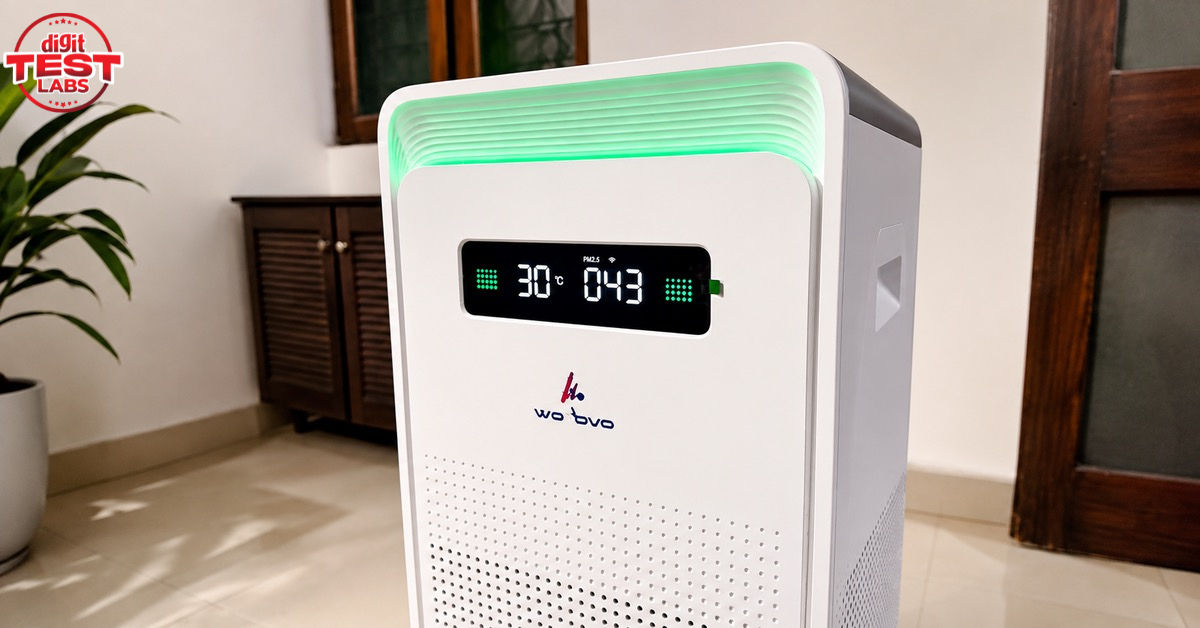

Until a few years ago, air pollution in India was largely a seasonal concern, making air purifiers feel more like a convenient gadget than something you actually needed at home. Now, the situation has changed considerably, with poor air quality becoming a more regular concern in several parts of the country. And as someone living in Delhi NCR, looking for an air purifier wasn’t really a choice for me.
 Survey
Luckily, I didn’t have to spend anything on one, as Wozoyo, a new entrant in the Indian air purifier market, sent us its Pure Air PA6 for review. At the time of writing, the air purifier retails for around Rs 25,000 on Amazon. Going by the specifications, Wozoyo has made some big claims. The PA6 boasts a CADR of 700 m³/h and is rated to cover spaces of up to 2,915 sq. ft.
Those numbers certainly sound impressive, but specifications only tell you so much about an air purifier. I’ve been using the PA6 in my regular routine to see how well those claims translate to real-world use, from its purification performance and noise levels to its app, smart controls and overall day-to-day usability.
Wozoyo Pure Air PA6: Design and build
As soon as I took the Wozoyo Pure Air PA6 out of the box, I could see why the company claims it can cover up to 2,915 sq. ft. It’s a fairly large air purifier, with a tall, upright body that gives it a noticeable presence in any room you place it. However, its relatively narrow footprint means it doesn’t take up much floor space from side to side. While I had no trouble finding a spot for it, its height makes it difficult to completely tuck away in a corner.
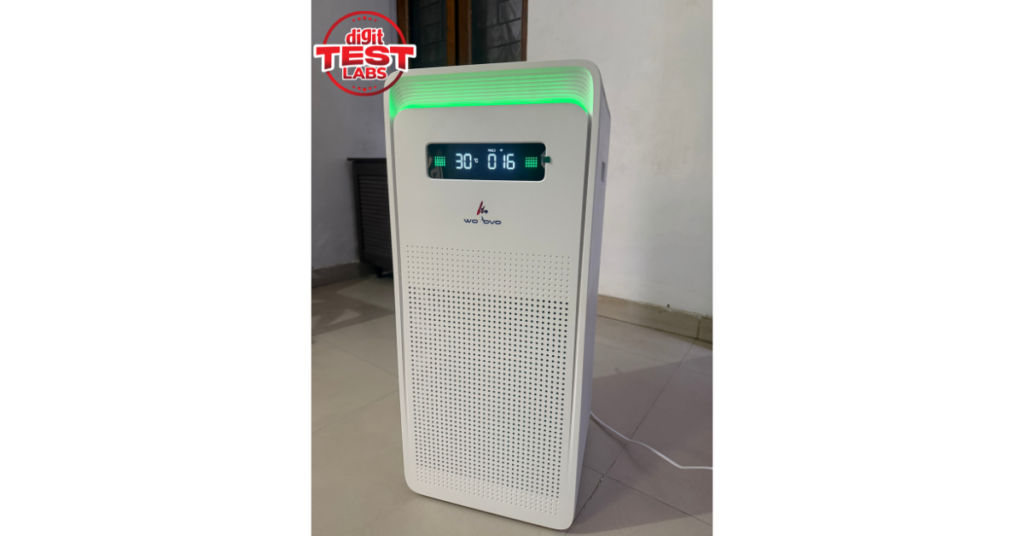
Design-wise, the PA6 doesn’t stray too far from the usual air purifier design. It has a rectangular body with rounded edges and large perforated intake panels on the front, left, and right sides. A black LED display sits on the front, with the Wozoyo logo underneath. The display is positioned at a comfortable height, so I could check the temperature and PM2.5 readings without having to bend down or open the app. Above the display, there’s also a colour-based air-quality indicator that gives you a quick visual reading at a glance. Red indicates very poor air quality, yellow means poor air quality, while green indicates satisfactory air quality. There are also recessed handles on both sides, which make it easier to get a proper grip when lifting the purifier.
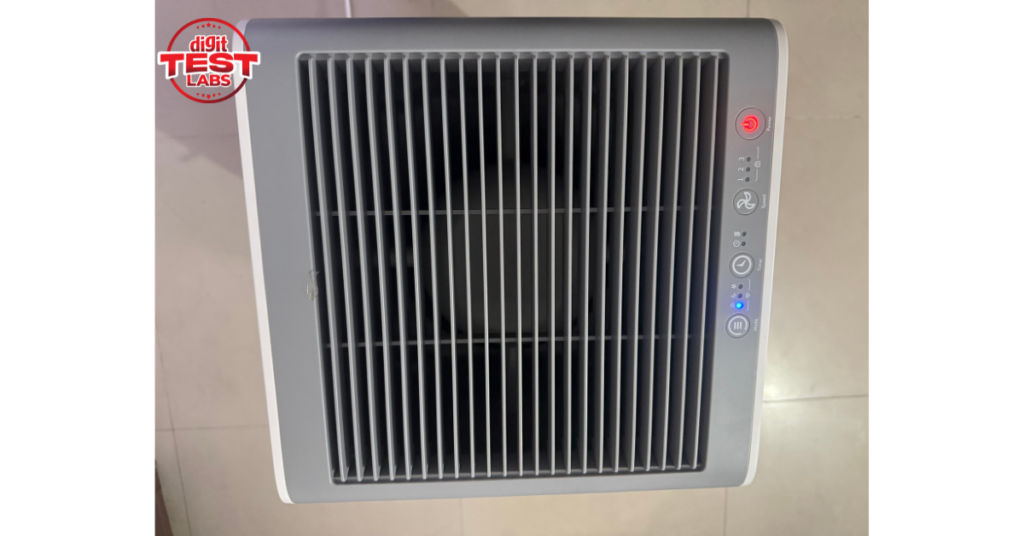
Up top, you’ll find the grey air vents along with a control panel featuring clearly labelled icons and text. The controls look like physical buttons at first glance, but they’re actually touch-sensitive and don’t require you to press them. I found the layout straightforward to use, with the controls easy to reach from the front.
One thing I didn’t like was the branding label. Instead of being embossed or integrated into the body, it’s a pasted-on label, and the one on our unit was already peeling off before we even took the device out of the box.
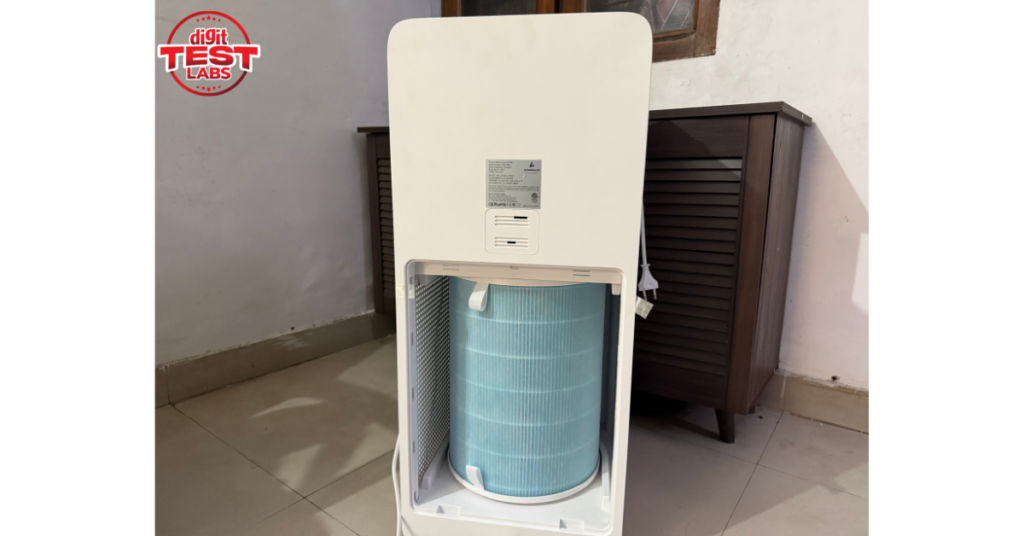
The filter comes pre-installed, so the PA6 is essentially ready to use as soon as you take it out of the box. Removing it is fairly simple as well. You just need to pull out the back panel and use the attached pull tabs to slide the filter out. There is also a particulate sensor above the back panel.
When it comes to durability, the PA6 feels solidly built. The body feels sturdy when you move or handle it, however, there’s also a little sense of the plastic flexing or feeling flimsy. At close to 8kg, however, it is fairly heavy. I would have preferred wheels at the bottom, as they would make moving the purifier between rooms considerably easier, especially given that it is designed to cover larger spaces.
Wozoyo Pure Air PA6: App setup and experience
As I mentioned above, you can start using the PA6 straight out of the box without going through any complicated setup. However, if you don’t want to walk over to the purifier every time you want to change the mode or fan speed, or simply turn it on or off, you can use the Wozoyo Purify app over Wi-Fi.
Setting up the app is fairly simple. Open it, tap the + button, connect the PA6 to your Wi-Fi network, and let the app search for the purifier. If automatic scanning doesn’t work, you can also add the PA6 manually by following the on-screen instructions. In my case, the app failed to locate the purifier during the first two attempts, but the third attempt worked. Since then, I haven’t had any issues controlling the PA6 through the app, even after moving it between my office and home.
One issue I noticed while using the app was that its air-quality readings didn’t always match those shown on the purifier’s display. During my testing, I noticed differences of around 10–12 points between the two readings. While this doesn’t affect the purifier’s operation, it can be confusing when you’re checking the air quality remotely through the app, particularly if you’re using the readings to track how quickly the purifier is cleaning the room. It is something Wozoyo should address through the app or sensor calibration.
The PA6 also supports voice control through Amazon Alexa and Google Assistant. Once connected, you can use voice commands to control the purifier without reaching for the controls or opening the Wozoyo Purify app. I found this particularly useful because my Alexa speaker is in the living room, while the PA6 is placed in my bedroom. I could control the purifier without having to walk into the bedroom or open the Wozoyo Purify app, which made it convenient to switch modes or turn the purifier on and off from another room.
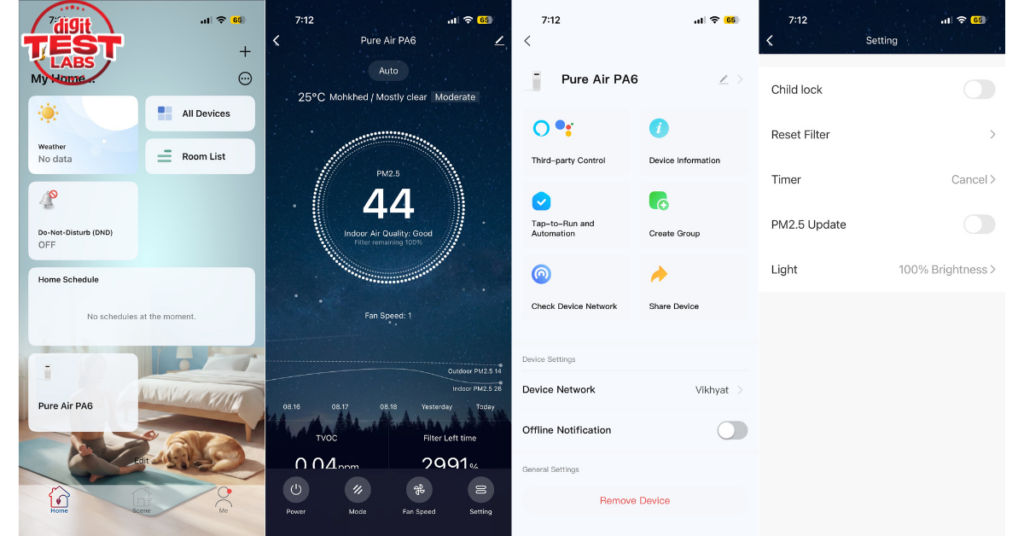
Besides the basic controls, the Wozoyo Purify app also lets you set a timer for one, two, four, or eight hours, enable the child lock, adjust the brightness of the display and indicator LEDs, and check the remaining filter life. You can also access a few other settings from the app, giving you more control over the purifier without having to use the physical controls.
Wozoyo Pure Air PA6: Air purification performance
Going by the claims in Wozoyo’s spec sheet, the PA6 had a lot to prove. A claimed coverage area of up to 2,915 sq. ft. and a CADR of 700 m³/h are impressive figures, especially for an air purifier in this price range. Wozoyo also claims that its four-stage filtration system can remove 99.99% of PM2.5, PM10, pet dander, pollen, smoke, dust mite debris, and other microscopic particles.
I first tested it in our Digit Test Lab, where it worked without any issues. Then I decided to take the PA6 home, where I could test it in a realistic domestic environment. My apartment is around 1,100 sq. ft., and I placed the PA6 in the living room for my testing. I kept all the windows and doors closed and the PA6 started with a PM2.5 reading of 310 µg/m³. I deliberately first left the purifier run in Auto mode to see how quickly it could bring the pollution levels down and how it would adjust the fan speed on its own.
The PA6 brought the PM2.5 level down to 259 µg/m³ within the first five minutes, and then continued to bring it down to 145 µg/m³ at the 10-minute mark. After 20 minutes, the reading kept moving between 115 and 140 µg/m³, while after 30 minutes, it stayed between 105 and 114 µg/m³. Once the PM2.5 level went below 150 µg/m³, the purifier automatically lowered the fan speed. At the one-hour mark, the reading had dropped to 63 µg/m³, and after running it for longer, it eventually settled around 30–35 µg/m³.
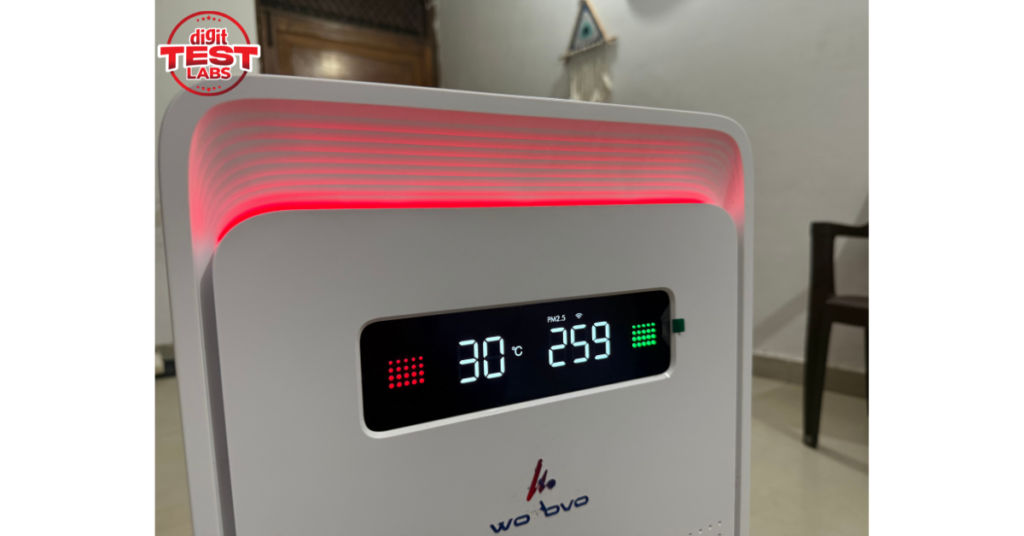
I repeated the test on multiple occasions, and the overall performance remained largely consistent. The exact numbers varied depending on the starting PM2.5 level, but the PA6 followed a similar pattern almost every time. It brought the levels down quickly at first and then gradually reduced the fan speed as the air became cleaner.
To see how it handled maximum airflow, I switched the PA6 to Turbo mode. Even at its highest fan speed, it took around 10 – 12 minutes to bring the PM2.5 level down by 50 percent. However, the rate of reduction remained fairly consistent as the air became cleaner, and the purifier continued bringing the PM2.5 level down steadily.
I also kept a separate AQI monitor running alongside the PA6 during my testing. On the first day, there was a difference of around 10–15 points between the readings, and that remained the case for most of my testing. However, the difference wasn’t always consistent. For example, on the 15th day, the gap between the two readings was almost double what I had usually seen. Both devices still showed the same overall trend as the air quality improved, but the difference in absolute readings was noticeable.
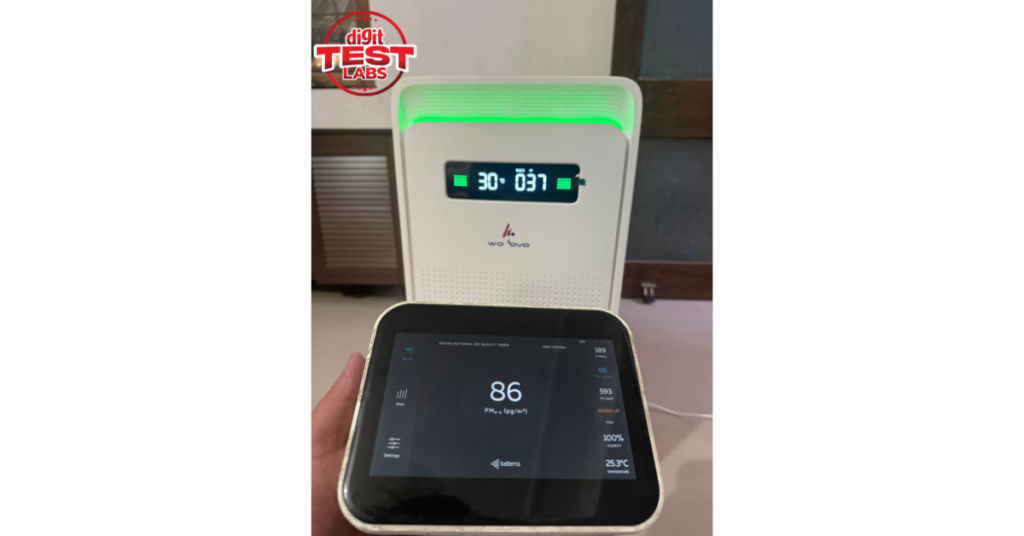
Overall, the PA6 did a good job of cleaning the air in my living room, and I found myself leaving it in Auto mode most of the time. It adjusted the fan speed as the air quality improved, while Sleep Mode made it easy to keep the purifier running at night without disturbing my sleep.
Wozoyo Pure Air PA6: Noise levels
Besides air purification performance, noise was one of the things I paid particular attention to while using the PA6, especially when working and sleeping. In Auto mode, the purifier usually runs at a lower fan speed, and the resulting noise is easy to ignore even if you aren’t focused on something else. I could comfortably leave it running while sleeping without finding the sound distracting.
If I wanted the lowest possible noise level, Sleep Mode was my go-to option. The fan slows down further, making the purifier completely quiet at night. I rarely felt the need to reach for the controls to reduce the fan speed once Sleep Mode was enabled.
Things change when you increase the fan speed or switch to Turbo Mode. The airflow becomes clearly audible, but that’s expected given the amount of air the PA6 is moving at its highest setting. For regular use, I found the lower fan speeds more than adequate. I mainly used the higher settings when I wanted to bring PM2.5 levels down more quickly.
Wozoyo Pure Air PA6: Filter maintenance and running costs
The PA6 uses a four-stage filtration system comprising a pre-filter, anti-bacterial layer, H13 HEPA filter, and activated carbon filter. Wozoyo claims that the system can remove 99.99% of PM2.5, PM10, pet dander, pollen, smoke, dust mite debris, and other microscopic particles. In day-to-day use, there isn’t much maintenance involved beyond keeping the purifier and its intake area clean. Since the app also lets you check the remaining filter life, you don’t have to keep track of the replacement schedule manually. I’d still recommend checking the pre-filter periodically, especially if you’re using the PA6 in an environment where it is regularly exposed to dust and smoke. A buildup of dust can restrict airflow and make the purifier work harder to maintain the same performance.
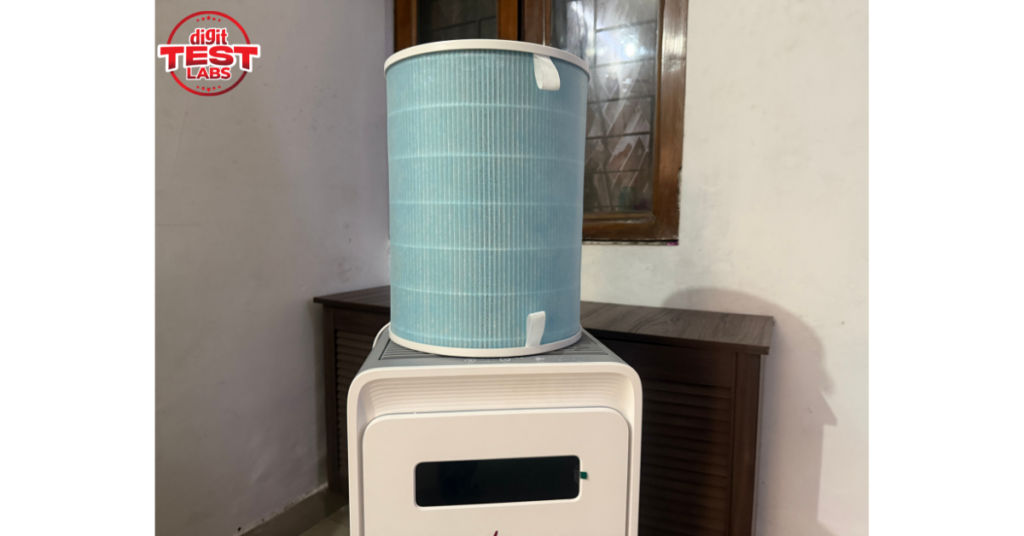
Wozoyo rates the filter for up to 9,000 hours of use, or roughly a year, depending on how frequently you run the purifier. The filter is accessed from the rear and can be replaced when needed. The filter reset indicator also notifies you when it’s time to replace the filter.
Wozoyo Pure Air PA6 vs the competition
At around Rs 25,000, the PA6 falls in the same broad price range as several established air purifiers in India. I compared it with the Philips AC4221/61, Xiaomi Smart Air Purifier 4 Pro and Coway Airmega 250 across some of the key specifications that matter when choosing an air purifier.
| Air purifier | Price | CADR | Coverage | Filter type | Filter life |
| Wozoyo Pure Air PA6 | ~ Rs 25,000 | 700 m³/h | 2,915 sq ft | Pre-filter + Anti-bacterial + H13 HEPA + Activated Carbon | Up to 9,000 hours |
| Philips AC4221 | ~ Rs 24,790 | 600 m³/h | 1679 sq ft | Pre-filter + HEPA NanoProtect + Activated Carbon | Up to 9 months |
| Coway Airmega 250 | ~ Rs 27,999 | 261 m³/h | 575 sq ft | Pre-filter + Green True HEPA + Activated Carbon | Up to 8,500 hours |
| Honeywell Ultra Touch U1 | ~ Rs 24,999 | 700 m³/h | 1085 sq ft | Pre-filter + Nano Silver + H13 HEPA + Activated Carbon | Up to 9,000 hours |
Note: Coverage figures are based on the manufacturers’ stated testing methods and may use different air-change-per-hour (ACH) assumptions.
Wozoyo Pure Air PA6: Should you buy it?
After using the Wozoyo Pure Air PA6 for the last few weeks, I came away impressed by its core performance. It consistently brought down high PM2.5 levels in my 1,100 sq. ft. apartment, and Auto mode did a good job of adjusting the fan speed as the air became cleaner. Sleep Mode is another strong point, making it easy to leave the purifier running overnight without noticeable fan noise or bright lights. For a large room, the PA6 has enough power to make a noticeable difference without requiring much input once it is running in Auto mode.
There are a few things that could have been better. The purifier is fairly heavy, and wheels would have made it much easier to move around. The app is useful and packed with controls, but the difference of around 10–15 points between its air-quality readings and those on the purifier can be confusing. I also wasn’t impressed by the branding label on my unit, which had already started peeling before I took the purifier out of the box. These aren’t deal-breakers, but they do keep the PA6 from feeling as polished as it could.
At around Rs 25,000, the Wozoyo Pure Air PA6 faces plenty of competition, but its 700 m³/h CADR, large coverage area and consistent purification performance make it a strong option for larger spaces. If you live in Delhi NCR or another part of India where an air purifier needs to run for much of the year, the PA6 is worth considering if strong purification performance is your priority.


