

Lenovo at CES 2026: Legion Go 2 with Steam OS, wireless keyboard and mouse that don’t need charging and more
 Follow Us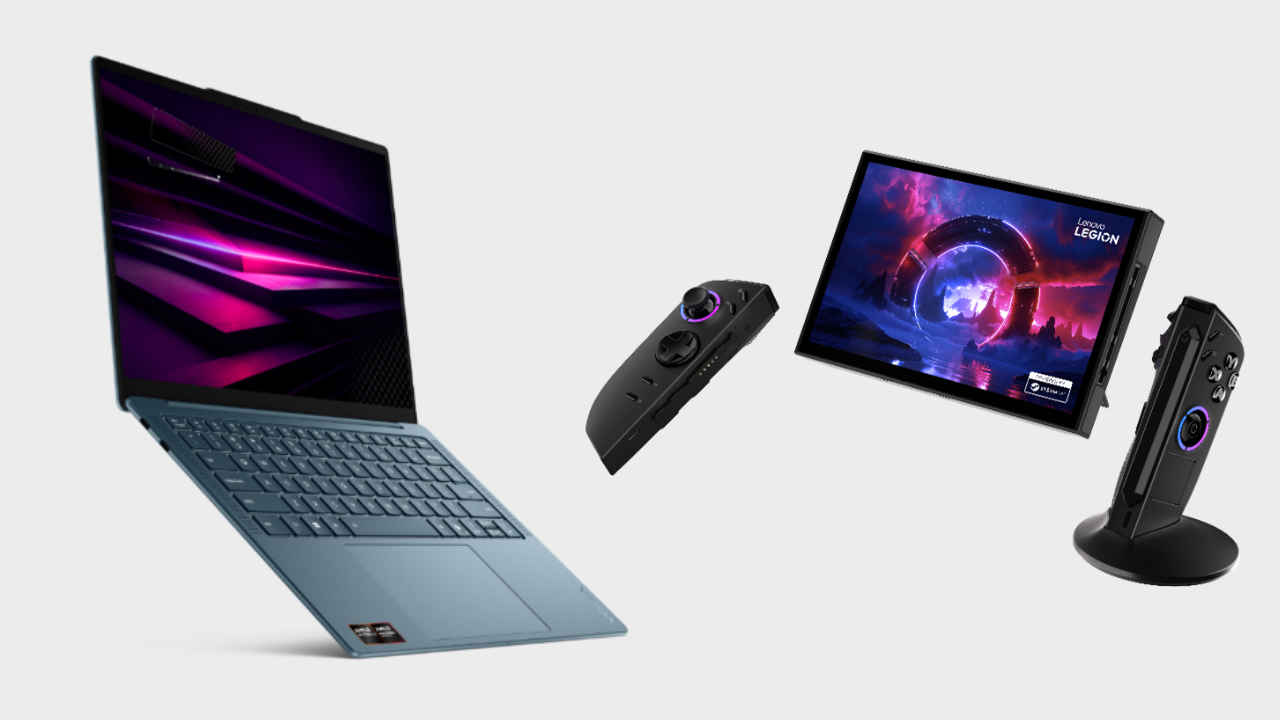

CES is often where Lenovo shows both its most practical ideas and its most ambitious ones and this time there is something for every kind of user. This year, the company’s announcements range from what’s next in handheld gaming, AI-powered laptops, experimental peripherals that aim to remove friction from everyday computing, and more. Whether it is bringing SteamOS to a premium handheld gaming PC or building an ecosystem where laptops, desktops, accessories, and AI features work more seamlessly together, Lenovo’s message at CES 2026 appears to be simple – smarter devices should quietly adapt to users.
 Survey
Also read: What is NVIDIA G-Sync Pulsar and why it matters to gamers
SteamOS finally lands on Lenovo’s flagship handheld
One of Lenovo’s most notable announcements at CES 2026 for gamers across the world is the introduction of the Lenovo Legion Go 2 with SteamOS. The Legion Go 2 originally launched in September 2025 as a powerful handheld gaming PC, but its Windows 11 software experience was widely seen as its weakest link. By shipping a SteamOS version, Lenovo is directly addressing one of the biggest complaints around controller-based Windows devices.
Hardware-wise, little has changed. The SteamOS-powered Legion Go 2 still runs on AMD’s Ryzen Z2 Extreme chip, paired with up to 32GB of RAM and up to 2TB of SSD storage. The more meaningful upgrade is the software layer. SteamOS offers a far more console-like interface, faster access to games, and fewer compromises when navigating with a controller. Lenovo also claims the operating system has been optimised to better utilise the handheld’s hardware, potentially unlocking more consistent performance.
Existing Legion Go 2 owners can install SteamOS themselves, but that process involves Linux workarounds that many users would rather avoid. With SteamOS now available out of the box, Lenovo is making the experience far more approachable for new buyers. The SteamOS model is expected to start at $1,199, which is $100 more than the Windows version. A release timeline or India pricing hasn’t been made official yet.
A future without charging
Lenovo is no stranger to experiments when it comes to CES. And its self-charging keyboard and mouse concept grabbed eyeballs this time. Dubbed the Self-Charging Kit Concept, the combo uses light-harvesting technology that allows it to charge using indoor lighting as low as 50 lux. That is much lower than what most existing solar-powered peripherals require.
The charging surface appears to be integrated directly into the keyboard and mouse design, eliminating the need for visible solar panels or charging ports. Lenovo says this could deliver a true no-charging experience, removing yet another cable from the desk. The concept also hints at multi-device Bluetooth pairing and an eco mode that prioritises battery longevity.
However, it is still a concept with no confirmed pricing or release plans. If the keyboard and mouse combo becomes a reality someday, it would surely be super useful for people who are at their desk most of the time.
AI-first laptops and more
The biggest chunk of Lenovo’s CES 2026 announcements sits within its AI-first laptops. Talking about the already successful Yoga lineup first, the company has introduced new Yoga Aura Edition devices said to combine AI-powered performance, high-end displays, and ecosystem-level features.
At the top of the lineup is the Yoga Pro 9i Aura Edition, aimed at creators who need serious horsepower. With up to Intel Core Ultra Series 3 processors, NVIDIA GeForce RTX 50 Series Laptop GPUs, and a high-brightness Tandem OLED display, it is positioned as a mobile workstation for creative professionals. Lenovo has also introduced a new Force Pad that doubles as a drawing surface, designed to work with the included Yoga Pen Gen 2.
Complementing the laptops is the Yoga Pro 27UD-10 monitor, which is designed to pair seamlessly with Yoga Aura Edition devices. Features like colour sync between screens, a detachable 4K camera, and Dolby Atmos support reinforce Lenovo’s push towards an interconnected creative ecosystem rather than isolated products.
Lenovo has also expanded its Yoga Slim lineup, focusing on ultra-portability without sacrificing AI performance. The Yoga Slim 7i Ultra Aura Edition stands out as the lightest 14-inch Yoga yet, weighing under 1kg while still offering Intel Core Ultra Series 3 processors and a high-resolution OLED display.
Alongside it, the Yoga Slim 7x brings Snapdragon-powered efficiency into the mix, promising long battery life and consistent performance on and off the charger. The Yoga Slim 7a offers a similar thin-and-light design powered by AMD Ryzen AI processors, giving users more choice across platforms.
Beyond premium Yogas, Lenovo refreshed its IdeaPad lineup with a focus on flexibility and value. The IdeaPad Pro 5i targets users who want strong performance for editing and multitasking, while the IdeaPad 5a and 5x 2-in-1 models lean into pen input and convertible designs. There is also a new IdeaPad Slim 5x for users who prioritise portability and battery life.
On the desktop side, Lenovo introduced the Yoga AIO i Aura Edition, a large all-in-one PC with a 4K OLED display and adaptive lighting, alongside the compact Yoga Mini i. Both aim to bring AI-enhanced experiences into home and studio setups without the complexity of traditional desktop builds.
Lenovo also showcased updates to its Aura Edition software features, new Yoga accessories, and a personal AI agent preview, all pointing towards a more connected and context-aware computing ecosystem in 2026.
Also read: CES 2026: Zenbook Duo, ProArt PX13 and more, Asus showcases new AI-powered laptops


