
Starlink vs Tata Nelco: Technology, target market, ecosystem, price and more compared
 Follow Us
Starlink and Tata Nelco are competing in India’s satellite internet market.
Starlink targets consumers, while Nelco focuses mainly on businesses.
Starlink may launch sooner, while Nelco’s own network is still in development.
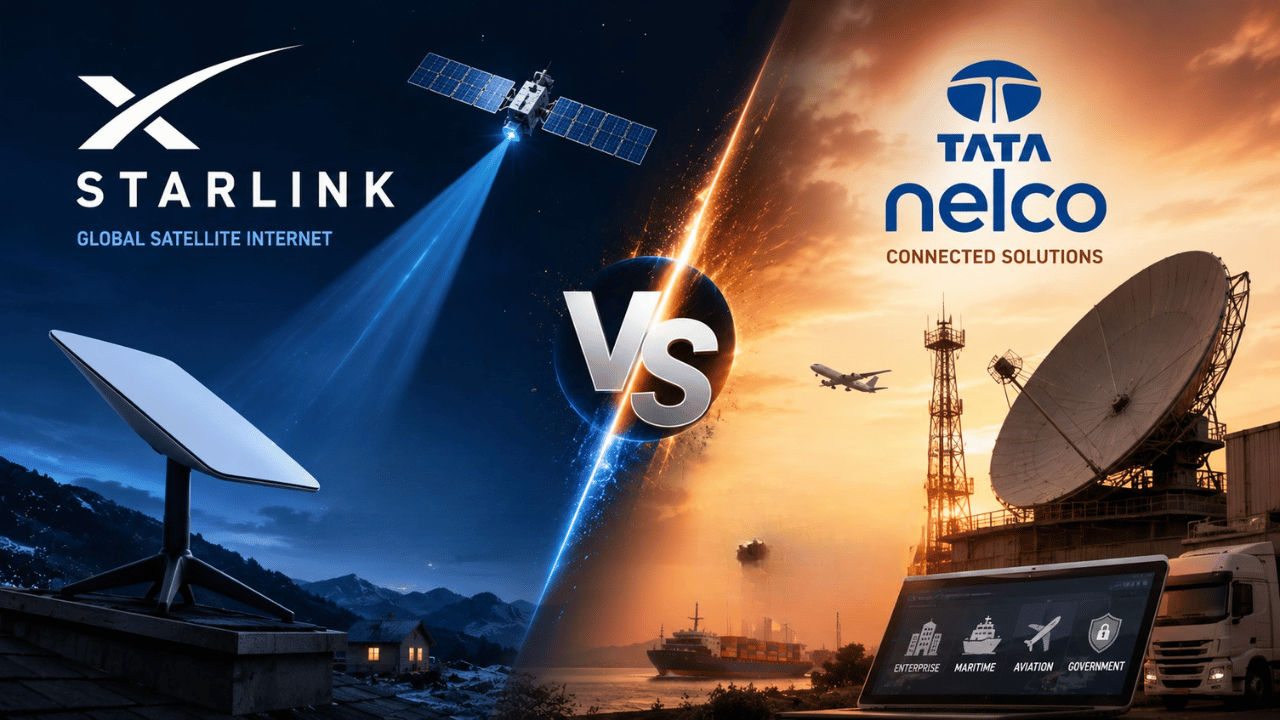

Starlink has recently re-submitted its revised deal to the Indian government, hoping to get approval to start the use of the Gen 2 satellites for internet service in India. With this, India’s satellite internet race is heating up. Indian company Tata is also working on a similar effort through its satcom arm, Nelco. Nelco plans to resell space-based internet from partners like Eutelsat OneWeb while quietly building its own direct-to-device network for the future. Starlink, meanwhile, operates its own satellite constellation directly rather than reselling anyone else’s capacity. If they succeed, this could change how millions of people in India access the internet, bringing fast, reliable connectivity to remote areas where traditional broadband and mobile networks are difficult to set up.
 Survey
Starlink vs Tata Nelco: Technology and Network
Starlink already operates a large constellation of thousands of satellites in low Earth orbit (LEO). Not only that, but the company has thousands more satellites approved for future deployment globally, though its bigger Gen 2 network still needs India-specific approval. An earlier bid was rejected by the Indian regulator over spectrum and feature requirements, and the fresh application is what’s currently under review. Its expansion plans also include newer satellites designed to support direct-to-device (D2D) connectivity.
On the contrary, Tata Nelco does not currently operate its own satellite constellation. Instead, it holds a reseller licence that allows it to provide satellite connectivity using capacity from partner networks such as Eutelsat OneWeb. Reports suggest that Nelco is investing in a separate direct-to-device initiative, but that network is still under development and is not expected to become operational for several years.
Also read: Apple Watch ECG spots unusual heart rhythm, helps athlete uncover congenital heart defect
Starlink vs Tata Nelco: Target market
Starlink in India is trying to cater to the general public and aiming to become a household name from big cities to remote villages. Not only that but it also wants to serve the Indian government and defence.
In contrast to that, reports suggest that Tata Nelco is only focusing on enterprise and critical needs. The company majorly wants to cover land, sea and air links for shipping, aviation, banking machines and secure government use.
Starlink vs Tata Nelco: Ecosystem and partnerships
Starlink is reportedly trying to enter the Indian market with the help of telecom giants Airtel and Jio. The companies are expected to do the hardware and support installation for Starlink. Not only that, but it’s also reported that the company is in talks with Nelco and BSNL for wider reach. Meanwhile, Tata Nelco has tied up with Eutelsat OneWeb for satellite capacity and picked up a stake in another network for future device connectivity.
Also read: India orders Google to take down 57 Firebase sites linked to cyber scams
Starlink vs Tata Nelco: Launch timeline and price
Starlink already holds a licence to operate in India, with plans reportedly ranging from roughly three thousand to over eight thousand rupees a month, though the higher figure, briefly listed on Starlink’s India website, was later described by the company as a technical glitch rather than confirmed pricing plus hardware costs near thirty to thirty-four thousand rupees.
Tata Nelco’s OneWeb-linked plans, on the other hand, are expected to be more affordable, while its own direct-to-device network is targeted for commercial launch only by 2028, placing it well behind Starlink’s rollout.


