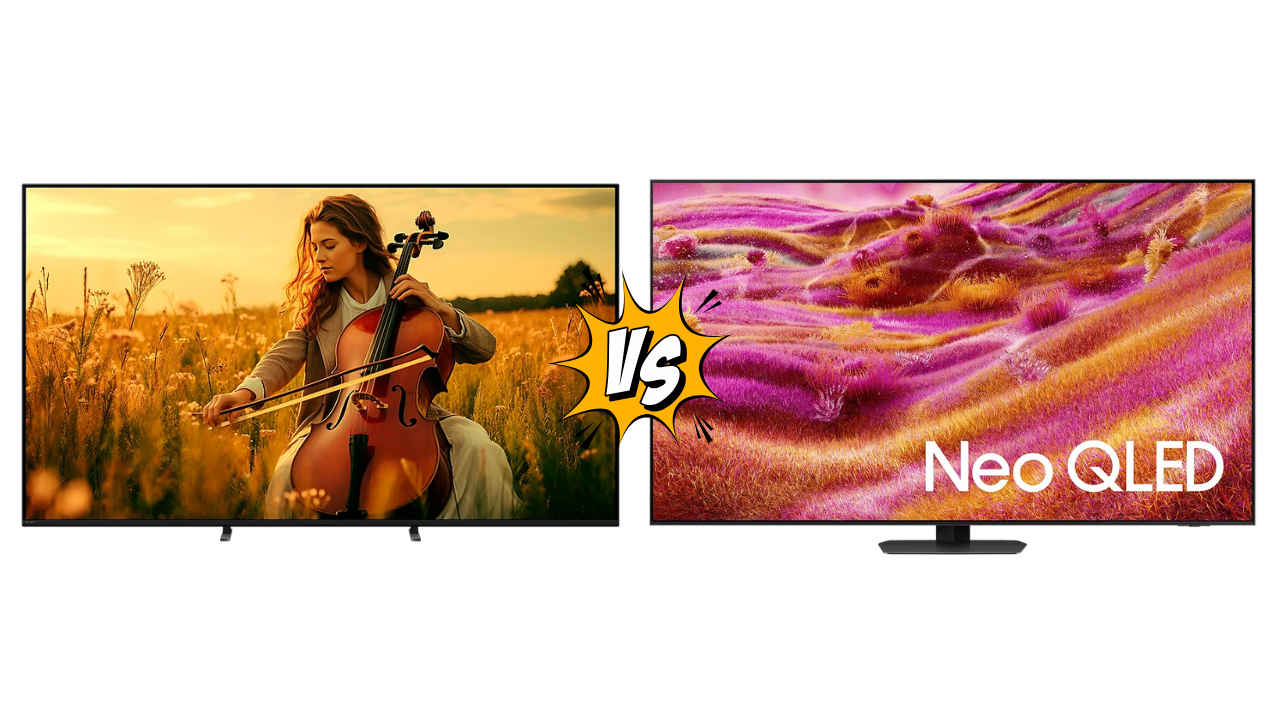
Sony BRAVIA 5 and Samsung QN90F are both high-end LCD TVs in India that use Mini LED backlighting technology. In terms of pricing and features, they sit very close. Both sport a 4K panel with 120Hz refresh rate and promise AI-enhanced picture quality, Dolby Atmos-driven sound, similar connectivity options, and advanced gaming features like VRR. But the differences come through in areas such as the software ecosystem, speaker power, etc. Here, we will do a spec-by-spec comparison of both these Mini LED TVs, which may help users who are confused between these two models for their premium home entertainment.
 Survey
Disclaimer: We have not tested these TVs side by side, so this is not an analytical comparison.


Price and availability
The Sony Bravia 5 launched in India at a starting price of Rs 1,37,740, while the Samsung QN90F started at Rs 1,49,390. The TVs are available on leading online and offline platforms.
| Model | Launch price (India) |
|---|---|
| Sony BRAVIA 5 | 55-inch: Rs 1,37,740 65-inch: Rs 1,73,840 75-inch: Rs 2,84,990 85-inch: Rs 4,17,990 98-inch: Rs 6,49,990 |
| Samsung QN90F | 55-inch: Rs 1,49,390 65-inch: Rs 2,05,900 75-inch: Rs 4,21,900 85-inch: Rs 5,64,990 98-inch: Rs 10,99,900 115-inch: Rs 17,49,990 |
Samsung offers the 115-inch model, which Sony doesn’t. So, that’s one more option, prioritising massive, cinema-like immersion.
Also Read: Lumio Vision 9 Review: Excellent Value
However, for this article, we will be comparing the 55-inch models only. The 55-inch Samsung TV is around Rs 10,000- Rs 15,000 pricier than its Sony counterpart. Let’s see if this difference is justified in terms of features on offer:
Display
Both use Mini-LED for local dimming. While Sony relies on its XR Processor to achieve a signature contrast and close to natural colours from the VA panel, Samsung has an additional Quantum Dot (QLED) layer for enhanced colour volume and brightness, especially in bright scenes. Samsung’s NQ4 AI Gen3 Processor aims for pop and vibrancy.
The BRAVIA 5 supports Dolby Vision, the preferred HDR format for most major streaming services (Netflix, Disney+, Apple TV+). The QN90F supports HDR10+, Samsung’s competing, open-source format. If you watch a lot of premium streaming content, the BRAVIA 5’s Dolby Vision support allows it to fully utilise the enhanced metadata for scene-by-scene optimisation. Sony also offers creator-calibrated modes like Prime Video Calibrated and Netflix Calibrated Mode.
Samsung highlights the QN90F’s anti-glare screen, which should make it better suited for very bright living rooms with unmanageable light sources. Since Sony hasn’t specified anything, Sony should be better in controlled or darker viewing environments.
Both are high-refresh panels with native 120Hz support, but Samsung’s Motion Xcelerator boosts this to 165Hz, which could give high-end PC gamers or future console players a slight edge.
Audio setup
The Sony Bravia 5 comes with a 40W speaker system arranged in a 2.0 channel setup, while the Samsung QN90F offers a more powerful 60W 4.2.2-channel system. This gives Samsung a clear advantage in terms of hardware, as its dedicated bass and height channels allow for a more immersive and room-filling sound straight out of the box.
On the software side, both TVs support Dolby Atmos for spatial audio. Sony adds DTS:X and 3D Surround Upscaling, while Samsung includes its surround sound technology: Object Tracking Sound+ (OTS+).
Both brands also allow their TVs to work in tandem with compatible soundbars. Sony uses Acoustic Centre Sync, which pairs the TV with Sony soundbars for centralised dialogue, while Samsung’s Q-Symphony blends the TV’s built-in speakers with Samsung soundbars for a wider, more dynamic soundstage.
Software and services
When it comes to the operating system, the Sony Bravia 5 runs on Google TV, based on Android 12 or later, while Samsung’s QN90F uses Tizen OS. Google TV has a more content-centric interface with deeper integration of Google services and access to a large app store. Tizen, on the other hand, is known for its speed, streamlined navigation, and smooth integration with Samsung and SmartThings devices.
For voice assistants, the Bravia 5 includes Google Assistant natively and also works with Alexa. Samsung builds in Bixby, but its TVs also support Google Assistant and Alexa. Both brands offer extensive voice control, though Sony’s native Google Assistant may be more appealing for homes already invested in the Google ecosystem.
On the update front, neither company officially specifies the duration of software support. However, Sony typically rolls out OS and security updates for multiple years, while Samsung has a record of aggressively updating Tizen to bring new features. In practice, users can expect several years of reliable updates from both brands.
Each TV line also comes with unique features. Sony offers Acoustic Multi-Audio for sound aligned with on-screen action, the Bravia Connect app for smartphone control, and ‘Perfect for PS5’ optimisations. Samsung highlights its Gaming Hub for cloud gaming, Object Tracking Sound+ for dynamic audio, and Multi View for split-screen use. Sony’s extras are designed to work best with the PlayStation 5 and its own audio ecosystem, while Samsung leans into broader utility and gaming flexibility.
On the services side, Sony includes Bravia Core, a streaming platform offering high-bitrate movies from Sony Pictures. Samsung pushes its in-house AI stack under the ‘Vision AI’ banner, which covers AI upscaling, auto HDR remastering, and other enhancements.
Both brands extend their proprietary ecosystems in ways that reflect their larger strategies: Sony’s focused on premium content and PlayStation integration, Samsung’s focused on AI-driven enhancement and multi-device connectivity.
Connectivity
Both TVs come with four HDMI ports, which is standard at this level, but the key difference lies in HDMI 2.1 support. The Samsung QN90F includes four full-bandwidth HDMI 2.1 ports, making it more flexible for gamers who want to connect a PlayStation 5, Xbox Series X, and a gaming PC simultaneously with full 4K at 120Hz or 144Hz support.
The Sony BRAVIA 5, on the other hand, only offers two HDMI 2.1 ports, which means you may need to prioritise which devices take advantage of the higher bandwidth.
Both models support eARC through one of their HDMI 2.1 ports, allowing uncompressed, high-quality audio like Dolby Atmos to be passed on to a soundbar or receiver.
In terms of wireless connectivity, the Sony has an edge with Wi-Fi 6, which can provide faster and more stable streaming if paired with a compatible router, while the Samsung is limited to Wi-Fi 5.
Gaming features
The Sony Bravia 5 supports a maximum 4K refresh rate of 120Hz, while the Samsung QN90F goes up to 165Hz over HDMI 2.1. This difference matters most for PC gamers, since the Samsung panel can display more frames per second, giving a smoother and more fluid experience in competitive games. For console players, however, 120Hz remains the practical ceiling because current-generation consoles like the PS5 and Xbox Series X are capped at that level for most titles.
In terms of adaptive refresh, both TVs support VRR, but Samsung goes further with FreeSync Premium Pro. This certification ensures lower latency and improved HDR tone handling during gaming sessions, making it especially appealing for Xbox and PC users who want guaranteed stability. Sony’s VRR works well too, but its implementation relies more on standard HDMI Forum VRR.
Both TVs include Auto Low Latency Mode (ALLM), which automatically switches to a low-lag Game Mode when a console is detected. This has become a standard feature on modern gaming TVs, so neither model gains a clear edge here.
Where they diverge is in console integration. Sony has tuned its Bravia 5 software with features like Auto HDR Tone Mapping and Auto Genre Picture Mode that work seamlessly with the PS5. Samsung, on the other hand, leans into its broader gaming ecosystem. Through the Samsung Gaming Hub, it offers access to cloud gaming platforms such as Xbox Game Pass without requiring a console, which could be a strong advantage for casual or non-traditional gamers who want flexibility.
Design and accessories
Both TVs weigh approximately 17.7 kg without the stand, which is typical for their size class and makes them equally manageable for mounting or placement.
In terms of mounting, the VESA patterns differ. Samsung uses a 300 x 300 mm pattern, while Sony has a 200 x 200 mm pattern. This means that any aftermarket wall mount must be compatible with the specific VESA dimensions of each TV, particularly for the Samsung, which requires a slightly larger bracket.
The stand designs are also distinct. The Samsung features a flat underlay stand that allows for a soundbar to be placed beneath the screen, while the Sony uses a sturdy pedestal stand designed to accommodate a compatible Sony soundbar on top, creating a more integrated look for the audio setup.
Finally, the remote controls differ in functionality. The Samsung comes with a rechargeable SolarCell remote with a built-in microphone, which charges via a small solar panel or RF signals, reducing the need for disposable batteries. The Sony includes a standard remote with a built-in microphone, which relies on traditional batteries.
Final thought
Both the Sony BRAVIA 5 and Samsung QN90F are strong entry points to the Indian premium Mini LED segment. Sony leans on colour accuracy, Dolby Vision support, and PlayStation integration, making it a good choice for cinephiles and PS5 users. Samsung offers higher peak brightness, a Quantum Dot layer, a more powerful speaker system, and broader HDMI 2.1 support, which may appeal to gamers and those who want a brighter, more versatile setup. Software and ecosystem preferences also play a role: Google TV favours content-centric navigation, while Tizen provides speed and seamless device integration.
Ultimately, the choice comes down to which features matter most and which price suits you.
Keep reading Digit.in for more such TV stories.
Also Read: Xiaomi QLED TV G32 2025 Review: Dares to Do More
 Follow Us
G. S. Vasan
G.S. Vasan is the chief copy editor at Digit, where he leads coverage of TVs and audio. His work spans reviews, news, features, and maintaining key content pages. Before joining Digit, he worked with publications like Smartprix and 91mobiles, bringing over six years of experience in tech journalism. His articles reflect both his expertise and passion for technology. View Full Profile


