

“People have more choices than ever, yet finding the right phone has only become harder”: Boltt co-founders on entering India’s smartphone segment
 Follow Us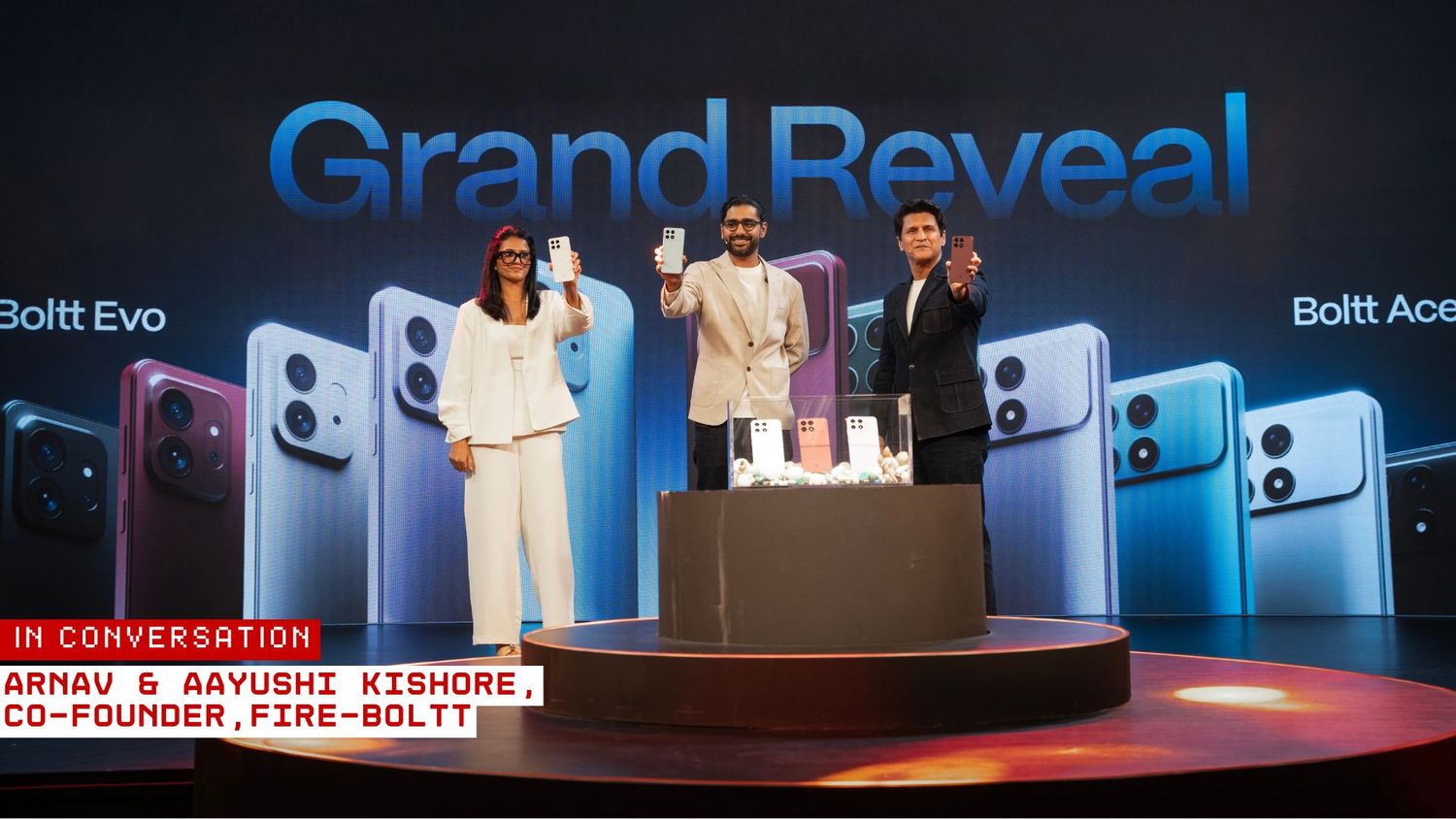

Over four years, Fire-Boltt built India’s leading wearable brand on the principle of offering the most features for the least money, sold through the widest possible distribution. The average selling price sat between Rs 1,500 and Rs 4,000 and the strategy worked, delivering market leadership, more than 40 million devices sold, and a captive user base spread heavily across tier-two and tier-three India. The next step, which the company has been developing in parallel for approximately 12 months, is a category that has broken every Indian hardware brand that has attempted it seriously: smartphones. Fire-Boltt is entering the segment under a separate identity, Boltt, with two devices at launch: the Boltt Ace 5G and the Boltt Evo 4G, both priced below Rs 15,000, both running stock Android 16 with a zero-bloatware promise, and both positioned around what Arnav Kishore, co-founder of Boltt describes as “honest specs and honest price.” When asked why the brand believes it is ready for smartphones, Kishore immediately pointed to Fire-Boltt’s four crore smartwatch users.
 Survey
In a conversation with Digit, Kishore and his co-founder Aayushi Kishore laid out the market thesis, the product decisions, and the argument for why this venture ends differently from the Indian smartphone brands that came before it.
Why a separate brand
Naturally, the most immediate question anyone would ask is why Boltt is not called Fire-Boltt. The answer, Arnav Kishore explains, comes down to price positioning and the perception that comes with it. Fire-Boltt’s wearables business was defined by the sub-Rs 4,000 segment; moving into smartphones at Rs 10,000 and above under the same name risked carrying that budget association into a category where the company wants to be seen differently. “We wanted to create a new brand which resonates with that target group,” Kishore told Digit. The ambition is for Boltt and Fire-Boltt to function as connected but distinct identities, with a 360-degree ecosystem of wearables, hearables, smart glasses and now smartphones working together at the hardware and software level, while maintaining separate brand languages aimed at different audiences.
Aayushi Kishore frames the reasoning in longer-term commercial logic: two product lines built to scale separately, rather than one brand stretched across incompatible price points and customer profiles. “More than anything else,” she says, “we wanted to create separate identities.”
The market gap
The segment Boltt is entering into is smartphones priced between Rs 10,000 and Rs 15,000, and as Aayushi Kishore puts it, “probably the most brutal segment out there, but it is also highly commoditised.” Her argument is not that the segment is empty but that it has become paradoxically difficult to navigate for buyers despite being crowded with options. “People have more choices than they ever had, yet finding the right phone has only become harder,” she told Digit. “Consumers are often paying more for features they rarely use, while what they really want is something simple: good performance, a good camera, good battery life, and reliable everyday value.”
The structural opening Boltt is identifying is less about features and more about availability. Because of rising memory prices, with analysts suggesting the situation is unlikely to normalise before early 2028, several of the dominant players in the sub-Rs 15,000 segment are finding it increasingly difficult to deliver at the price points they once held. Arnav Kishore’s contention is that availability will be the defining issue in this segment for the next six to ten months and that Fire-Boltt’s supply chain experience in wearables, a category that requires managing a dense stack of components at very low price points, gives Boltt an edge that otherwise would not have been possible.
“A smartwatch is actually much tougher to crack as a product even compared to smartphones,” he said, “because of the number of components. We have been through a very turbulent time in wearables and we have been able to maintain our supply chains very effectively.”
Aayushi Kishore also points to the policy environment as a tailwind. The government’s mobile phone manufacturing scheme is actively encouraging Indian brands to enter a smartphone market that, despite India being the second-largest in the world by volume, has seen almost no domestic players sustain meaningful presence. “Why only leave that to the Chinese players?” she said.
The products
Boltt is launching with two devices. The Ace 5G carries a 6.79-inch HD+ display with a 120Hz refresh rate, a 64MP primary camera with an 8MP front camera in a punch-hole notch, a 6,000 mAh battery with 18W charging, and 8GB of RAM with 128GB of storage, expandable to 1 TB via a microSD card. The processor is the Unisoc T8200, an octa-core 5G chip. Three colour options are available.
The Evo 4G shares the same display size and refresh rate as the Ace, along with a 6,000 mAh battery and the same punch-hole front camera design. The primary camera steps down to 50MP, the processor moves to a Unisoc T7250, and the device adds a side-mounted fingerprint sensor. The Evo is available in two configurations: 4GB RAM with 64GB storage, and 6GB RAM with 128GB storage, both supporting up to 1 TB of expandable storage. Five colour options are available. Both devices launch on stock Android 16.
The choice of Unisoc silicon across both devices is likely to receive the closest scrutiny from reviewers. The T8200 and T7250 are not chips that the segment’s dominant brands, Redmi and Realme, have leaned on recently, and benchmark performance relative to MediaTek Dimensity or Qualcomm Snapdragon entries at comparable prices will be the most direct test of whether the Boltt hardware proposition holds.
The Android 16 and zero-bloatware bet
The software experience is what Arnav Kishore is most invested in making. In the sub-Rs 15,000 segment, bloatware has become effectively standard with pre-installed third-party apps, monetisation-driven API additions, and firmware modifications that consume storage, affect battery life and in some cases handle user data in ways that are not clearly disclosed to buyers. “One of the common problem statements was that a lot of phones in the segment below Rs 15,000 have a lot of bloatware burnt onto the phone for monetary reasons,” Kishore said. “We wanted to be very true to customers from day one and make sure that the experience is a very clean, native, stock Android experience.”
Boltt is launching on Android 16 with only the essential Google applications pre-installed. OTA updates are planned every two to three months, with Kishore confirming an update commitment of a minimum of four to six years. The FOTA roadmap, he says, is already planned in advance, with a focus on AI and camera improvements arriving in phases.
There is, however, a nuance to the “stock Android, zero bloatware” claim. Boltt is building a proprietary layer on top of Android 16 that includes a dedicated in-built customer support channel, Gemini AI integration across the camera system and device-level search, and additional features to be delivered via OTA. The framing Kishore offers is of stock Android as a clean baseline that the brand will build upon gradually, rather than front-loading firmware with additions the buyer did not ask for. How that distinction holds up over the device lifecycle, and whether the promised update cadence is maintained beyond the first year, will determine whether the software commitment translates into a durable product advantage.
Made in India: what that actually means
Boltt positions itself as a Made in India brand and Aayushi Kishore says that approximately 60 to 70% of components will be sourced domestically at launch, with the remainder still being imported. Assembly is 100% in India, through partnerships with top-tier EMS companies that Boltt declined to name publicly. The target, she says, is to move considerably more of the supply chain onshore within six months, including components such as the display and battery. “By the next six months, almost all of our manufacturing of the smartphone will be 100% here,” she told us.
The engineering work is split between India and China, and the company is explicit that this is not a rebadging exercise. “The complete IP of the phones is completely going to be owned by Boltt,” Arnav Kishore said. “We have designed the phone in-house and we are not going to be following the footsteps of other brands.” The PLI scheme is on the company’s radar for when it reaches the scale required to qualify.
The distribution and the numbers
Flipkart is the primary online partner at launch and Boltt is entering offline retail with an existing head start that most new smartphone brands do not have. Fire-Boltt has operated across 25,000 to 30,000 retail outlets for smartwatches and hearables and approximately 10,000 of those outlets overlap with smartphone retail. The plan is to activate that trade relationship quickly, with the focus tilted toward tier-two and tier-three markets where the Boltt target buyer is most concentrated.
The initial sales target is one million units between August and December 2025, a number Kishore describes as the opening benchmark before the roadmap expands into higher price points, up to the Rs 25,000-30,000 range and beyond, from December onwards.
On cross-sell, Kishore is measured. Converting 20 to 30% of Fire-Boltt’s four-crore wearables user base into Boltt smartphone buyers would be, he says, a significant achievement and not the ceiling. Many of those users, he notes, are first-time smartphone buyers upgrading from feature phones, which means they are not switching from a competitor brand but entering the category for the first time. The platform strategy on Flipkart will also work differently for Boltt than it did for Fire-Boltt in wearables, with cross-category merchandising and bundled offers intended to push the two ecosystems toward each other at the point of consideration.
The longer-term ecosystem play involves Fire Lens, the audio smart glasses line Fire-Boltt launched which Arnav Kishore says will integrate more tightly with Boltt smartphones over the next year as the engineering roadmap matures. “Because we have control over the OS in both segments, we will be able to figure out feature sets that will be exclusive to the Boltt ecosystem,” he said. The analogy he reaches for is Apple’s hardware integration and the ambition, if not yet the execution, points in that direction.


