

Touchscreen MacBook Pro with OLED display vs MacBook Pro M6: What’s new and which one is right for you?
 Follow Us
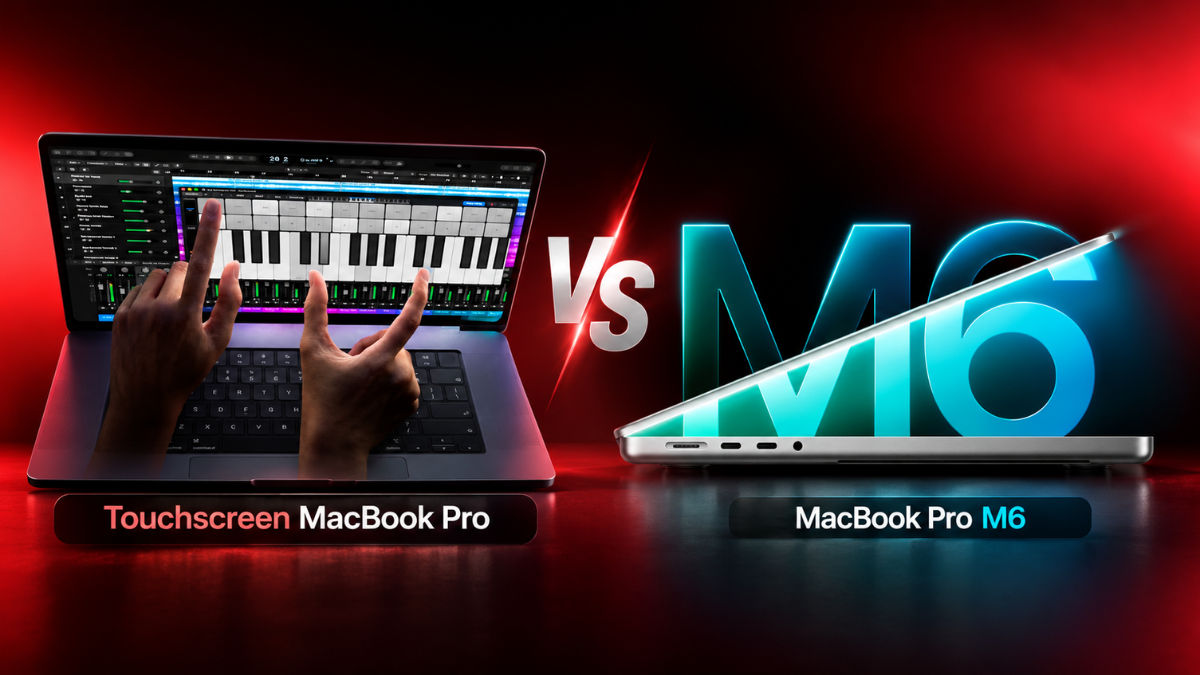

Apple has announced two new MacBook Pro models in a span of just two days, and the more interesting launch is the one that changes how you use a Mac. The new 14-inch MacBook Pro with M6, announced on 27 October, brings faster performance, better graphics, and improved AI capabilities. However, just a day later, Apple unveiled the MacBook Pro with PROLED XDR Display, introducing touchscreen support (finally!) to the Mac for the first time. It is a change that has been a long time coming. For John Ternus, the touchscreen MacBook Pro has to be his second major product moment after the iPhone Duo, and one that finally brings an idea Mac users have been asking about for years to life.
 Survey
Also read: iPad mini 2026 vs iPad mini 2024: What has changed and should you upgrade?
MacBook Pro M6 vs touchscreen MacBook Pro: What’s new?
The biggest difference between the two laptops is not their chipsets (well, that is), but it is how you interact with them, and the kind of work each one is designed to handle.
The MacBook Pro with M6 is the more straightforward standard upgrade. It retains Apple’s familiar design and Liquid Retina XDR display, but gets a new 12-core CPU and 12-core GPU. Apple claims up to 30 per cent faster graphics performance and up to 25 per cent faster AI workloads compared with the M5.
The touchscreen MacBook Pro with a Tandem OLED display, meanwhile, introduces a redesigned display, touch controls, a slimmer and lighter body along with the return of the glowing Apple logo. It is available in 14-inch and 16-inch sizes, with M5 Pro and M5 Max chips powering the more demanding configurations.
Touchscreen MacBook Pro: A change that’s been years in the making
Apple has long maintained a distinction between the Mac and the iPad. The Mac offers a traditional desktop operating system built around a keyboard, mouse, and trackpad, while the iPad relies on touch. That separation has existed for years, but it has also left users wondering when Apple would bring the two experiences closer together.
Well, that day has finally arrived. On the new MacBook Pro, you’ll be able to scroll through webpages, pinch to zoom into images, move objects around presentations, and rearrange windows using your fingers. The touchscreen is built directly into the display panel rather than being added as a separate layer, which Apple says helps reduce latency. More importantly, touch is designed to work alongside the keyboard and trackpad, and note — not replace them. Graphic designers can draw directly on the screen, musicians can play software instruments, and developers can test touch interactions for their iOS and iPadOS apps.
Apple is also updating its creative software to take advantage of the feature. Final Cut Pro will let editors mark ranges, move clips, and zoom into edits using touch. Logic Pro gains onscreen musical instruments, while Pixelmator Pro lets users interact directly with their designs. For video editors, designers and musicians, this could actually come in handy. Being able to drag a clip on the timeline or make a quick adjustment with your finger is something you just couldn’t do on a MacBook Pro. Well, that was until now.
PROLED XDR vs Liquid Retina XDR: The display difference
The touchscreen model also brings a major display upgrade. The new PROLED XDR panel uses tandem OLED technology, with two self-illuminating pixel layers. Apple claims peak brightness of up to 2,000 nits, a contrast ratio of 10,000,000:1 and an adaptive refresh rate of up to 120Hz.
The existing Liquid Retina XDR display on the M6 MacBook Pro is no slouch, with up to 1,600 nits of peak HDR brightness and a 1,000,000:1 contrast ratio. However, the new OLED panel promises deeper blacks, brighter highlights and improved contrast.
There is also a practical benefit for professionals. PROLED XDR supports both P3 and Adobe RGB colour spaces, making it better suited to colour-critical work such as photography, print design and HDR video grading. The touchscreen model also supports a nano-texture option to reduce glare.
For someone who primarily writes, browses the web or works with spreadsheets, the M6 model’s display should still be more than adequate. But creators who need greater control over colour and contrast have more reason to consider the PROLED XDR version.
Performance, battery life and design
Interestingly, the touchscreen MacBook Pro does not use Apple’s newest base M6 chip. Instead, it is powered by the M5 Pro and M5 Max, which are designed for demanding professional workloads.
The M6 MacBook Pro features a 12-core CPU, a 12-core GPU, and a dual 16-core Neural Engine. It comes with 16GB of unified memory as standard, configurable up to 32GB.
The touchscreen MacBook Pro model goes further with up to 128GB of unified memory and storage configurations reaching 16TB. This makes it better suited to intensive workloads such as 3D rendering, visual effects, large AI models, and editing multiple streams of high-resolution video.
Both models promise up to 24 hours of battery life. The touchscreen version is also thinner and lighter, with the 14-inch model weighing 1.36kg and the 16-inch version weighing 1.81kg.
Both laptops feature a six-speaker sound system, a 12MP Center Stage camera, Wi-Fi 7, Bluetooth 6, and a range of ports. The touchscreen model, however, adds a redesigned hinge for better stability when interacting with the display. Another new addition is Dynamic Island on the Mac. It provides a convenient place for Spotlight search, Live Activities, and Siri AI, bringing an iPhone-inspired interface element to macOS.
MacBook Pro M6 vs touchscreen MacBook Pro: Price in India
The 14-inch MacBook Pro with M6 starts at Rs 2,39,900 in India, with education pricing bringing the starting price down to Rs 2,27,900. It is available in Space Black and Silver, with pre-orders open and availability beginning November 6.
The touchscreen MacBook Pro is considerably more expensive. The 14-inch model with the M5 Pro chip starts at Rs 3,49,900, while the 16-inch version starts at Rs 4,09,900. With education pricing, these come down to Rs 3,31,900 and Rs 3,85,900, respectively.
If you need more power, the 14-inch MacBook Pro with M5 Max starts at Rs 5,49,900, while the 16-inch version costs Rs 5,89,900. Education pricing brings these down to Rs 5,12,900 and Rs 5,52,900, respectively.
Pre-orders for the touchscreen MacBook Pro are also open, with sales beginning on November 9. That is a substantial jump over the M6 model, and the touchscreen alone probably won’t justify the extra cost for most people. The higher price would probably make sense if you also need the M5 Pro or M5 Max’s processing power and the new display for demanding creative work.
Which MacBook Pro model is right for you?
If you need a MacBook Pro for your day-to-day work, the M6 model is worth considering. It has the performance to handle programming, photo editing, video work, and AI tasks, without making you pay extra for a touchscreen or the more powerful M5 Pro and M5 Max chips.
Also read: Apple launches touch-screen MacBook Pro in India: Check price, specs, availability and more
The touchscreen MacBook Pro is a completely different ballgame. If you spend most of your day editing footage, working on designs or making music, being able to work directly on the display could be a welcome change. But before spending upwards of Rs 3.49 lakh, it is worth asking how often you would actually use the touchscreen. If you are happy working with a keyboard and trackpad, you may not need it at all.
After years of keeping touch and macOS separate, Apple has finally decided to bring the two together. It is a huge moment for the MacBook Pro, but not one everyone needs to rush out and buy. For now, the M6 model is the one most people should look at, while the touchscreen version is for those who know they will make use of what it brings to the table.


