
Snapdragon X2 Plus chip explained: Qualcomm’s more affordable AI laptop chip
 Follow Us
Qualcomm unveils Snapdragon X2 Plus with mainstream AI laptop focus
Claims to offer up to 35% faster performance and multi-day battery life
Bridges gap between Snapdragon X2 Elite and everyday laptops

Every year, at CES, chipmakers wax eloquent about their next big laptop chip. It’s an annual ritual that takes place like clockwork. They point out how a brand new slab of silicon will make soon-to-launch laptops feel less like a laptop and more like a fanless supercomputer. At least, that’s been their noticeable tune for AI PC chips for the last year or so.
 Survey
In this mix, Qualcomm’s Snapdragon X2 Plus, announced at CES 2026, feels like a more grounded kind of flex. I say this not because of the intrinsic features of the platform, but because it’s designed to show up in a vast majority of laptops that people will actually consider buying later this year.
Beyond all the hyperbole, Qualcomm is clearly positioning the Snapdragon X2 Plus as the mainstream step in its Snapdragon X2 ladder – powering Windows 11 Copilot+ PCs and laptops that still care for long battery life and snappy responsiveness, but don’t need to charge a heavy premium like laptops sporting the X2 Elite chips.
Laptops based on the newer, slightly more modest Snapdragon X2 Plus chip are expected in the first half of 2026, according to Qualcomm’s comments at CES 2026.
Snapdragon X2 Plus: Key specs highlights
Basically, there are two main versions of the Snapdragon X2 Plus, and Qualcomm is unusually transparent about what changes they will be sporting (compared to the Snapdragon X2 Elite chip variants):
- X2P-64-100 (10-core): 6 “Prime” + 4 “Performance” cores, with up to 4.04-GHz single-core and 4-GHz multi-core performance, with 34MB of total cache.
- X2P-42-100 (6-core): 6 Prime cores (no Performance cores), the same 4.04-GHz single-core ceiling, with slightly lower 22MB of total cache.
Also read: Snapdragon X2 Elite benchmarks: Windows 11 gaming on Adreno X2 GPU
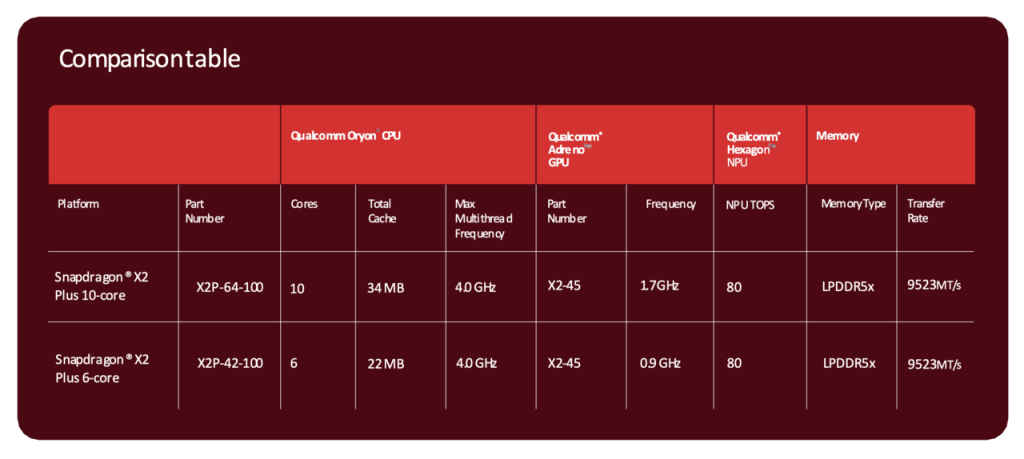
Both chips run an Adreno X2-45 GPU, which looks great on paper, but obviously there’s a slight difference between the two. Their individual clock speeds tell you which one’s meant to play nicer – the 10-core part goes up to 1.7-GHz, while the 6-core version drops to about 0.9-GHz.
If you were hoping “Plus” secretly means “budget gaming beast,” this is Qualcomm gently taking your hand and guiding you away from that thought. But apart from that everything else is expected to be rosy on laptops sporting the Snapdragon X2 Plus, at least on paper.
The big headline here is of course the fact that both chip variants of the Snapdragon X2 Plus sport the same integrated Hexagon NPU rated at 80 TOPS (INT8). Qualcomm is betting that in 2026, “AI PC” isn’t a sticker – it’s whether your laptop can do heavy on-device work (vision, transcription, generative features) without draining the battery super fast or bouncing everything to the cloud.
Memory support is also unapologetically ambitious for this tier: up to 128GB of LPDDR5x-9523 (with a 128-bit bus and 152GB/s bandwidth). But with the AI-induced memory woes, it remains to be seen how laptop OEMs finally decide to package the requisite RAM for the Snapdragon X2 Plus variants.
In terms of pure performance of these new Snapdragon X2 Plus variants, Qualcomm is currently comparing everything to the previous Snapdragon X Plus generation. The company claims up to 35% faster single-core CPU performance, with multi-core gains peaking at 17% on the 10-core model (and 10% on the 6-core). Similarly, GPU uplift depends on Adreno SKU, with gains pegged up to 29% on the 10-core chip and up to 39% on the 6-core.
Not to forget the all important battery performance claims, Qualcomm says the Snapdragon X2 Plus can use up to 43% less power than the prior generation, while still chasing “multi-day battery life.” It’s the same philosophy that’s defined Snapdragon laptops so far – sustained performance on battery, not a sprint followed by an unplugged collapse.
Snapdragon X2 Plus vs X2 Elite: Key differences explained
Make no mistakes, the Snapdragon X2 Elite (announced September 2025) is still the “bigger engine” family. Qualcomm’s own product brief shows Elite parts scaling up to 18 cores and 53MB cache, with higher-tier Adreno X2 GPUs (X2-85 / X2-90) running up to 1.70–1.85GHz. That’s the obvious additional headroom X2 Plus doesn’t chase – especially when the 6-core X2 Plus variant drops its GPU clock to 0.9GHz.
With respect to the NPU and AI is where the gap narrows between the two, based on numbers Qualcomm has shared at CES 2026. The Snapdragon X2 Plus stays at 80 TOPS, while the Elite lineup ranges 80–85 TOPS depending on the SKU. In other words, Qualcomm isn’t treating on-device AI as a luxury feature – it’s trying to make it a baseline across the stack. This is great for relatively lower-priced Snapdragon laptop buyers, especially in a price sensitive market like India.
And yes, pricing “swim lanes” matter. Qualcomm has suggested Plus laptops belong around the $800+ tier, with Elite higher. We’ll have to wait and see the launch price of laptops sporting the Snapdragon X2 Plus here in India, let’s hope Qualcomm and its OEM partners are aggressive in their pricing and make X2 Plus laptops really affordable for Indian consumers.
Also read: Security to sensing: Three key Snapdragon X2 Elite highlights on Windows business laptops


