

Wi-Fi 8 will work in India without 6-GHz access, Intel explains how
 Follow Us
Intel says Wi-Fi 8 prioritizes reliability over speed for real-world performance
Multi-AP coordination and smarter power use boost stability dramatically
Works well even without 6 GHz, fitting India’s spectrum reality

Attending an Intel technical deep dive on Wi-Fi 8 seemed strange, especially when I’m still waiting to experience and enjoy Wi-Fi 7 to its fullest in India. Even though devices supporting Wi-Fi 7 have started selling in India, the 6-GHz spectrum – the bit that really matters for Wi-Fi 7 – remains locked behind regulatory doors.
 Survey
So the idea of discussing Wi-Fi 8, the next-next standard, sounds almost like reading the sequel to a book we haven’t gotten the first copy of. But Wi-Fi 8 is built differently, according to Intel Fellow Dr Carlos Cordeiro, as it’s not just a speed bump. In fact, it’s the first Wi-Fi generation that doesn’t really care about breaking “gigabit barriers” altogether, focusing on making your Wi-Fi more consistent, predictable, and wired-like. And that’s precisely why it matters for India.
Not faster, but smarter: The Wi-Fi 8 mantra
According to Dr Carlos Cordeiro’s Intel whitepaper on the technical outlines of Wi-Fi 8, the IEEE’s ongoing work on the 802.11bn standard, the task group has set three deceptively simple goals:
• 25% better throughput (especially at range)
• 25% lower latency
• 25% fewer dropped packets
They sound like spreadsheet metrics, but the real-world translation is going to be immediately visible and translate to smoother streaming, more responsive gaming, and fewer “hello? hello?” moments on video calls.
Wi-Fi 7 might give you 50 Mbps in your faraway bedroom, but Wi-Fi 8 wants to give you 65–70 Mbps and keep it stable. It wants your network to degrade gracefully instead of collapsing the moment you step behind a concrete wall, points out Dr Cordeiro.
This shift reflects a broader philosophical turn. As Intel Fellow Dr Carlos Cordeiro puts it, devices today waste enormous energy simply waiting for something to happen. “Devices spend 50% of their time just listening. We’re going to be able to significantly reduce that.”
In other words, Wi-Fi 8 doesn’t just talk faster, but it thinks better as well. That’s important because the next decade of devices – from AR glasses to AI-enhanced collaboration apps – depend on reliability more than sheer top speed. Wi-Fi 8 is deliberately built for that world.
Wi-Fi 8’s key technical highlights
According to Dr Cordeiro, three major ingredients define how Wi-Fi 8 gets there eventually in terms of delivering on the three simple goals mentioned above.
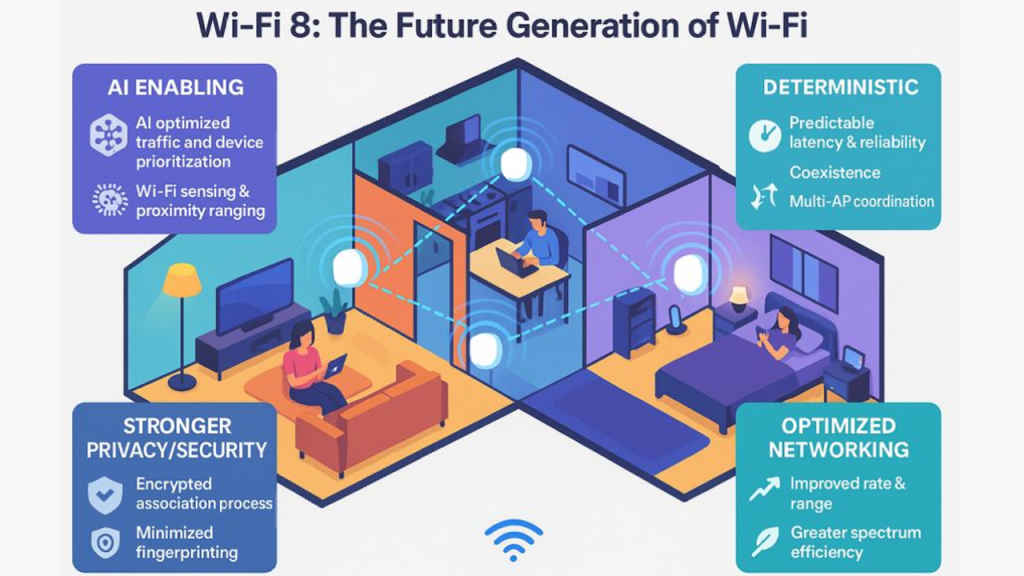
1. Multi-AP coordination: Your access points stop behaving like rivals fighting for spectrum and start acting like a coordinated team. Cordeiro explains it through, “coordinated beamforming… multiple access points can talk to each other on a more real-time basis to nullify interference.”
For India’s congested apartments – where your neighbour’s router is basically a roommate – this might be the single biggest upgrade.
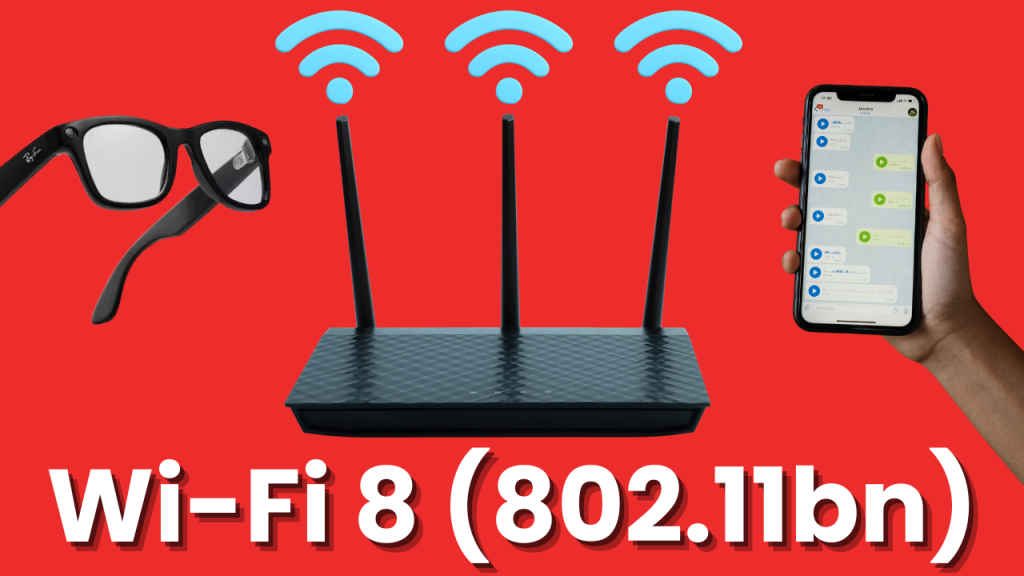
2. New power models for new devices: Many emerging devices – wearables, sensors, mixed-reality glasses – live on tiny batteries. Wi-Fi 8’s multi-link power management lets devices coordinate power states across different bands. Cordeiro addresses the paradox quite well, “There’s no free lunch… if you want to do sensing, you have to consume some power. But the net overall power consumption is going to be much lower.”
This is why Wi-Fi 8 isn’t just a home-router story, but a story about glasses, earbuds, IoT sensors, factory robots, and the invisible mesh of devices we’ll soon surround ourselves with in the near future.
3. Reliable roaming: One of Wi-Fi 8’s most user-visible improvements will be roaming between access points without hiccups. Mesh networks today often feel like three different routers pretending to be one. Wi-Fi 8 wants to eliminate that illusion entirely, emphasises Dr Cordeiro.
Wi-Fi 8 will work in India, despite 6-GHz restriction
There’s another reason Wi-Fi 8 feels almost tailor-made for India, because it’s designed to work even in countries that don’t allow 6 GHz spectrum. “Look, I’m going to be honest here. I don’t think that becoming mandatory is going to happen,” Dr Cordeiro said when asked if Wi-Fi 8 will have 6-GHz spectrum as mandatory..
Just like India hasn’t allowed 6-GHz spectrum for commercial, third-party use, Cordeiro points out that markets like China have the same restriction, which means Wi-Fi 8 simply can’t depend on 6-GHz being universally available.

That means India won’t be locked out. Wi-Fi 8 routers and devices will cover Wi-Fi 5/6/7 bands while delivering most of the new benefits. That means expect better interference management, more consistent performance in crowded areas, smarter mesh behaviour, and improved battery efficiency.
And when is Wi-Fi 8 expected to arrive? According to Dr Cordeiro, “The expectation is that certification is going to be available by the end of 2027… in about two years.” Intel, he notes, aligns launches with certification for maximum interoperability, because as he says, “We want to avoid any problems in the market.” That likely puts the first Wi-Fi 8 laptops and routers in India around 2028, while smartphones might start to arrive with certified Wi-Fi 8 chips in them by the end of 2027 at the earliest.
Wi-Fi 8’s promise for India
For everyday users, Wi-Fi 8 promises something deceptively simple: Wi-Fi that “just feels better.” Higher speeds in more corners of your home. Fewer dead zones. Less jitter. Fewer Bluetooth glitches. Longer battery life. Devices smart enough to wake up only when needed.
For gamers, this is the biggest wireless leap since Wi-Fi 6 introduced OFDMA. For AI workloads, it’s a stabilizing force. For India’s spectrum-starved homes, Wi-Fi 8 is a quiet blessing.
Wi-Fi 7 might still be waiting at the gate, but Wi-Fi 8 represents something bigger: the moment wireless stops showing off – and starts growing up. It’s still early days, but already it feels like the Wi-Fi generation built not just for benchmarks, but for the messy, crowded, concrete-walled, interference-heavy reality that millions of urban Indians live in. And I can’t wait to give it a try, just have to wait for a couple of more years.
Also read: Wi-Fi surveillance: Your router can identify you without devices, warns study


