
 E-Magazine
Microsoft MAI Code 2 explained: Does it stack up against Claude Code and Codex
GitHub is owned by Microsoft, and it is funded by OpenAI; however, they have now created their own code model which is way cheaper. The performance of MAI Code 2 is 96% of Claude Opus 5.5 but is 5% of Claude Opus 5.5, and it is 98% of GPT 6.1 Sol at 40% of its price. Can you believe this? Frontier code at such low prices. It has been recently launched by Microsoft on the 17th of November along with its sister model MAI Code 2 Flash on GitHub Copilot. Will it replace Claude Code/Codex? Not really, let us find out why.
Wrong fight, right question
Claude Code and Codex are the agents. The MAI Code 2 model is the competitor. And the comparison will be made here between the engines that are hidden underneath all of it - Opus 5.5 and GPT 6.1 Sol, which is the focus of Microsoft's chart. The other limited preview product by Microsoft Foundry is Code 2 Flash, but both models are soon to be available on Open Router, Vercel, Hermes, Open Code and Kilo.
Benchmark numbers are calculated from four benchmarks: DeepSWE 1.1, Terminal Bench 2.1, SWE-Atlas and FrontierCode v1.1. Three of them were tested via MSBench, Microsoft's internal benchmarking tool with the use of GitHub Copilot CLI without any subagents. That is critical because subagents enable Claude Code and Codex to split large tasks into several pieces. If turned off, it gives you an idea of the raw performance of the model rather than the convenient service provided by developers. And the third aspect is the price. The price of MAI Code 2 is promoted in Microsoft's chart at 50% discount rate. After the discount period expires, 5% won't be 5% anymore.
Not for a month-long refactor
Microsoft has been forthright about the scope. MAI Code 2 will be used to do the routine tasks in the enterprise, which implies production code, debugging, file editing, and reasoning, as well as UI design. MAI Code 2 certainly won’t be used for basic science discoveries or agentic actions with a long horizon.
It’s precisely the sort of task that Claude Code and Codex were built to do. Give an agent a difficult task and allow it to proceed without any intervention from your side. Based on appearance, MAI Code 2 seems to have some justification. In blind reviews by 258 annotators, it beat GPT-6 Sol 67% of the time.
Flash is the quiet star
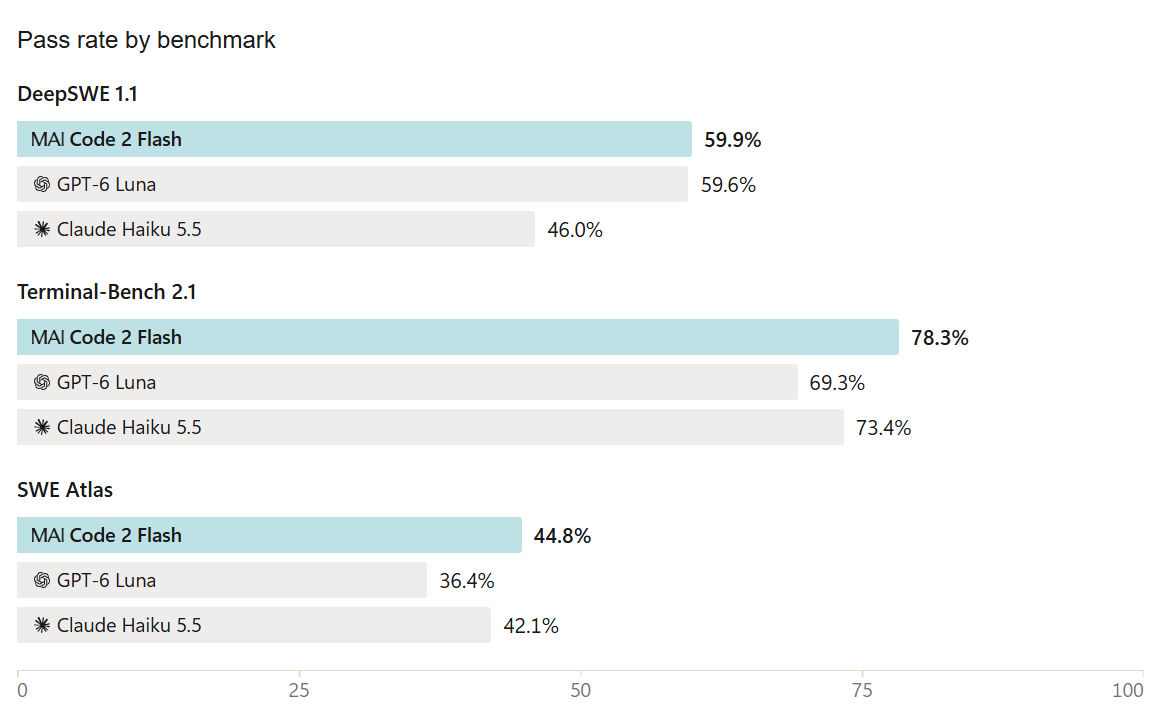
Code 2 Flash manages complex jobs such as code interpretation and specific corrections. As Microsoft claims, there is parity in performance levels with GPT-6 Luna and Claude Haiku 5.5 at 65% and 20% lower costs, respectively, due to promotional pricing. If you own a dev company in India sending hundreds of small tasks every day, these numbers are more important for you than any benchmarks.
Have a look into details, and you'll see that it's not only for programmers. MAI Work Flash, the descendant of Code 2 Flash, was designed to work on Excel, PowerPoint, Word, Teams and Fabric IQ. As stated by Microsoft, there is parity in performance with GPT 6 Luna on Excel and PowerPoint, and 42% fewer input tokens per request when comparing GPT 6.1 Sol to GPT 6 on Word. Cheaper models let Microsoft reduce its dependence on partners.

Vyom Ramani
Vyom Ramani A journalist with a soft spot for tech, games, and things that go beep. While waiting for a delayed metro or rebooting his brain, you’ll find him solving Rubik’s Cubes, bingeing F1, or hunting for the next great snack.
View full profile