
 E-Magazine
GPT 6.2 Sol and Astra explained: How do they improve on GPT 6.1 and 6
Two models have been released simultaneously by OpenAI, and the names alone require a flowchart. GPT-6.2 Astra will be your advanced model for the toughest tasks. GPT-6.2 Sol is the more affordable option for day-to-day work. They both boast improved performance in terms of fewer output tokens, which means that the AI industry now talks less and thinks more. However, the comparison of 6.1 is a little bit more complicated than just mentioned above, as only one of two 6.1 models made its way to you. What has changed, what became more affordable, and what was admitted by OpenAI?
The 6.1 mix-up
Firstly, address the uncomfortable part. The launch of GPT-6.1 Astra that was supposed to occur in October had to be canceled due to the internal tests showing its poor performance with respect to scope and authorization limitations; meanwhile, GPT-6.1 Sol became independently released at DevDay. Thus, Sol 6.2 has an official 6.1 brother to compete with. Astra 6.2 does not have one. It is compared to GPT-6 Astra, meaning that two versions are involved in the progression.
What Sol gets
The Sol model is the one most of you will use, so it counts much more. For the LifeVal benchmark, which measures proficiency in hard-to-complete practical tasks proposed by OpenAI, Sol 6.2 performs 5.3 points better than its predecessor Sol 6.1 and outperforms the GPT-6 Astra model with almost one-seventh of the cost. Pay attention to that.
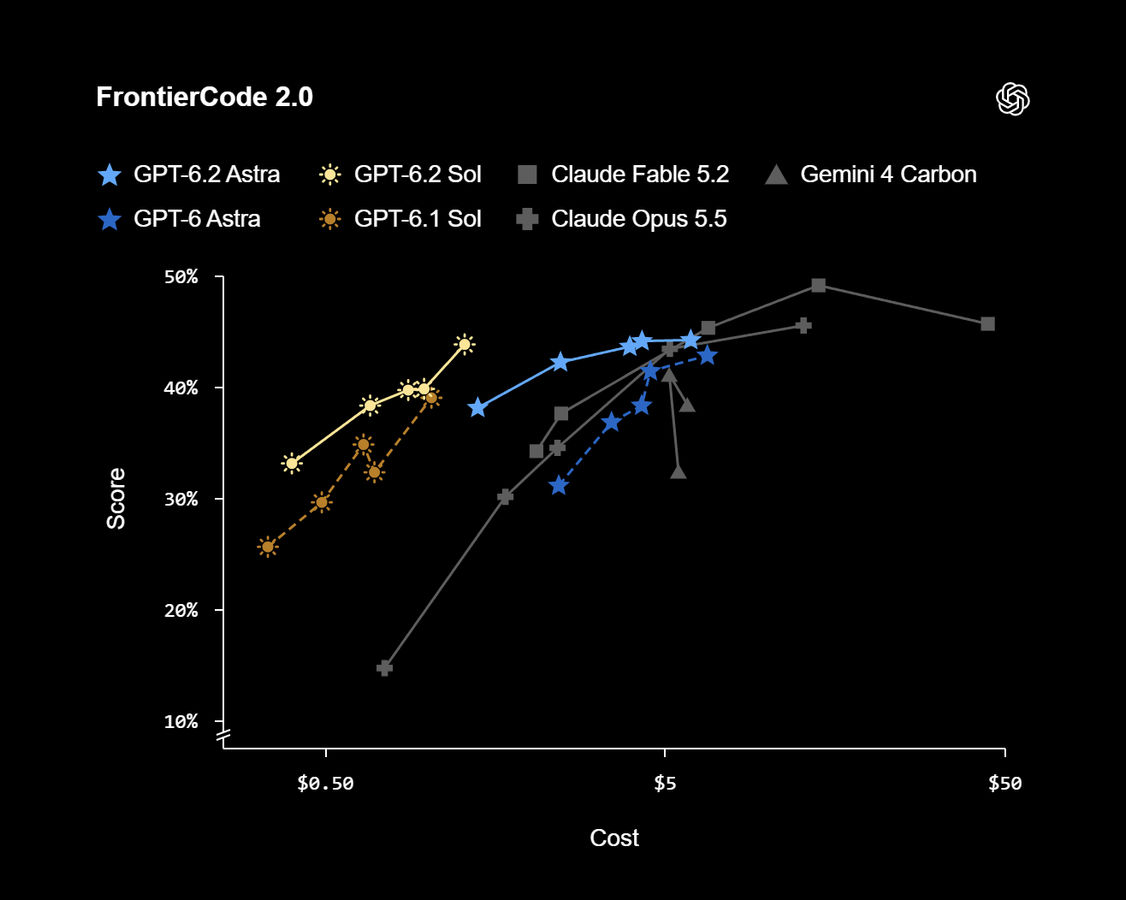
As for the FrontierCode 2.0 benchmark in coding developed by the Cognition AI, Sol is only 0.5 points worse than the Astra 6.2 model at one-fifth of the price. The cost remains the same ($2 for one million input tokens and $10 for one million output tokens), and OpenAI states that users can do more work under the same plan as Sol 6.1.
What Astra gets
Astra is the heavy lifter, setting a new benchmark in Agents' Last Exam, a multi-step professional assignment test, with 5.2 points over GPT-6 Astra at less than one-third the price. In the LifeVal test, it beats the competition by 6.2 points with 22% lower output tokens. Astra scores an increase of 9 points in Terminal-Bench-Science 0.1, and it is the best model in the world for scientists according to OpenAI.
The next is the counter swipe, where on Harvey LAB-AA, a legal assignments test, Astra has beaten the pass rate of Anthropic's Claude Fable 5.2 by more than double at roughly one-sixth the price. Consider all of these as vendor figures until independent tests come out.
Office work gets attention
The practical improvement is mundane and good. Astra was designed to generate slides, spreadsheets, and documents using the standards of disciplines like law, sales, finance, and accounting. Give it a sample document, and it will reproduce the same layout, colors, and typefaces including the exact font size.
Accounting AI company Basis states that its mean time for long-horizon tasks decreased 50%, with its complex tasks seeing an improvement of up to 73%. Anyone who has ever had to fix a deck at 11pm because the AI used the wrong font knows why that's important.
Price and access
Astra charges $8 per million input tokens, 40 cents for cached input and $40 per million output tokens, receiving a 20% discount on top of GPT-6 Astra. This discount will go directly into the margins of developers from India paying OpenAI in dollars.
Both models are available for Plus, Pro, Enterprise and Edu users on ChatGPT Work and Codex, and through the API, requiring an administrator to enable them for Enterprise and Edu users. Both models satisfy the Critical standard of cybersecurity within the Preparedness Framework of OpenAI, so they come with increased security features that OpenAI claims also hinder some legitimate vulnerability testing. Astra is the first external OpenAI model to satisfy the High standard of self-improvement of artificial intelligence.
In two tests of alignment, the new models had a higher probability of not mentioning any obstacle like a non-existent file compared to GPT-6 Astra. OpenAI introduced additional instructions for Codex, reducing the gaps and conducting further investigation.

Vyom Ramani
Vyom Ramani A journalist with a soft spot for tech, games, and things that go beep. While waiting for a delayed metro or rebooting his brain, you’ll find him solving Rubik’s Cubes, bingeing F1, or hunting for the next great snack.
View full profile