
Meta memo claims Avocado AI better performing than Llama 4 models
 Follow Us

Just months after the rollout of Llama 4, Meta is already preparing to move past it. According to a recent report by The Information, an internal memo from Meta’s elite Superintelligence Labs (MSL) reveals that the company’s next-generation AI model, codenamed “Avocado,” is significantly outperforming the Llama 4 series in both power and efficiency.
 Survey
The memo, authored by MSL Product Manager Megan Fu, describes Avocado as Meta’s “most capable pre-trained base model to date.” This internal update signals a massive shift in Meta’s AI strategy as it looks to reclaim the lead from rivals like OpenAI and Google.
Also read: Meta’s new AI model is called Avocado: Everything we know about it so far
A “10x win” over Llama 4
The most striking detail in the leaked memo is Avocado’s efficiency. Internal testing shows that Avocado achieved 10x compute efficiency “wins” on text-based tasks compared to Llama 4 Maverick, which was previously Meta’s flagship high-performance model.
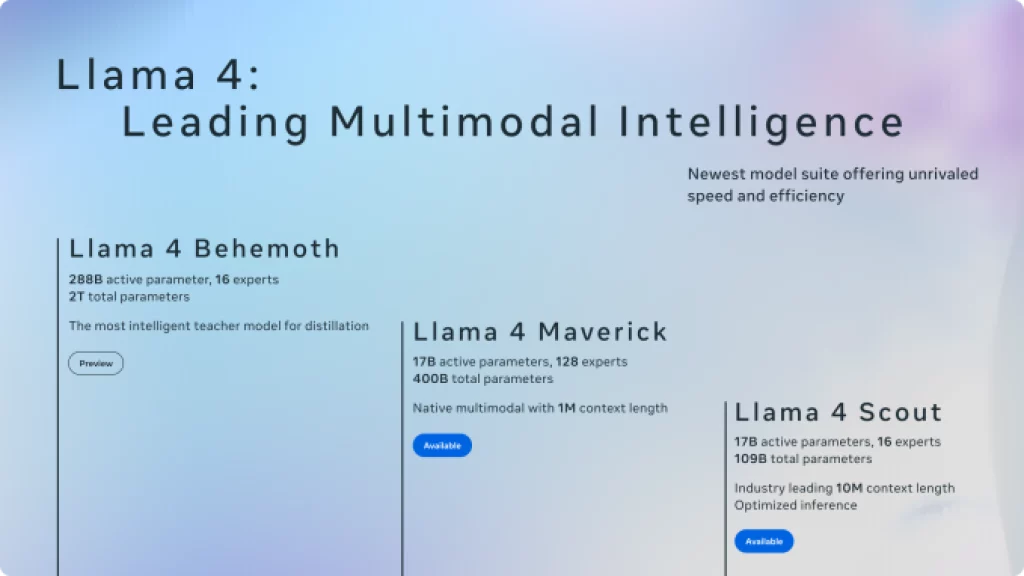
Even more impressive is the comparison to the delayed Llama 4 Behemoth. The memo claims Avocado is over 100 times more efficient than Behemoth, suggesting that Meta’s new Superintelligence Labs has found a way to deliver “frontier-level” performance without the massive compute costs that plagued earlier projects.
Superintelligence labs: The team behind the pivot
The development of Avocado is the first major milestone for Meta Superintelligence Labs, a dedicated unit formed by Mark Zuckerberg in 2025. Led by Alexandr Wang (founder of Scale AI), the lab was created to move Meta beyond the “Llama era” and toward AGI-level reasoning.
While Llama 4 focused on native multimodality and “Mixture of Experts” (MoE) architecture, Avocado appears to be a ground-up rebuild. According to the memo, Avocado has completed pre-training. It is already outperforming leading open-source models in knowledge and visual perception. Despite being a “base” model (not yet fine-tuned for specific tasks), it is matching the performance of models that have already undergone extensive optimization.
Also read: Sam Altman defends ChatGPT ads, calls Anthropic dishonest: Here’s what happened
The shift to “closed” AI?
For years, Meta has been the champion of open-source AI with the Llama series. However, the Avocado memo reinforces rumors that Meta is pivoting toward a proprietary or “closed” model strategy.
By keeping Avocado’s weights and architecture private, Meta could monetize the model through high-end enterprise tools and better protect its competitive edge. This shift reportedly contributed to the departure of Meta’s long-time AI chief, Yann LeCun, who remains a staunch advocate for open-source development.
What’s next for Avocado?
While Avocado is currently “finished” in its pre-training phase, it still needs to go through post-training and safety alignment before it’s ready for the public.
Meta is aiming for a first-half 2026 launch (likely Q1 or early Spring). Avocado (text/code) is being developed alongside “Mango,” a next-gen model focused on high-fidelity image and video generation. As Meta prepares for its next major release, one thing is clear: the Llama family is no longer the top priority. The future of Meta AI belongs to the “Superintelligence” projects.
Also read: OpenAI ignoring research, Sora and DALL-E, suggest people leaving ChatGPT maker


