Centaur bridges AI and psychology, offering scientists a virtual lab to test human decision theories
Unlike chatbots, Centaur simulates how we learn, adapt, and react in entirely new situations
With brain-like internal patterns, Centaur may be the closest AI yet to human cognition
In a major step forward for cognitive science and artificial intelligence, researchers at Helmholtz Munich have introduced Centaur, an AI system that can simulate and predict human behavior with a level of accuracy previously thought impossible.
 Survey
Developed by Dr. Marcel Binz and Dr. Eric Schulz at the Institute for Human-Centered AI, Centaur is being described as a “virtual laboratory for the mind.” Built on Meta’s Llama 3.1 language model and fine-tuned on a massive dataset of human decisions, it offers new ways to study cognition and raises important questions about how closely machines might one day resemble the human mind.


Also read: Meta and Mark Zuckerberg bet big on AI Superintelligence: Here’s how
A new kind of cognitive model
Psychologists have long wanted a tool that could do two things at once: explain how people think, and accurately predict how they’ll behave. Existing models were often limited to one or the other. Centaur changes that.
At its core is Psych-101, a dataset comprising over 10 million decisions from more than 60,000 people across 160 psychological experiments. These range from simple memory tasks to complex moral dilemmas. Every experiment was carefully standardized and rewritten in natural language so the AI could understand and learn from them. The result is an AI model that doesn’t just reflect past human choices, it can anticipate new ones.
Also read: Community Notes to fact-check: X becoming a playground for AI?
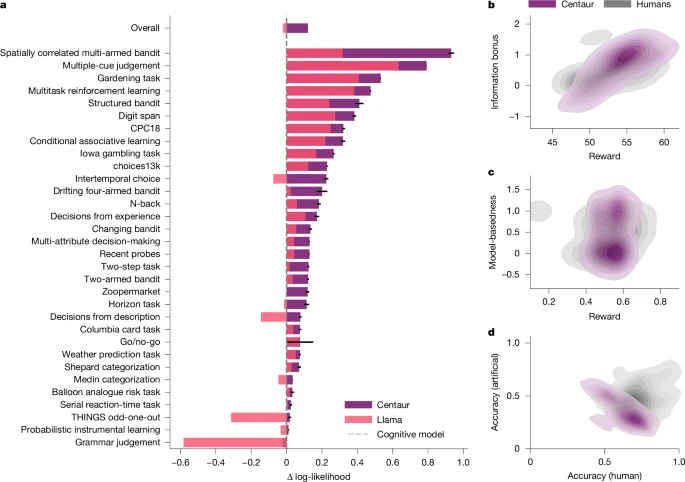
What sets Centaur apart is its ability to generalize. It can handle entirely new situations and still make surprisingly accurate predictions about how a person would behave. Change the scenario, swap the setting, tweak the instructions and Centaur adapts. In tests, it outperformed long-standing cognitive models, including those specifically designed to study individual tasks. It even predicted how long someone might take to make a decision, showing a level of insight into human behavior that goes beyond language.
One of Centaur’s most interesting discoveries came when researchers compared its internal representations to human brain activity. Without ever being trained on neural data, the AI’s behavior aligned with actual fMRI scans of people doing the same tasks. This suggests that in learning to model our decisions, Centaur developed a way of thinking that closely mirrors the computational structure of the human brain. Not just mimicking behavior, but echoing the way we process information.
Applications beyond psychology
Researchers believe Centaur could play a major role in fields far beyond psychology. In medicine, it could help model how patients with anxiety or depression make decisions. In education, it could inform personalized learning systems. In design and marketing, it might help companies understand how users would react to a new product or interface, before it ever hits the market. Both Centaur and the Psych-101 dataset have been made publicly available to encourage collaboration and transparency. The research team is already working to expand the dataset to include more diverse populations and broader psychological domains.
With this kind of predictive power, ethical considerations are front and center. The ability to model and anticipate human thought raises concerns around privacy, manipulation, and bias. The researchers have emphasized responsible use, hosting the model locally and promoting data sovereignty to protect user information.
They’re also clear-eyed about Centaur’s limitations. Its current strengths lie in learning and decision-making, but less so in areas like social behavior or cultural variability. And like much of psychology, the data it’s trained on is skewed toward Western, educated populations.
Centaur doesn’t offer a complete model of the human mind, but it brings researchers closer to that goal than ever before. It’s not just a powerful AI tool, it’s a system that reflects how we think, how we choose, and how we respond to the world around us. As it evolves, it could reshape not just how we study human behavior, but how we understand it.
Also read: Microsoft’s medical AI system is four times more accurate than human doctors: Here’s how
 Follow Us
Vyom Ramani
A journalist with a soft spot for tech, games, and things that go beep. While waiting for a delayed metro or rebooting his brain, you’ll find him solving Rubik’s Cubes, bingeing F1, or hunting for the next great snack. View Full Profile


