
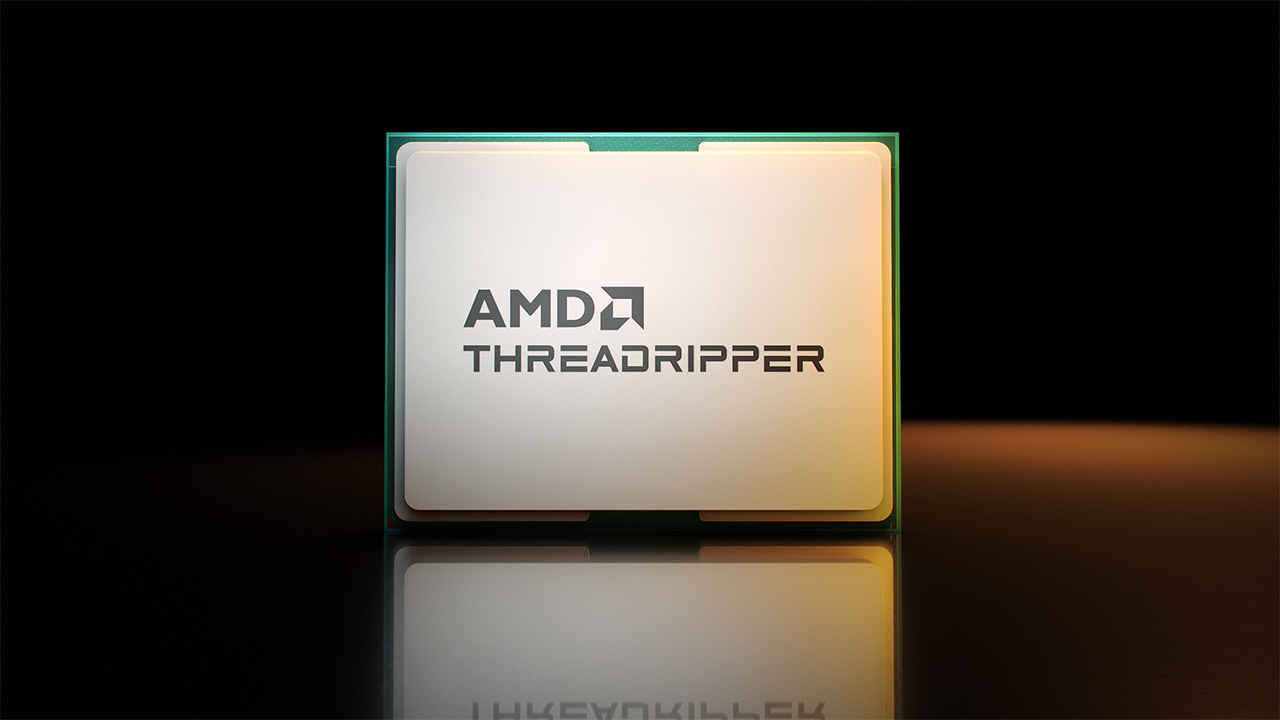
AMD’s Threadripper platform has long been the preferred solution for professionals who need desktop-class flexibility with workstation-class performance. The AMD Ryzen Threadripper 9970X carries that legacy forward with a 32-core, 64-thread configuration built on AMD’s latest Zen 5 architecture, manufactured on TSMC’s 4nm FinFET process. Slotted just below the flagship Threadripper 9980X (which we’ve also reviewed), this processor offers a compelling balance of raw compute power, high-frequency responsiveness, and platform flexibility that makes it ideal for a wide range of professional workloads.
Unlike the 64-core 9980X, which is built for relentless parallelism, the 9970X caters to creators and developers who require high performance across both single-threaded and multi-threaded workloads but without the power draw, thermal density, or cost associated with a full-core-count behemoth. At least, we hope that it has a lower power draw. Its higher base clock and identical boost clock allow it to shine in real-time workflows, simulation, and build environments where frequency and latency matter.
The 9970X runs on AMD’s TRX50 platform and offers access to quad-channel DDR5, up to 80 PCIe Gen 5 lanes, and full overclocking support. It’s a high-end desktop processor that remains flexible, approachable, and incredibly powerful in the right hands. For video editors, engineers, and software professionals working across large projects or pipelines, this chip presents a compelling upgrade path, one that delivers top-tier performance without crossing into overkill.
AMD Ryzen Threadripper 9000 + TRX50 Platform
The Ryzen Threadripper 9970X is built for AMD’s TRX50 platform, a high-end desktop ecosystem that strikes a balance between workstation-level performance and enthusiast-grade customisation. TRX50 has matured considerably since its introduction, and with the 9000 series, it continues to support an impressive set of features tailored to creators, engineers, and power users who need bandwidth, scalability, and control.
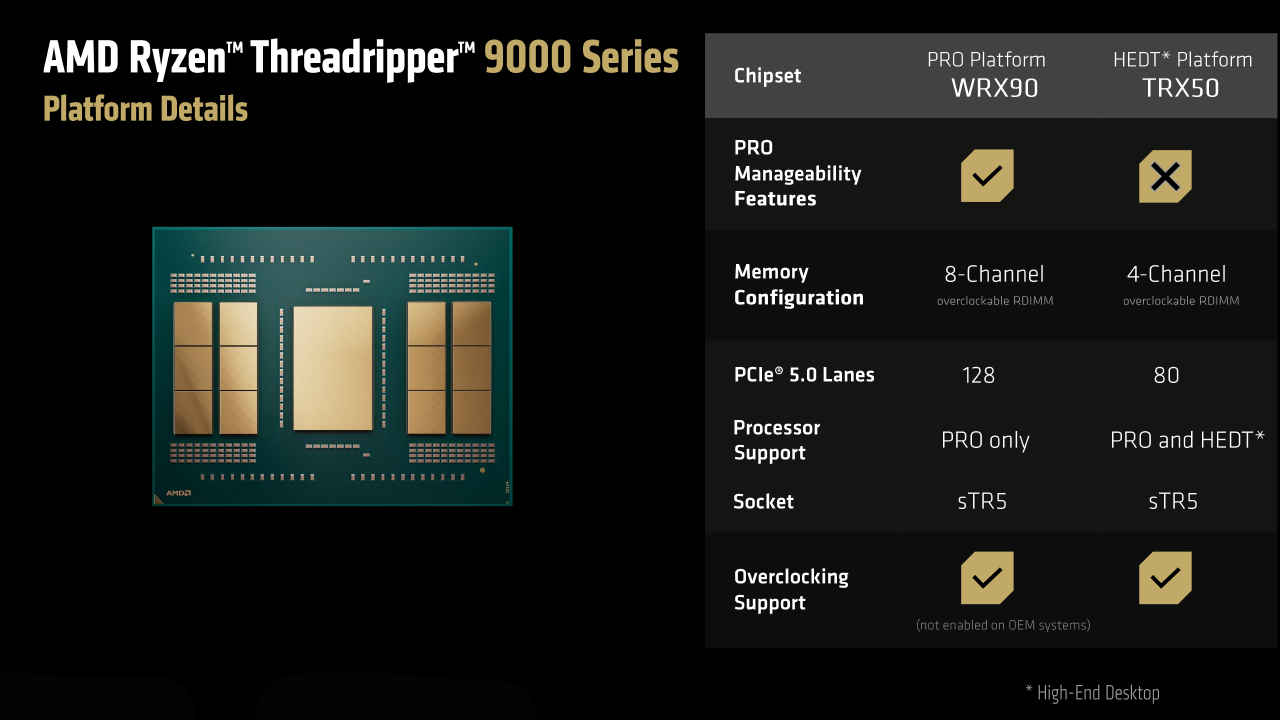
At the heart of the TRX50 platform is the sTR5 socket, which is shared with the WRX90 platform used for Threadripper PRO processors. While Threadripper PRO 9000 series CPUs can run on both WRX90 and TRX50 boards, standard 9000-series chips like the 9970X are exclusive to TRX50. This distinction allows AMD to offer users a more affordable and open-ended platform that’s free from enterprise-only features such as remote management and mandatory ECC validation, while still delivering core workstation-grade performance.
Memory support is one of TRX50’s key advantages. The 9970X supports quad-channel DDR5 RDIMM configurations with capacities of up to 1TB, assuming you populate the board with 256GB modules. The platform supports speeds up to DDR5-6400 using AMD EXPO profiles, and the memory controller operates in a 1:2 ratio, which ensures excellent stability at high frequencies. For professionals working with large simulations, 8K editing timelines, or VM-heavy development stacks, this kind of memory headroom is nice to have.
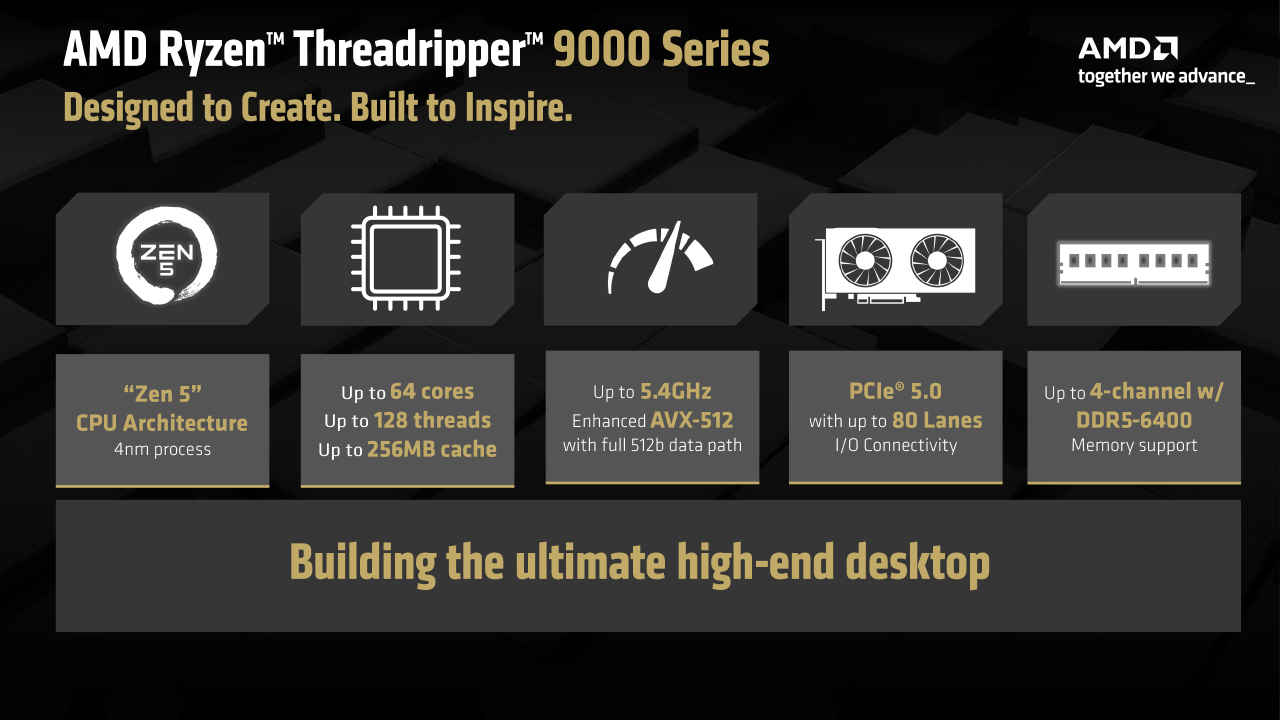
Then there’s the PCIe layout. TRX50 boards offer up to 92 PCIe lanes, 80 of which are PCIe 5.0 and routed directly from the processor. This makes multi-GPU rigs, fast storage arrays, and high-bandwidth I/O cards easy to deploy without worrying about bandwidth contention. The result is a platform that’s built to scale, whether you’re connecting dual RTX workstation GPUs for rendering, chaining together multiple NVMe SSDs for real-time playback, or installing high-speed networking cards for remote collaboration workflows.
What truly sets TRX50 apart, though, is its full support for overclocking. Unlike the WRX90 platform, where most OEM systems ship locked down, the TRX50 gives users access to Precision Boost Overdrive, Curve Optimiser, and full manual voltage and frequency control via BIOS or AMD Ryzen Master. For users who want to push their system beyond stock or fine-tune it for specific workloads, this level of control is a welcome addition.
Overall, TRX50 complements the 9970X in a way that feels purpose-built. It offers the connectivity, memory bandwidth, and tuning flexibility that HEDT users expect, while keeping platform complexity in check. Whether you’re a seasoned workstation builder or a developer stepping up from consumer-grade hardware, the TRX50 + 9970X pairing delivers a blend of performance and versatility that’s hard to beat.
AMD Ryzen Threadripper 9970X Specifications
With the Ryzen Threadripper 9000 series, AMD continues to refine its high-end desktop (HEDT) strategy by focusing not just on core counts, but also on architectural uplift, memory performance, and platform scalability. Built on Zen 5 and manufactured on TSMC’s 4nm node, the 9970X offers a 32-core design with full support for quad-channel DDR5, PCIe 5.0, and overclocking via TRX50. While it shares its platform DNA with the flagship 9980X, its configuration brings a different kind of appeal: high-end performance that doesn’t overwhelm your power budget or your thermal envelope.
| Specifications | 9980X | 7980X | 9970X | 7970X | 9960X |
| Architecture | Zen 5 | Zen 4 | Zen 5 | Zen 4 | Zen 5 |
| Cores / Threads | 64 / 128 | 64 / 128 | 32 / 64 | 32 / 64 | 24 / 48 |
| Base Clock | 3.2 GHz | 3.2 GHz | 4.0 GHz | 4.0 GHz | 4.2 GHz |
| Boost Clock | Up to 5.4 GHz | Up to 5.1 GHz | Up to 5.4 GHz | Up to 5.3 GHz | Up to 5.4 GHz |
| L2 Cache | 64 MB | 64 MB | 32 MB | 32 MB | 24 MB |
| L3 Cache | 256 MB | 256 MB | 128 MB | 128 MB | 128 MB |
| PCIe Lanes (5.0) | 80 | 48 | 80 | 48 | 80 |
| Memory Support | DDR5-6400 (Quad-Channel) | DDR5-5200 (Quad-Channel) | DDR5-6400 (Quad-Channel) | DDR5-5200 (Quad-Channel) | DDR5-6400 (Quad-Channel) |
| ECC Support | Yes | Yes | Yes | Yes | Yes |
| Overclocking | Yes (Unlocked) | Yes (Unlocked) | Yes (Unlocked) | Yes (Unlocked) | Yes (Unlocked) |
| TDP | 350 W | 350 W | 350 W | 350 W | 350 W |
| Socket | sTR5 | sTR5 | sTR5 | sTR5 | sTR5 |
| Boost Algorithm | Precision Boost 2 | Precision Boost 2 | Precision Boost 2 | Precision Boost 2 | Precision Boost 2 |
| Max Temp (TjMax) | 95°C | 95°C | 95°C | 95°C | 95°C |
While it doesn’t carry the brute force of the 9980X, the 9970X offers a better balance of frequency and core count for users whose workloads blend multi-threaded throughput with latency-sensitive tasks. The 4.0 GHz base clock (significantly higher than the 9980X’s 3.2 GHz) means the 9970X responds more quickly to burst workloads and stays closer to its boost ceiling during sustained performance.
It also maintains a healthy 128 MB of L3 cache and 80 PCIe 5.0 lanes, giving it the same platform-level flexibility as its more powerful sibling. Whether you’re using multiple GPUs, chaining together NVMe storage arrays, or working with large datasets, the 9970X is not meaningfully limited in any way that affects professional use.
In terms of audience, the 9970X is ideally suited for professionals working in software development, video editing, CAD design, and animation who want serious horsepower but don’t necessarily need 64 threads working in parallel. It’s also the more practical choice for users building high-performance desktops in thermally constrained environments. For many, this chip hits the sweet spot between overkill and underpowered as it delivers the core advantages of the 9000-series platform without the extreme demands of its flagship counterpart.
Threadripper Test-Rig configuration
To evaluate the real-world performance of the AMD Ryzen Threadripper 9980X, the test system was configured to eliminate any bottlenecks and reflect optimal conditions for high-end desktop workloads. AMD’s guidelines were followed closely, with the latest drivers, BIOS, and firmware updates applied.
- Processor: AMD Ryzen Threadripper 9980X
- Cooler: SilverStone XE360-TR5 (360 mm AIO)
- Graphics card: NVIDIA GeForce RTX 5090
- GPU driver: NVIDIA GeForce 577.0
- Motherboard: GIGABYTE TRX50 AERO D
- Memory: 128 GB DDR5-6400 EXPO RDIMM (4 x 32 GB)
- Storage: Crucial T705 1TB PCIe Gen 5 SSD
- Power supply: Corsair RM1200X Shift (1200W, ATX 3.0)
- Operating System: Windows 11 Pro, Version 24H2
- Power Mode: Best Performance
This setup represents a realistic yet high-performance environment for creators and power users. The combination of quad-channel DDR5-6400 memory and PCIe Gen 5 NVMe storage ensures that the CPU isn’t starved for bandwidth, while the RTX 5090 provides ample headroom for GPU-accelerated workloads.
Performance
Compression and synthetic workloads
This group of tests focuses on raw CPU throughput, multi-threaded scaling, and architectural efficiency in workloads that stress integer operations, cache latency, and memory bandwidth. These benchmarks are indicative of how the 9970X handles tasks like file compression, decompression, scientific parsing, and mathematical modelling which are core functions for many engineering, content creation, and software development workflows.
7-Zip Benchmark
The 7-Zip benchmark evaluates LZMA compression and decompression speeds using an inbuilt CPU stress test. It’s a highly scalable benchmark that tends to favour chips with strong multi-threaded execution and cache coherency.
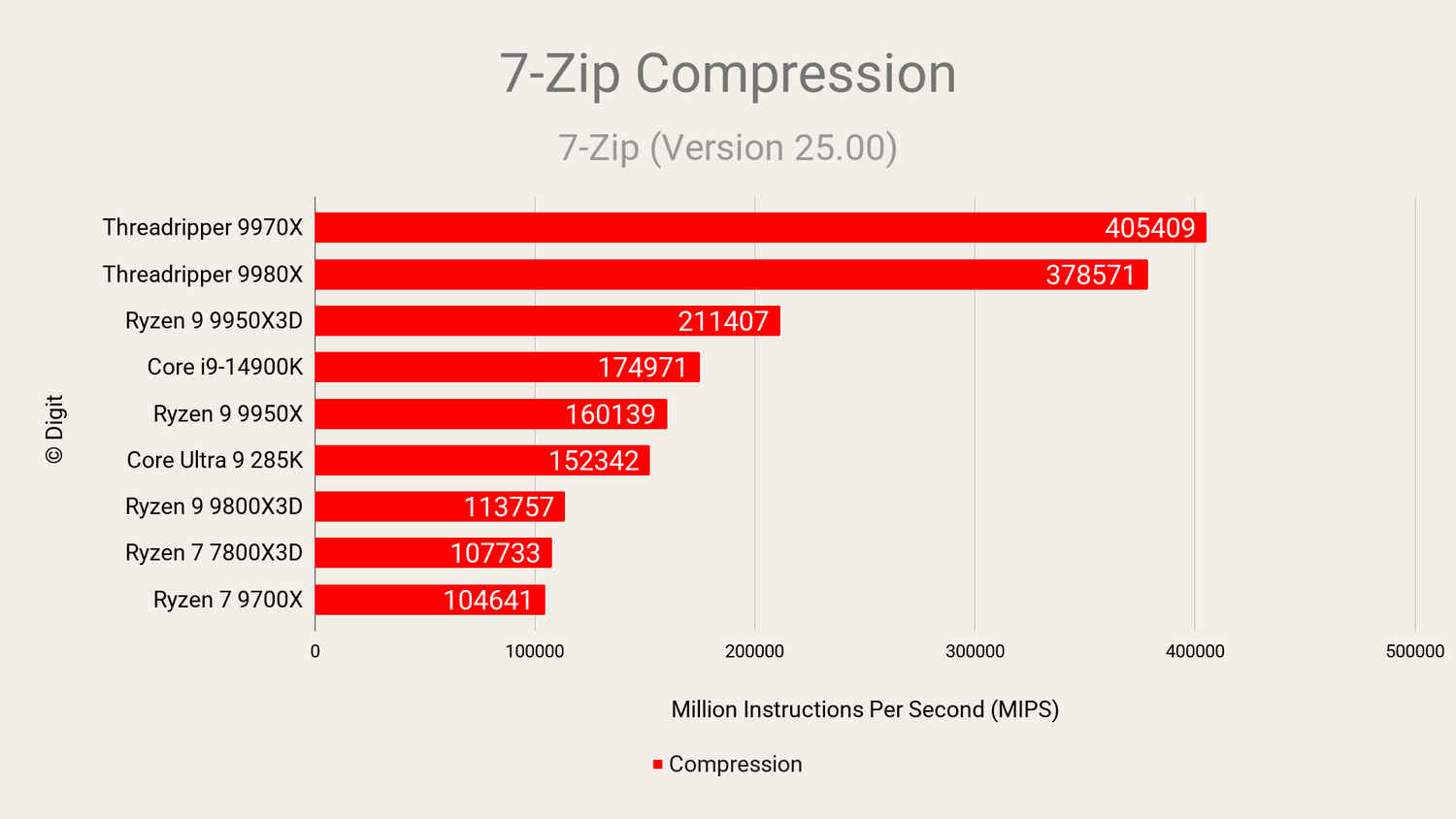
In this test, the Threadripper 9970X delivered 405,409 MIPS in compression and 510,336 MIPS in decompression. Compared to the Ryzen 9950X3D, which scored 263,357 (compression) and 211,407 (decompression), the 9970X came in slightly behind on raw throughput. That difference, however, is expected, considering the 9950X3D’s large 3D V-Cache advantage in decompression-heavy workloads.
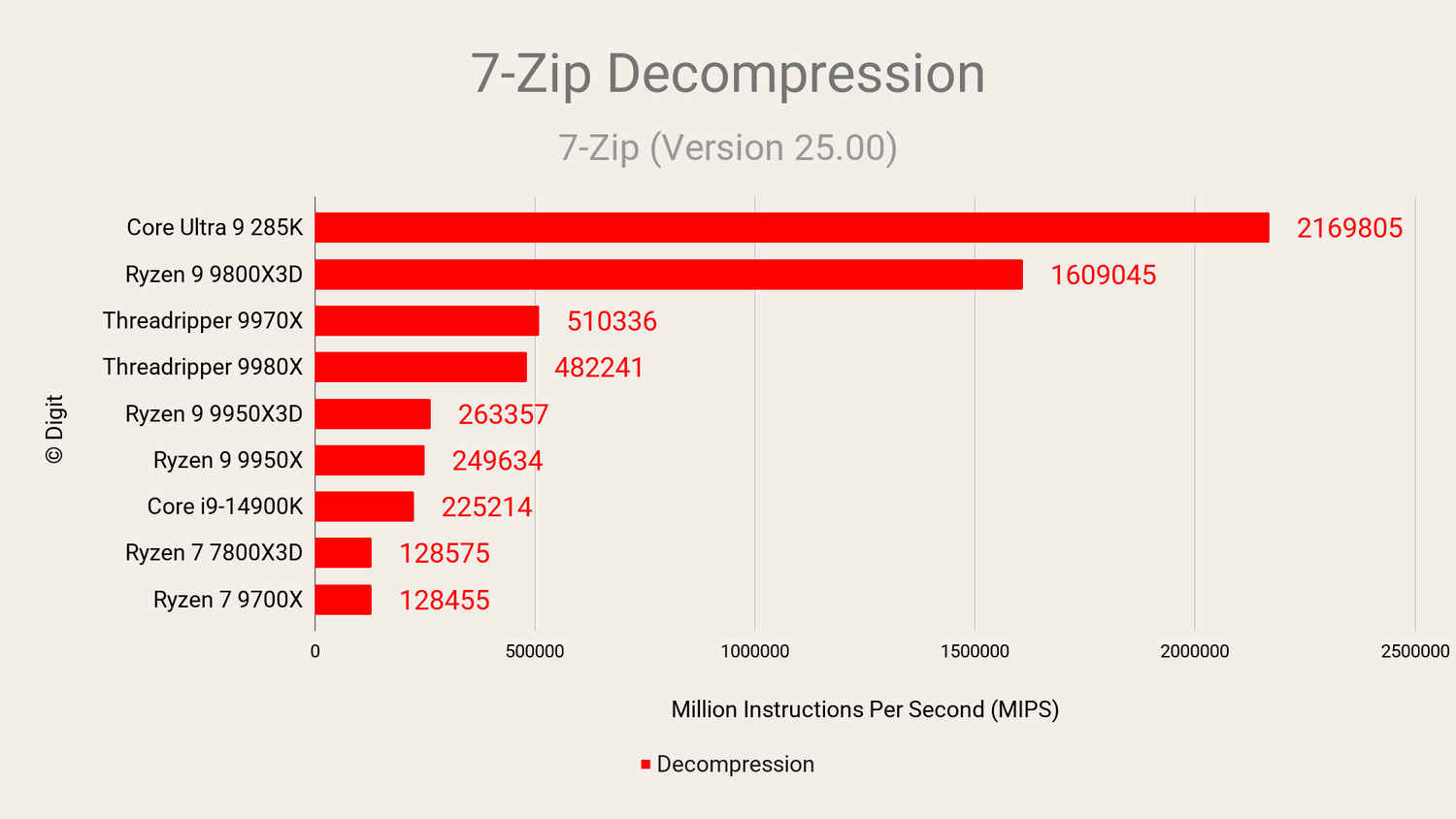
Despite this, the 9970X holds a meaningful edge in responsiveness. Compression times were faster on short, multi-part datasets thanks to its higher base clock, and the core-to-core latency advantage over the 9980X made small workload bursts more efficient. For users working with moderate-sized archives or automated batch compression in CI pipelines, the 9970X delivers excellent balance between speed and system responsiveness.
WinRAR Benchmark
WinRAR’s benchmark measures how quickly a CPU can handle real-world compression workloads, often involving single-threaded burst performance and memory throughput. While it’s not the best workload for large-core-count chips, it offers insight into IPC and cache hierarchy efficiency.
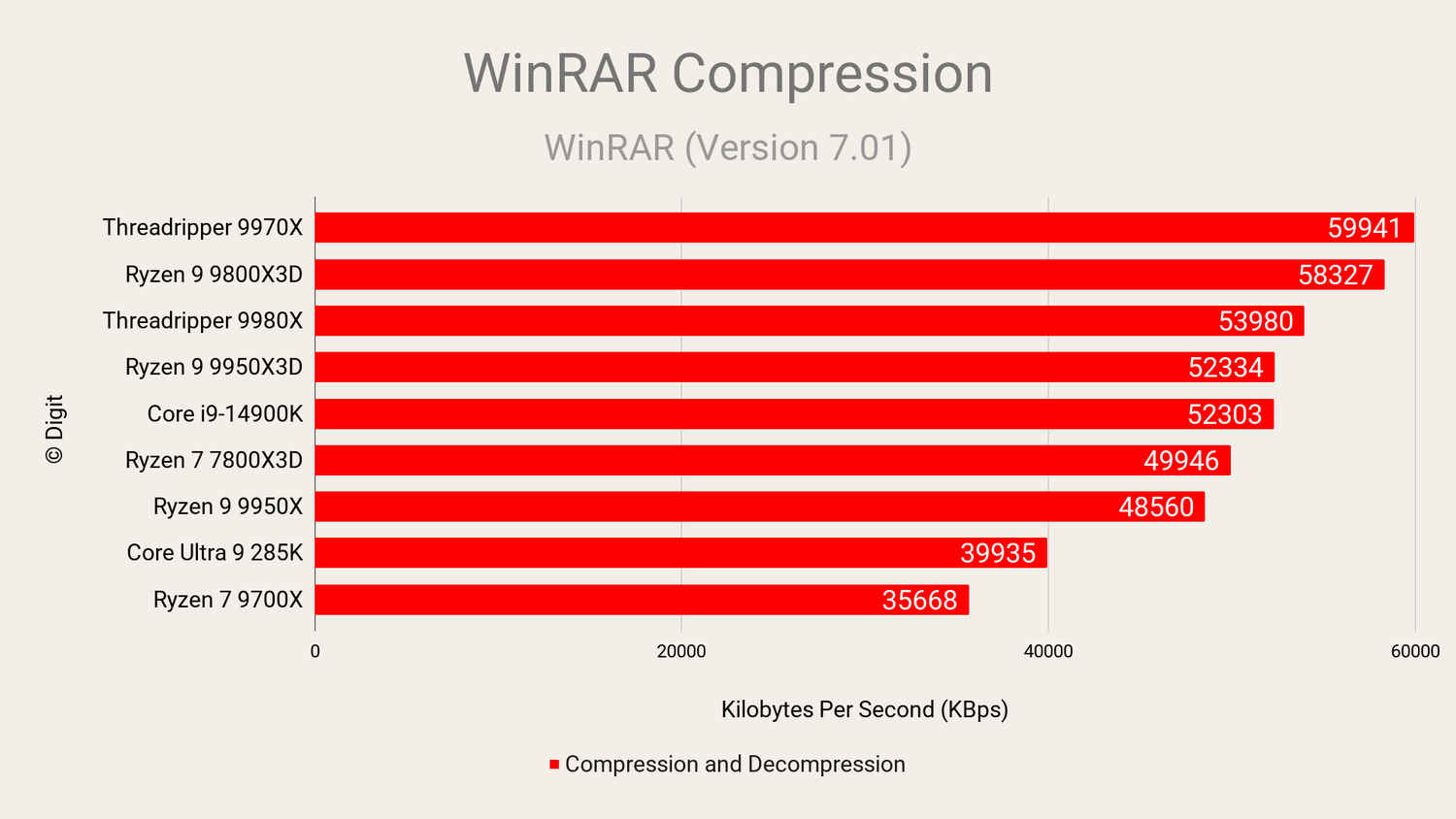
The Threadripper 9970X scored 59,941 KB/s, slightly ahead of the 9980X’s 53,980 KB/s and 9950X3D’s 52,334 KB/s. The margin may seem small, but it’s telling. With its higher clock speeds and leaner CCD topology, the 9970X avoids the cache latency and cross-CCD inefficiencies that start to show on 64-core parts in lightly threaded workloads. If you rely on WinRAR or similar tools in your post-production or archival workflow, this chip is as fast as HEDT gets. It’s barely short of dropping back down to consumer desktop parts with fewer cores.
Y-Cruncher
Y-Cruncher is a brutal multi-core benchmark that computes Pi to billions of digits using advanced integer and floating-point math. It pushes cache, memory bandwidth, and scheduling efficiency to the limit.
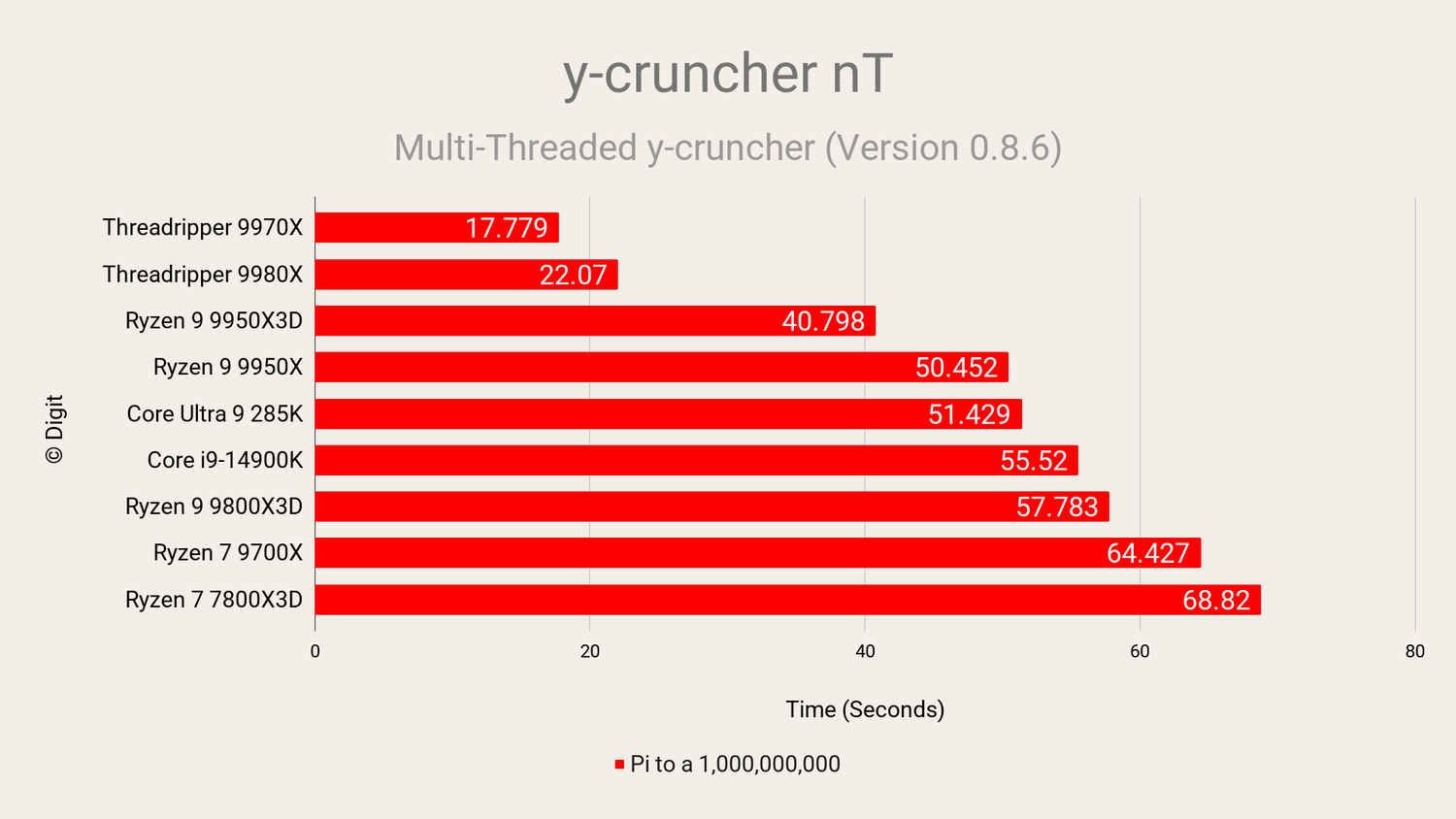
The 9970X completed the 2.5B digit test in 17.78 seconds, placing it ahead of the 9950X3D (40.80s) and not far behind the 9980X (22.07s). More interestingly, its single-threaded Pi calculation came in at 306.168 seconds, slightly outperforming the 9980X’s 325.377s and almost on par with the 9950X3D.
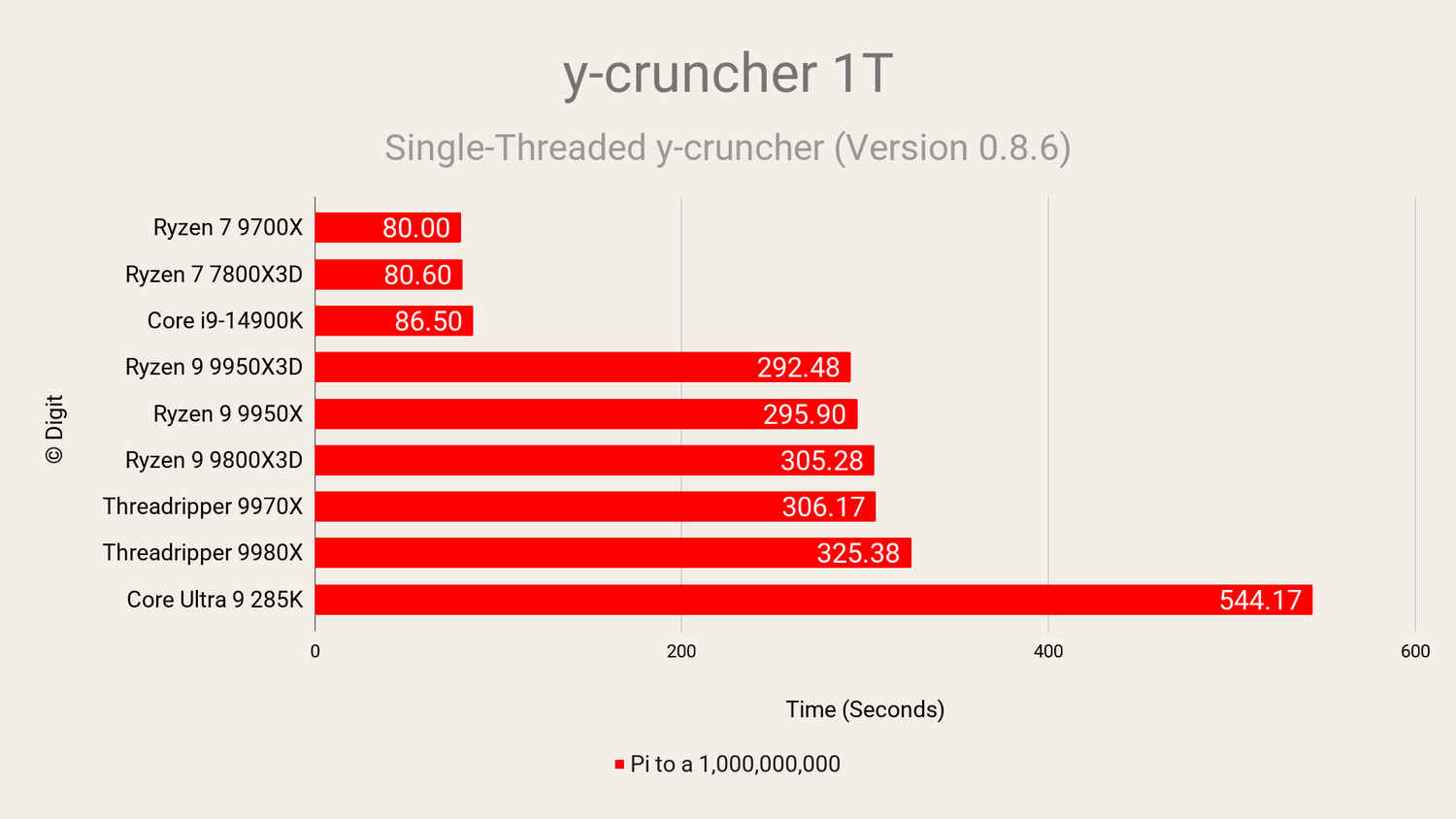
This shows that the 9970X’s strength lies in its hybrid core-count and frequency approach. It isn’t as fast as the 9980X in wide workloads, but its ability to maintain high clock speeds under sustained load makes it feel more agile. For anyone running algorithmic computations, heavy compiles, or numerical analysis in parallel, the 9970X offers excellent scaling without the higher power draw or thermal complexity of a 64-core design.
Encryption Algorithms
AIDA64 offers a suite of synthetic tests that isolate instruction set throughput and memory interactions. ZLib tests general compression speed, AES measures symmetric encryption, and SHA3 benchmarks hashing throughput. All are excellent indicators of architectural efficiency.
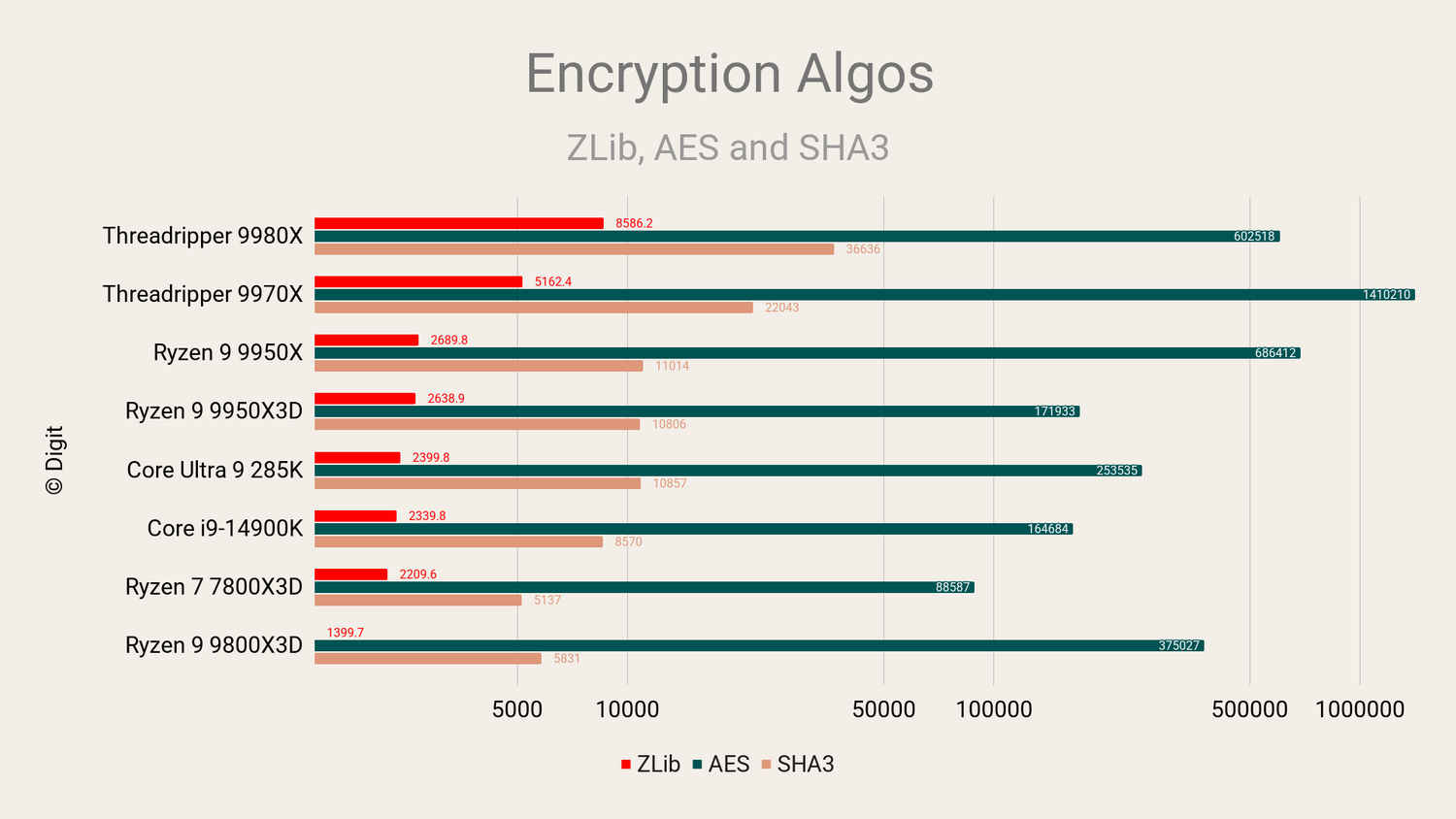
In ZLib compression, the 9970X achieved 5162, while in AES encryption it posted 1410210. SHA3 hashing came in at 22043. These results place it just behind the 9980X across the board, but ahead of the 9950X3D in both ZLib and SHA3. The real takeaway here is that the 9970X hits a sweet spot in bandwidth-heavy and instruction-diverse tasks. Security professionals, devops engineers, or software testers running encryption pipelines or VM deployment scripts will appreciate the consistent throughput across variable workloads.
Web-based scripting and browser performance
Although not a traditional stronghold for HEDT-class CPUs, browser benchmarks offer insight into how a processor handles low-latency, lightly threaded workloads. They’re especially relevant for developers working on modern web frameworks, Electron apps, or browser-based IDEs where script parsing, DOM handling, and in-memory compute speed all matter. For the 9970X, this is an opportunity to showcase its strong per-thread performance and turbo boost responsiveness.
Google Octane 2.0
Octane 2.0 is a JavaScript performance test developed by Google that combines a variety of workloads including 3D simulations, regex matching, and memory manipulation. It rewards high clock speeds, strong IPC, and low core-to-core latency.
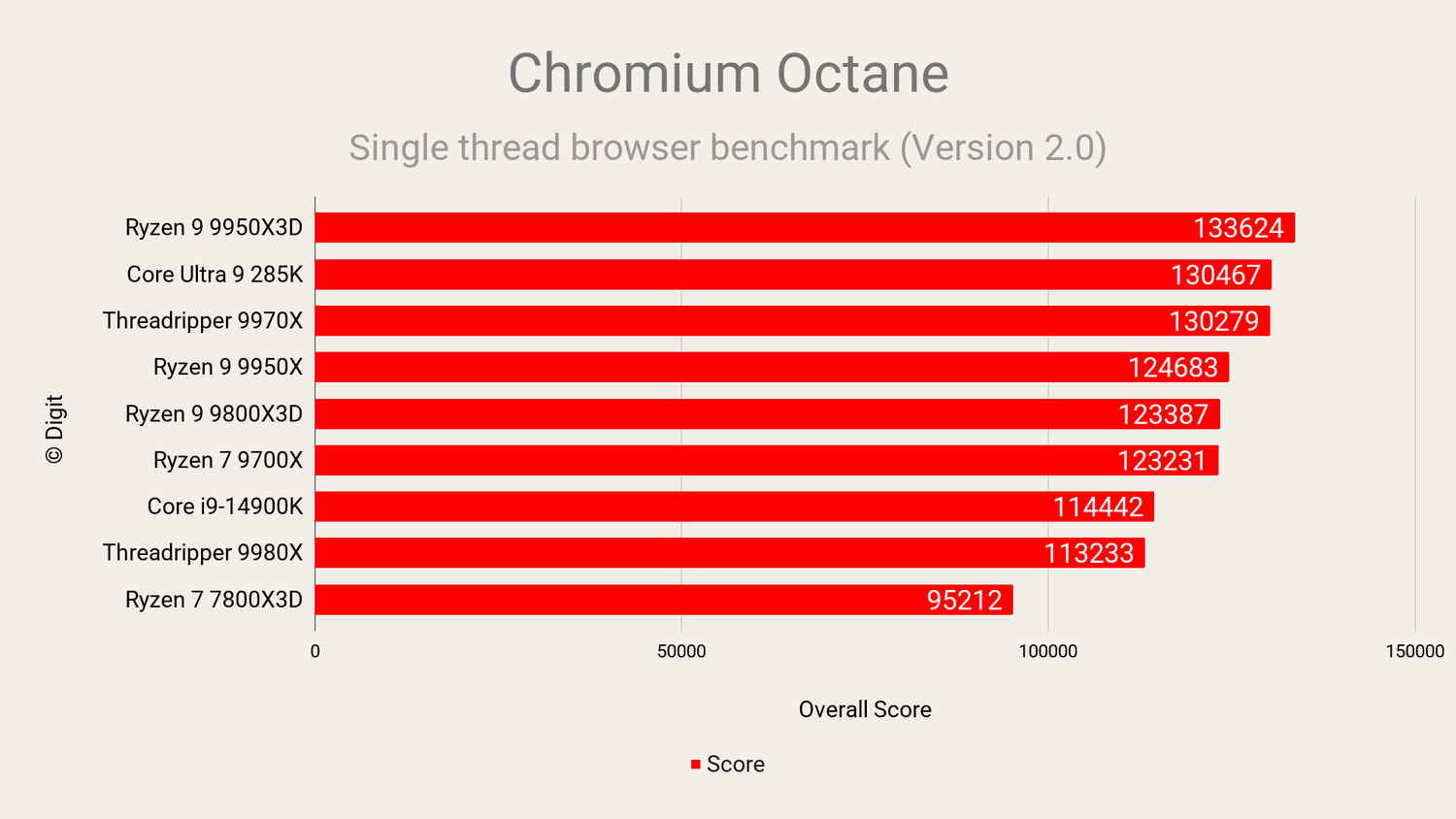
The 9970X posted a score of 130,279 points, which puts it marginally ahead of the 9980X and comfortably ahead of the 9950X3D. While the difference may seem incremental, it reflects the advantage of the 9970X’s higher base and boost clocks coupled with lower CCD overhead. For devs running local test servers or live-updating UIs in Chromium-based environments, this translates to faster compile cycles and a more fluid preview experience.
Mozilla Kraken 1.1
Kraken 1.1 is Mozilla’s JavaScript benchmark suite, designed to stress the browser’s handling of audio processing, image filtering, and cryptographic workloads. It reflects more real-world complexity than Octane and offers a good measure of how CPUs juggle thread responsiveness and memory bandwidth.
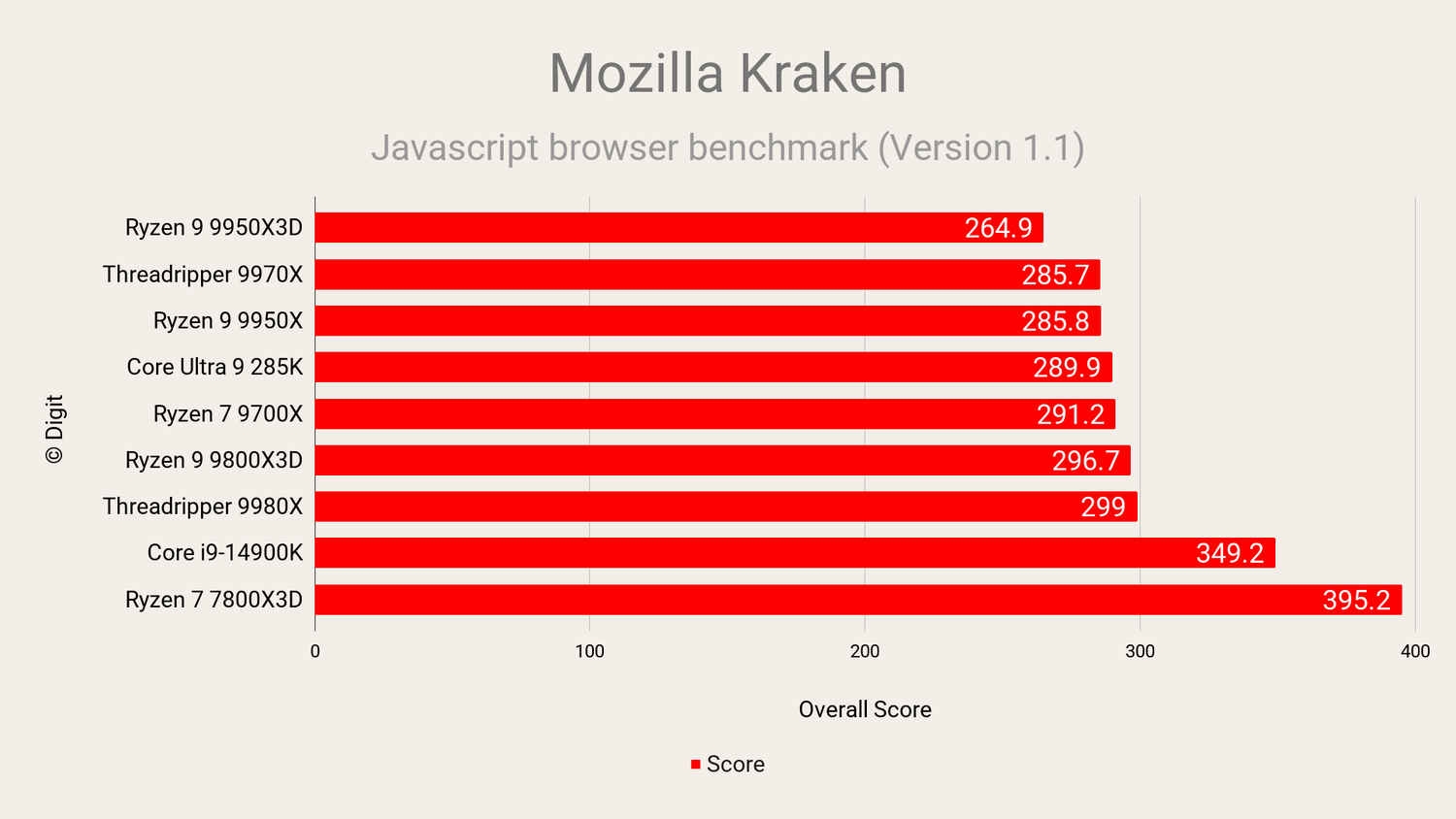
In this test, the 9970X completed the suite in 285.7 milliseconds. The 9980X, by comparison, took 299 ms, while the 9950X3D came in at 264.9 ms. The 9970X’s slightly lower intra-CCD and memory latency clearly plays a role here, keeping data paths tighter and reducing the number of cycles lost to synchronisation.
These results suggest that the 9970X, while clearly a workstation-class chip, can easily handle frontend-heavy IDEs, code transpilation, and complex dashboard rendering without compromising on interactivity or preview speed.
Rendering and content creation
This category showcases the 9970X’s ability to handle one of its primary use cases: 3D rendering, video processing, ray tracing, and complex visual effects workflows. These workloads tend to scale well with core count, but they also benefit from high clock speeds, fast memory, and a responsive cache hierarchy which are all areas where the 9970X brings a different flavour of power compared to its 64-core sibling.
Cinebench R23
Cinebench R23 is a staple in the CPU benchmarking world, simulating real-world CPU rendering using the Cinema 4D engine. Its multi-core score shows raw throughput, while the single-core score reflects responsiveness and IPC.
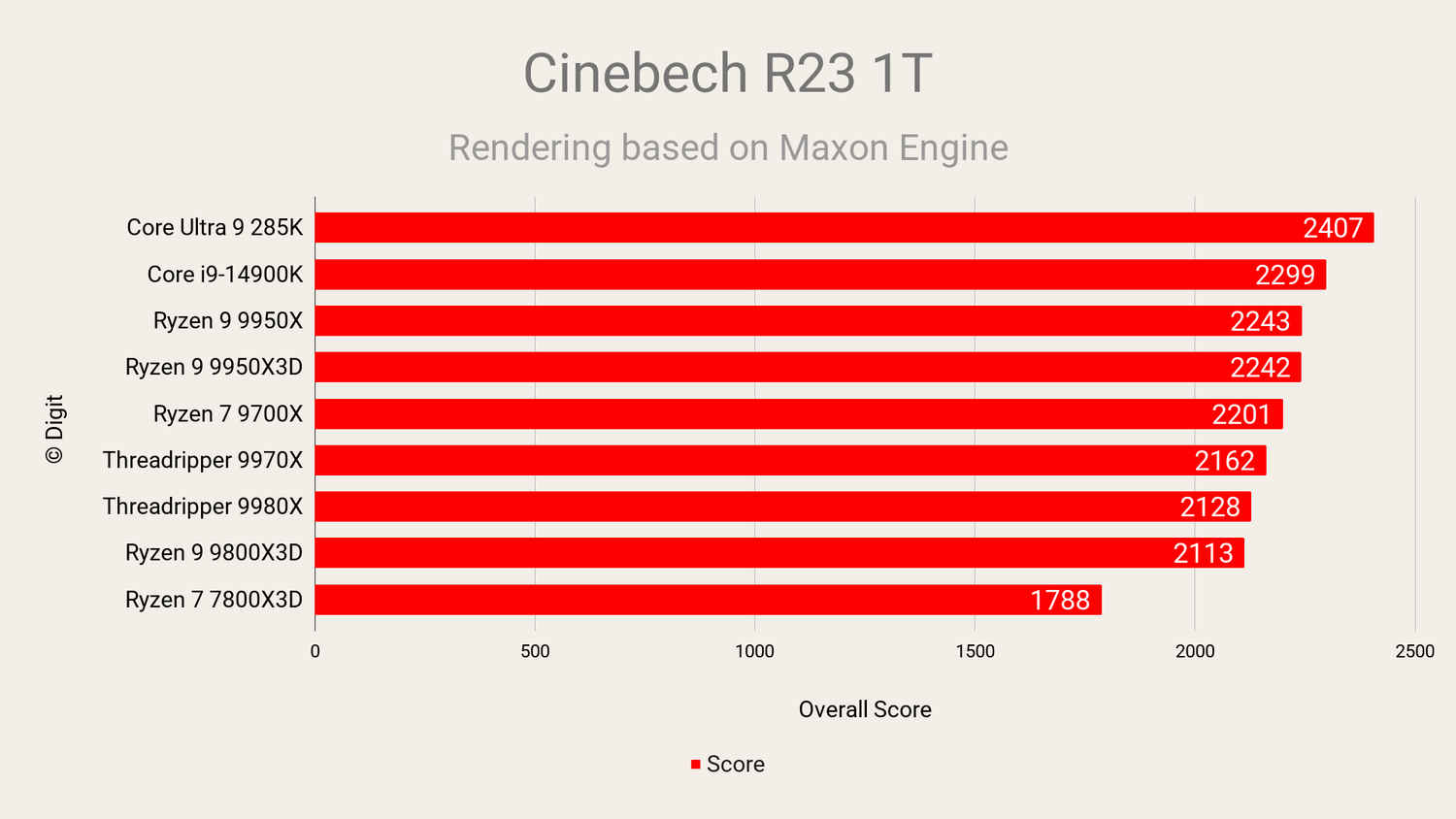
The 9970X achieved 76,392 points in the multi-core test, trailing the 9980X by about 25 percent but coming in comfortably ahead of the 9950X3D. In single-core performance, it scored 2,162 points, which is virtually identical to the 9980X.
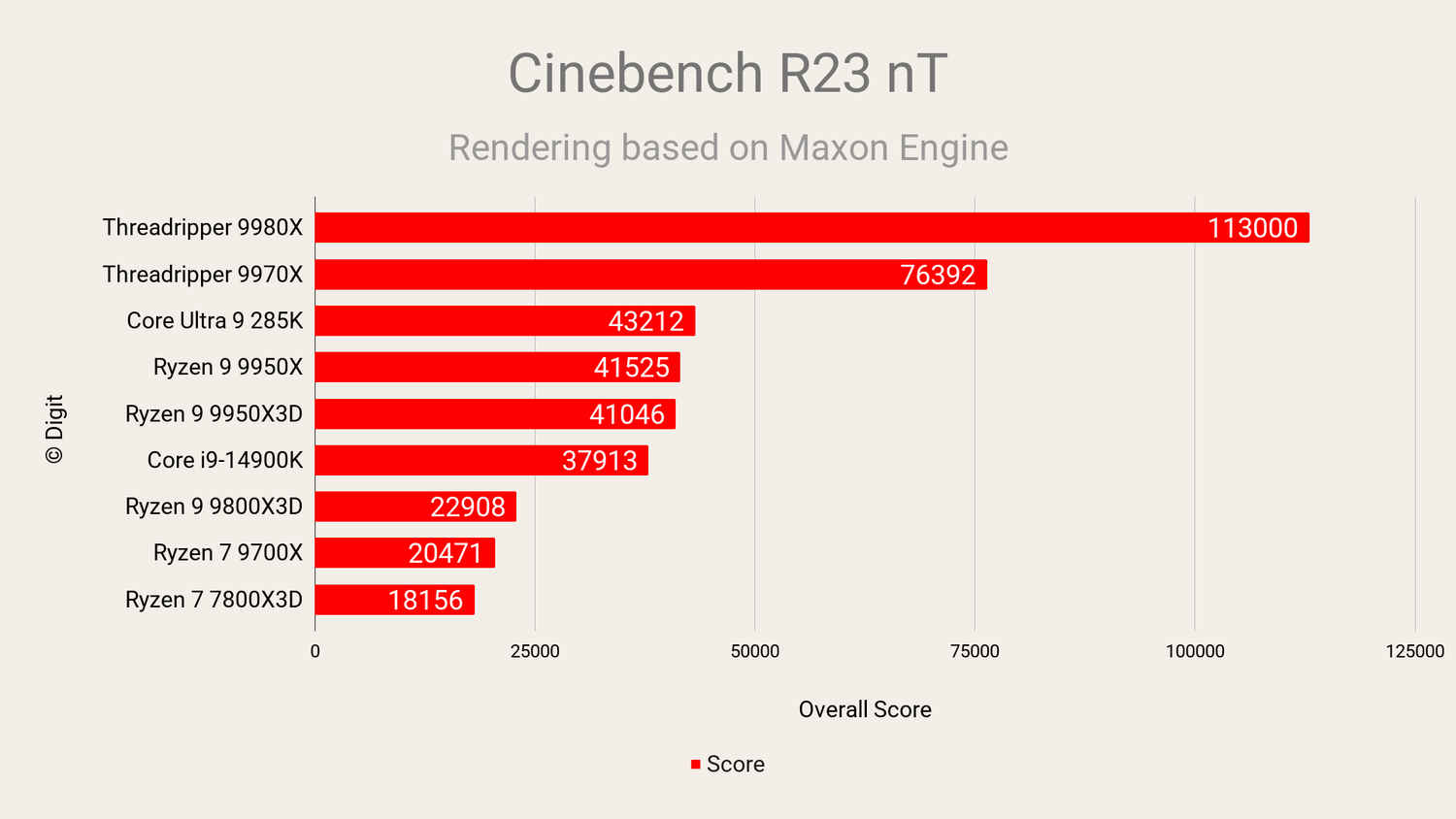
These results reflect what the 9970X is optimised for: strong all-core rendering performance with minimal compromise on per-thread responsiveness. For artists working with Cinema 4D, Redshift, or similar tools, this CPU offers excellent balance between live viewport interactivity and final render throughput.
Cinebench 2024
Cinebench 2024 builds on the same testing foundation but uses a newer rendering engine with updated threading and memory subsystems. It’s better optimised for modern CPUs and exposes more bottlenecks in cache and memory latency.
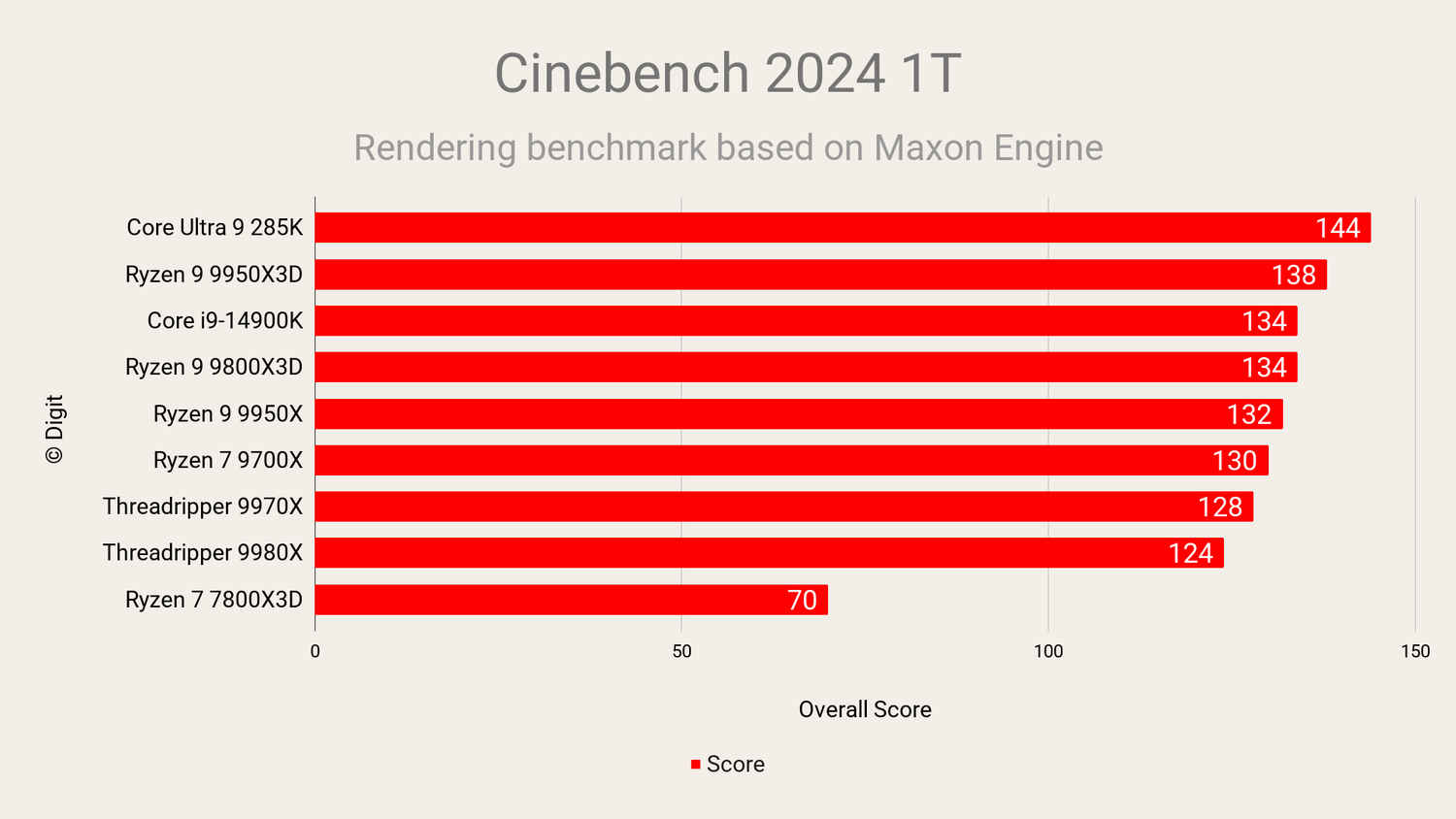
The 9970X pulled in 4,159 points in multi-core and 128 points in single-core. This puts it just behind the 9980X in overall throughput but again leads in responsiveness. The chip’s ability to maintain higher clock speeds under load and stay closer to thermal limits without throttling makes it ideal for real-time content work.
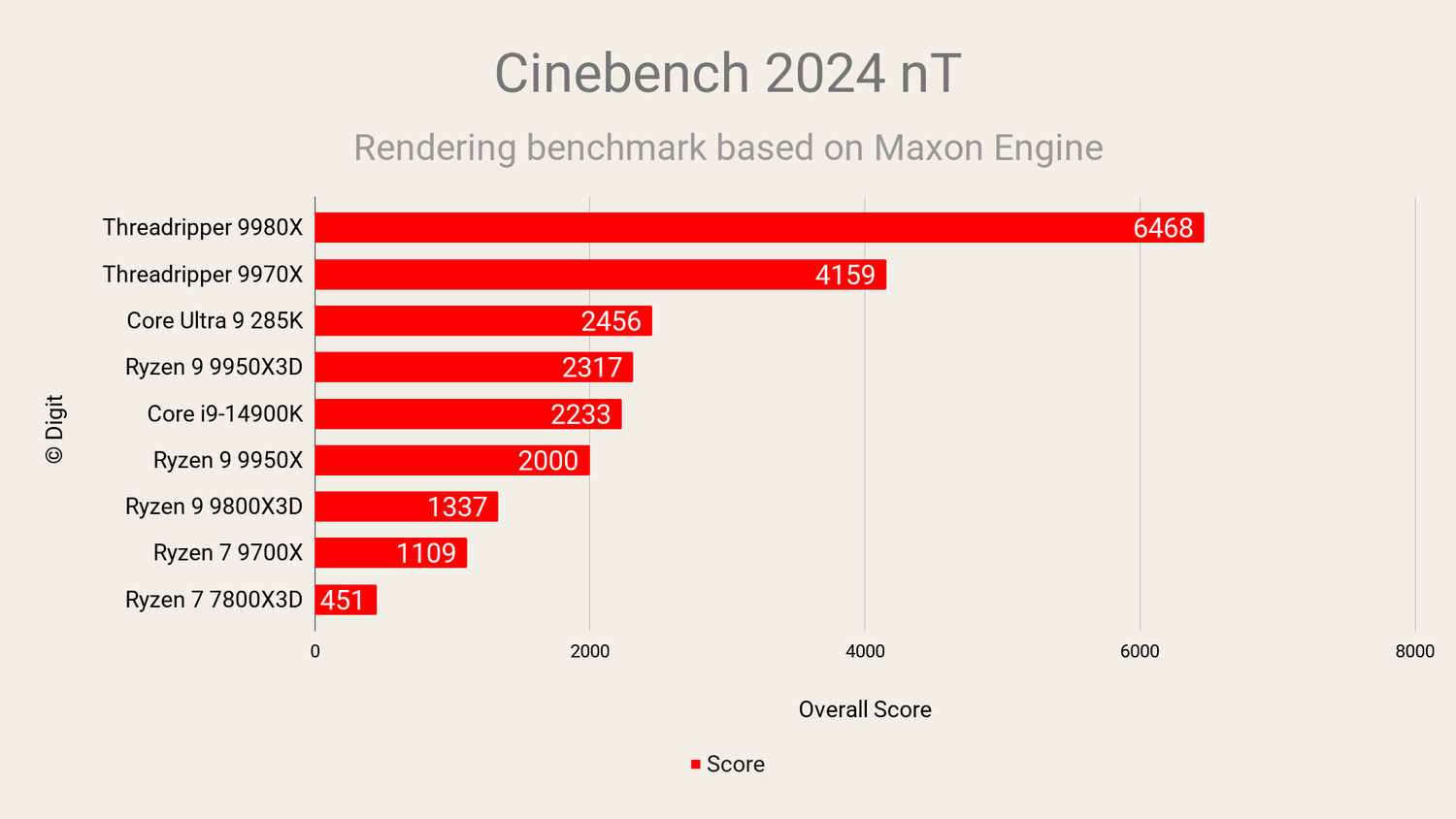
This newer version of Cinebench also highlights how well Zen 5 scales with memory-bound workloads. The 9970X maintains better efficiency per core than the 9980X, which begins to show diminishing returns when scaled past 48 threads.
Blender
Blender’s Cycles engine is a real-world renderer that’s fully open source, popular in game design, animation, and indie filmmaking. Its benchmark includes three scenes: Monster (GPU-heavy), Junkshop (hybrid), and Classroom (CPU-heavy).
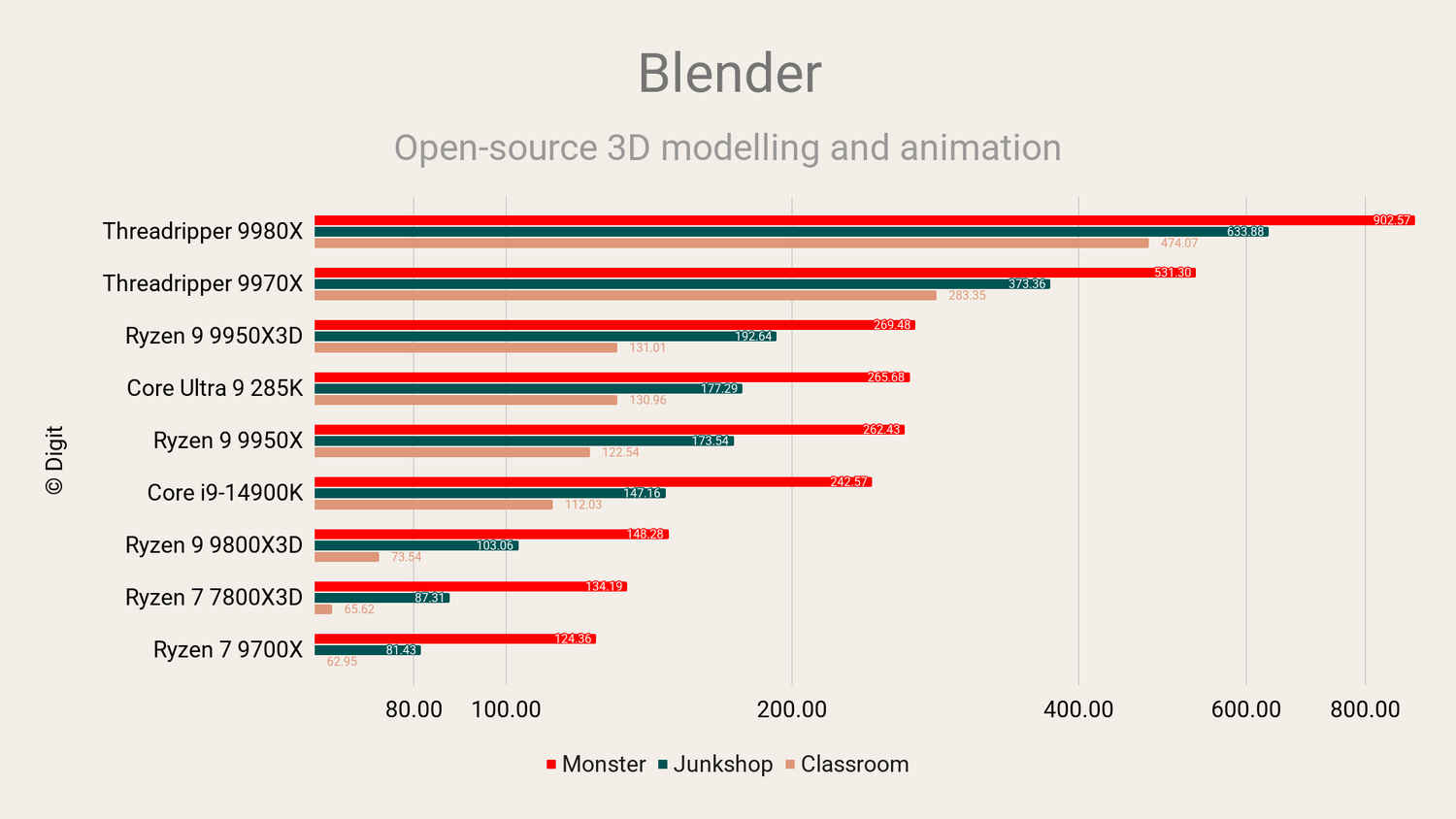
In CPU-only mode, the 9970X rendered the Classroom scene with 531.302 samples/second, Junkshop with 373.357 samples/second, and Monster in 283.349 samples/second. The 9980X was faster on all three counts, but not drastically so, most notably in the Junkshop scene where the difference was just 12 seconds.
These scores suggest that the 9970X is more than capable of serving as a primary Blender workstation. Unless you are pushing multi-layer compositing across several scenes simultaneously, the 9970X offers excellent frame-to-frame responsiveness and competitive final render times.
V-Ray
V-Ray 5 is a professional renderer used in architectural visualisation and product design. Its benchmark tool splits output into CPU and GPU tests, though here we’re focusing solely on CPU.
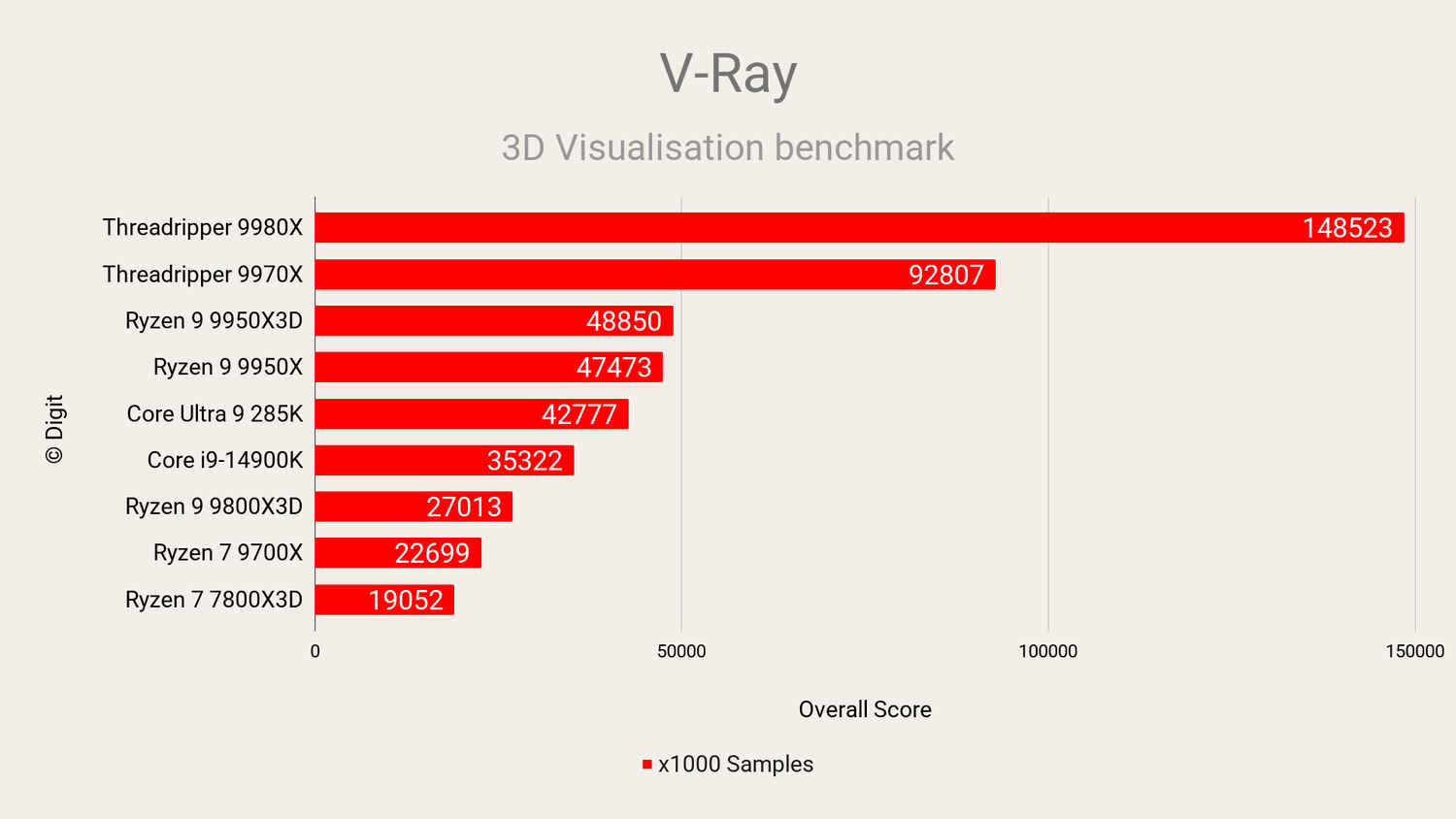
The 9970X posted a score of 92,807 vsamples. This puts it roughly 22 percent behind the 9980X, which is expected given the core difference, but it remains highly competitive with older generation 64-core chips like the 7980X and dramatically outperforms any mainstream desktop CPU.
In practical terms, the 9970X can easily handle multi-light setups, high-polygon scenes, and real-time material previews, making it a strong choice for architects and 3D artists.
Indigo Renderer
Indigo Renderer is a physically-based renderer often used in product visualisation and photorealistic CGI. It supports full CPU acceleration, including SIMD instructions and multithreaded path tracing.
In this test, the 9970X completed the Supercar benchmark with 23.892 M samples/second, just a touch slower than the 9980X’s 40.497 M samples/second. Considering the 32-core count, that’s impressive scaling efficiency considering that Indigo is particularly sensitive to cache hierarchy and memory latency.
These results underline the 9970X’s real strength: it doesn’t waste performance. Whether rendering light simulations, refractions, or global illumination passes, it keeps all threads engaged with minimal overhead.
Professional workloads and content creation suites
This suite of tests reflects real-world content pipelines, particularly those driven by Adobe Creative Cloud and other popular media production tools. These workloads are often hybrid in nature, combining single-threaded performance for UI and preview tasks with multi-threaded demand during exports or complex batch processing. For professionals in photography, video editing, and post-production, this is where the rubber really meets the road.
Procyon Photo Editing (Adobe Photoshop)
UL Procyon’s photo editing benchmark replicates a realistic editing workflow in Adobe Photoshop and Lightroom Classic, blending single-threaded UI tasks with filters, layer manipulation, and batch exports.
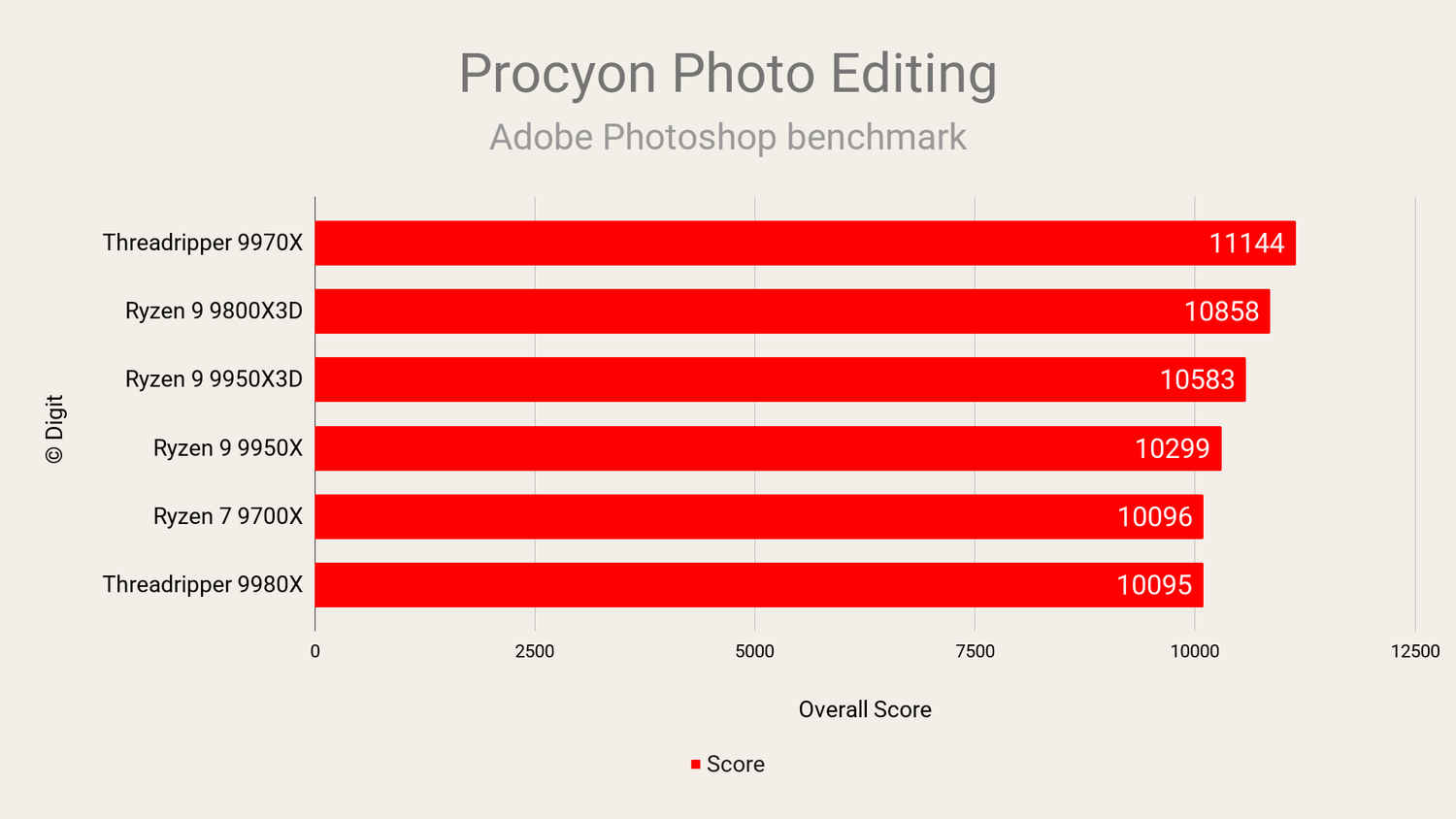
The 9970X scored 11,144 points, slightly ahead of the 9950X3D and notably ahead of the 9980X. The margin here is a reflection of how well the 9970X balances boost frequency and memory throughput, particularly in Lightroom’s export module, which tends to spike all available threads briefly while handling large image libraries.
In typical use, this means faster brush responsiveness, smoother preview generation, and quicker multi-layer edits, especially with high-resolution RAW files or complex adjustment stacks. Unless you’re working in high-end fashion or architectural post-processing environments with 100MP images, the 9970X delivers more than enough muscle.
Procyon Video Editing (Adobe Premiere Pro)
UL’s video editing test automates a standard 4K video production workflow in Adobe Premiere Pro, including effects, transitions, colour correction, and final render.
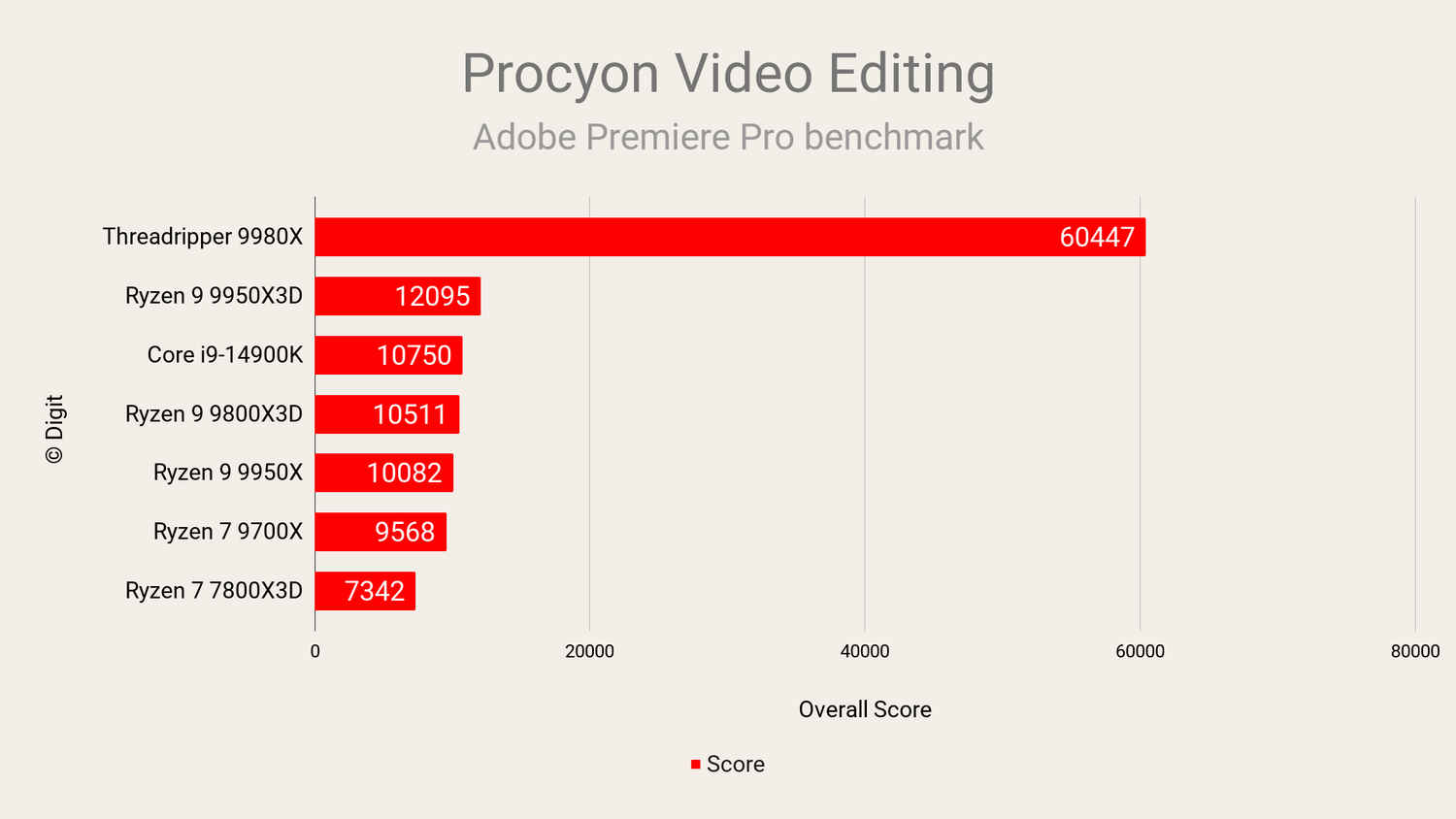
The 9970X did not complete the benchmark successfully. Nor did Puget Bench. We ran through several older versions of Premiere Pro going all the way back to 24.6.5 and none of them worked. We’ll update this section when we get valid scores.
AI and modern inference
As creative pipelines evolve to include machine learning, local inference, and data-centric automation, AI workloads are no longer limited to data centres or cloud endpoints. Modern HEDT processors like the 9970X must now serve both traditional workstation tasks and local AI processing, whether that’s through direct model execution, accelerated plugins, or simulation-driven workflows.
Procyon AI Inference
The Procyon AI benchmark uses ONNX models like ResNet50, MobileNet V3, and BERT to simulate real-world AI workloads running on the CPU. These workloads include image classification, natural language inference, and feature extraction which are all key components in local productivity and enterprise AI applications.
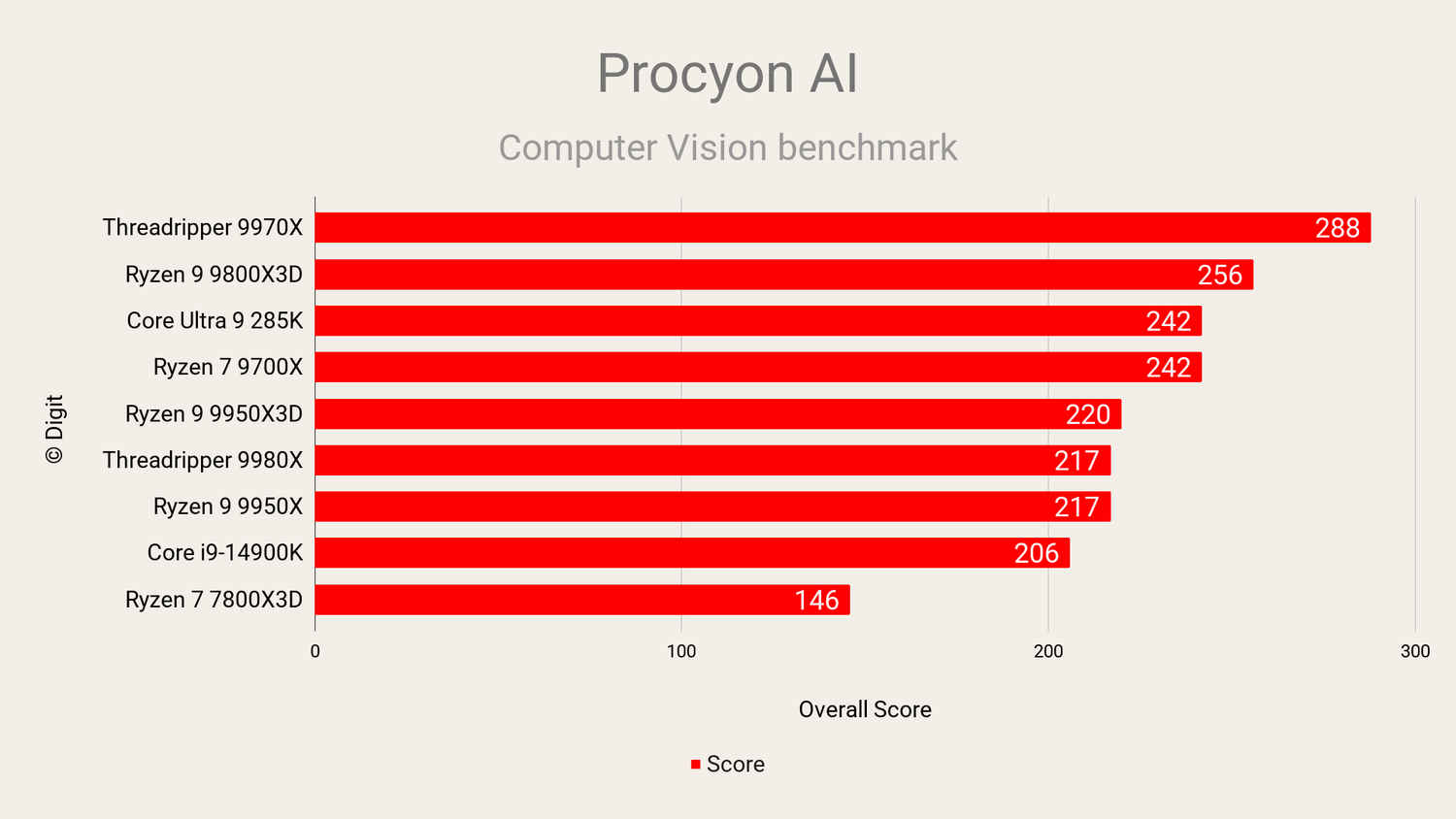
The Threadripper 9970X scored 288 on the CPU inference suite, besting the 9980X slightly and outperforming most mainstream desktop CPUs. In practical terms, this means AI-powered applications like Photoshop’s Neural Filters or After Effects’ Scene Edit Detection run with greater fluidity and reduced latency.
While the 9970X lacks a dedicated NPU (unlike mobile processors in AMD’s Ryzen AI family), its 32 Zen 5 cores provide enough throughput to handle low-latency model inference, automation scripts, and integrated ML tools for creators and researchers alike.
Productivity and workstation simulation
This segment focuses on synthetic and semi-synthetic benchmarks that emulate office productivity, workstation-class compute tasks, and memory-intensive scenarios. These tests are useful for enterprise and scientific users looking to understand how the CPU performs in heavily parallelised real-world workflows, memory-bound applications, and high-precision floating point operations across diverse industries.
SPECworkstation 4.0
SPECworkstation 4.0 is one of the most exhaustive benchmarking suites for professional workflows, simulating a broad range of tasks across verticals like media and entertainment, architecture and engineering, life sciences, and financial modelling. It includes application traces from real software such as Autodesk Maya, SolidWorks, 7-Zip, and more, offering a meaningful view of how workstation CPUs behave under complex, mixed workloads.
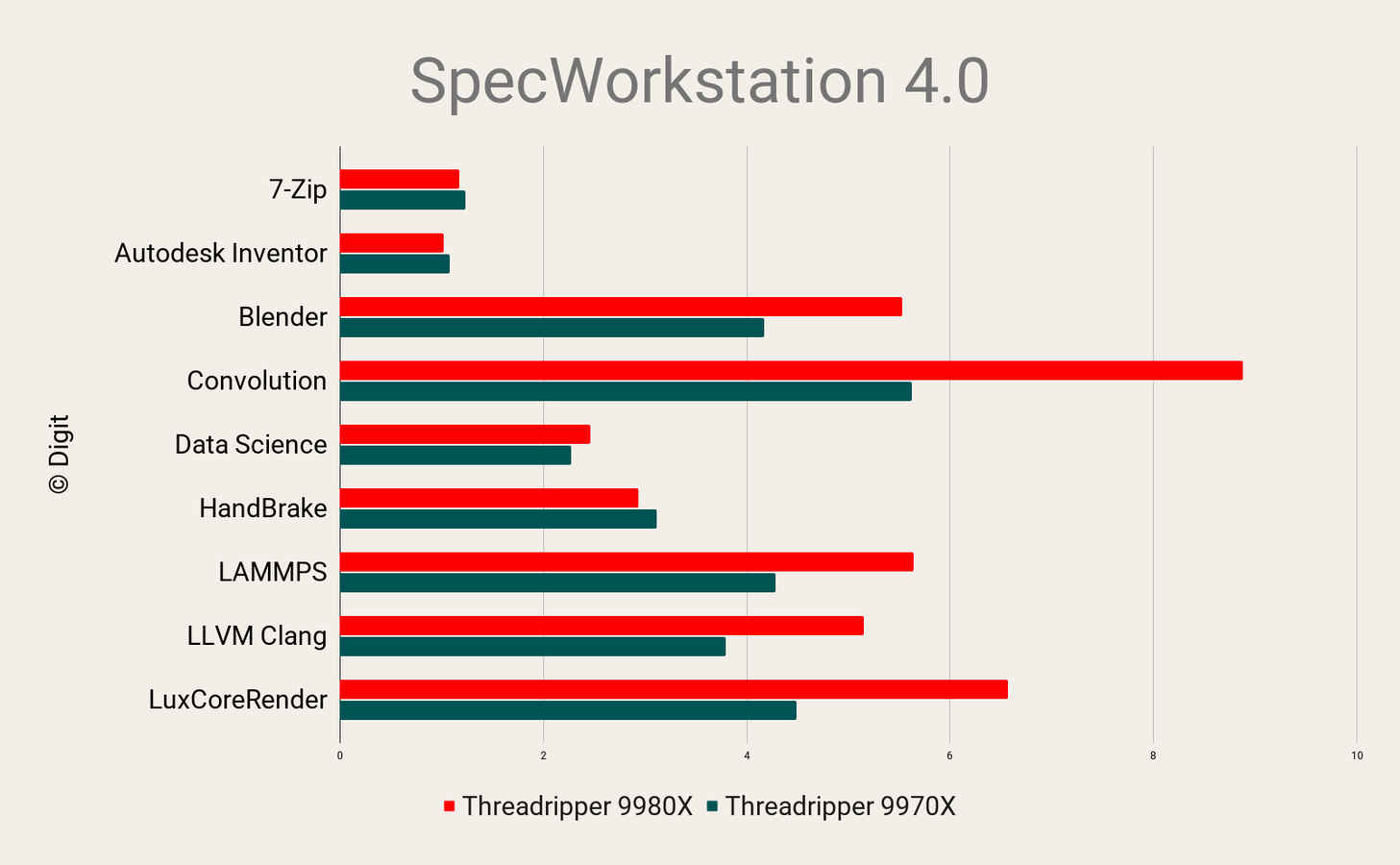
The Ryzen Threadripper 9970X performed admirably across the board, delivering results that matched or even exceeded the 9980X in several key areas. In the 7-Zip sub-tests, for instance, the 9970X achieved SPEC ratios of 1.42 in compression and 0.87 in decompression, slightly ahead of the 9980X’s 1.38 and 0.80. These are the kinds of gains that come from higher sustained clocks and lower inter-CCD latency, rather than brute core count.
In the Autodesk Inventor test suite, which includes tasks such as document opening and interactive model manipulation, the 9970X posted composite scores of 1.08 and 1.06. These outpaced the 9980X’s 1.02 and 1.05, reinforcing the notion that many CAD and design applications continue to reward frequency and memory responsiveness over core scale.
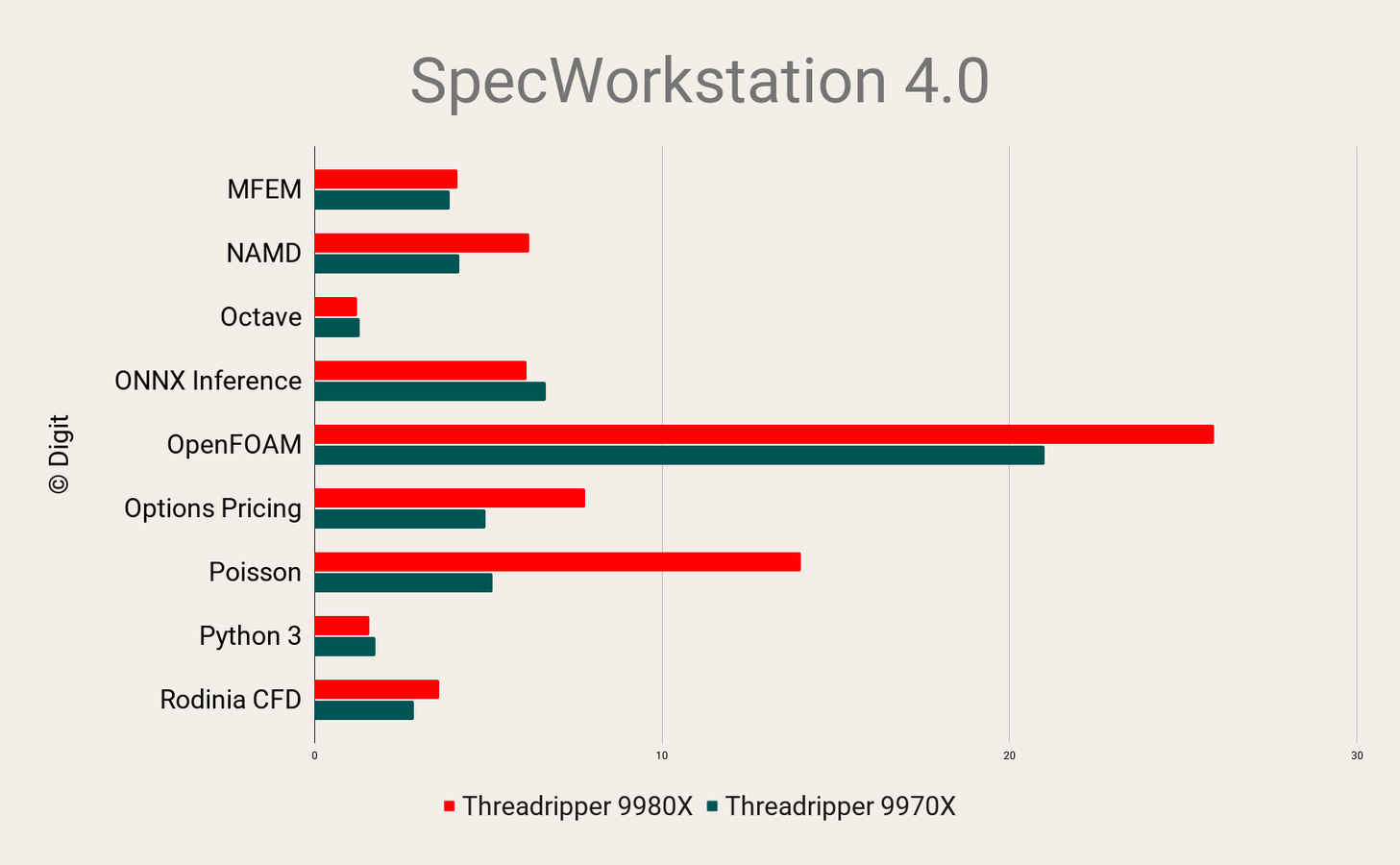
Overall, the 9970X delivers a level of consistency that makes it highly suitable for a wide spectrum of real-world workstation tasks. SPECworkstation’s broad test coverage shows that most professional applications either cap out in scaling well before 64 threads or are limited by other bottlenecks such as disk I/O and memory access patterns. For buyers focused on architecture, media production, or engineering workloads that demand reliability and speed rather than raw parallelism, the 9970X offers almost indistinguishable performance from its more expensive sibling at a substantially lower investment.
The 9980X still holds the advantage in highly parallel workloads that can leverage its full 64-core layout. However, for the majority of current real-world use cases represented in SPECworkstation, the 9970X strikes a more sensible balance between price, performance, and platform efficiency.
AIDA64 Memory Benchmark
AIDA64’s memory suite evaluates raw memory throughput and access latency across read, write, and copy operations. It’s an excellent way to gauge the benefits of quad-channel DDR5 RDIMM at 6400 MT/s, especially for applications that demand high memory bandwidth.
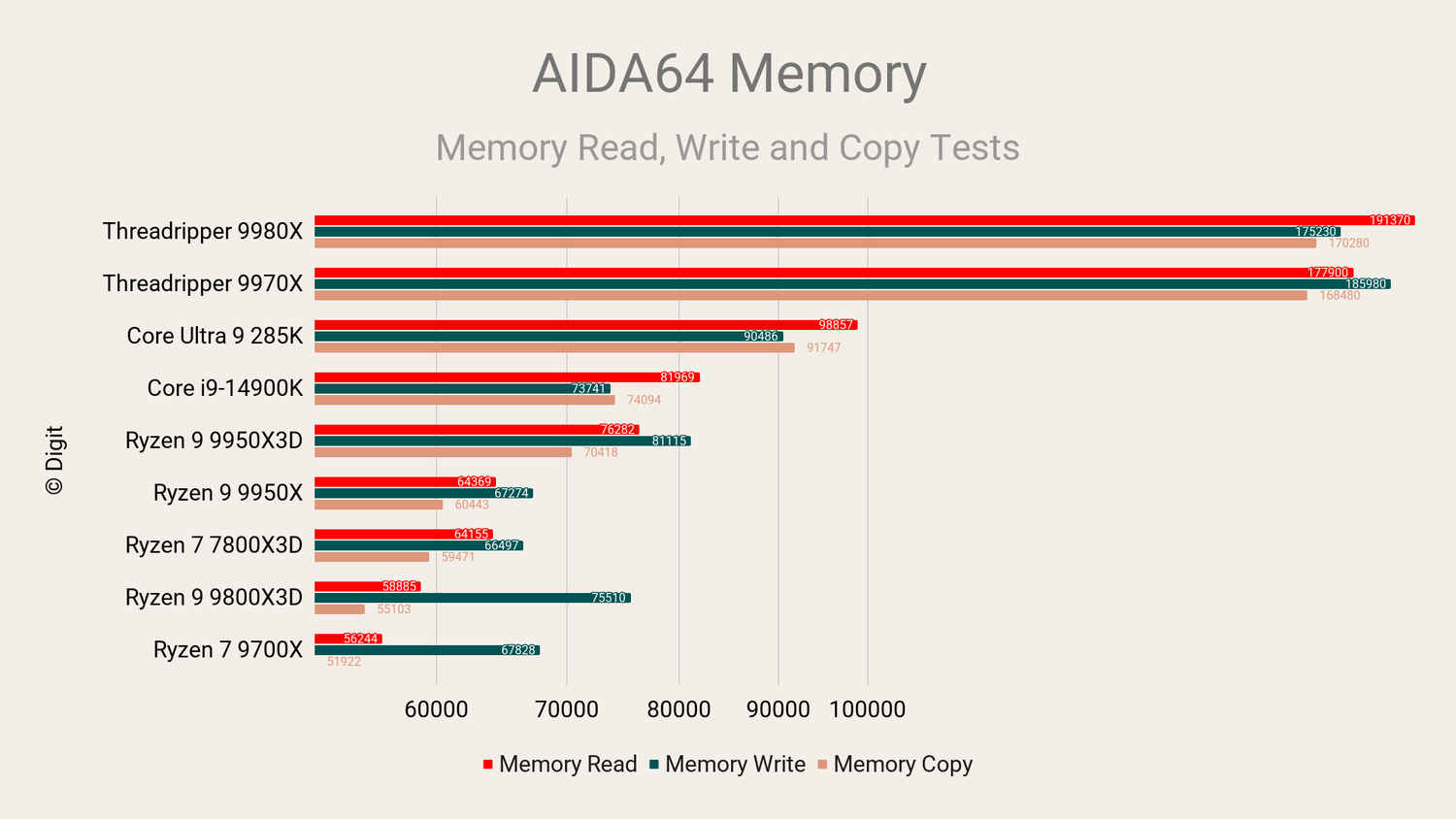
The 9970X achieved a read throughput of 178 GB/s, which is a step behind the 9980X’s 191 GB/s. However, write bandwidth favoured the 9970X, coming in at 186 GB/s versus 175 GB/s. Copy speeds were closely matched, with the 9970X delivering 168 GB/s against the 9980X’s 170 GB/s. Where the 9970X pulled ahead decisively was in memory latency, recording an average of 99.4 ns compared to 118.4 ns on the 9980X. That reduction in latency pays dividends in applications with frequent memory access or small working sets.
UL Procyon Office Productivity (Microsoft Office)
The Office Productivity benchmark from UL Procyon runs a mix of Microsoft Word, Excel, PowerPoint, and Outlook tasks. It includes heavy spreadsheet calculations, mail merges, content editing, and data visualisation, etc. all with macros and scripts enabled to simulate power-user workflows.
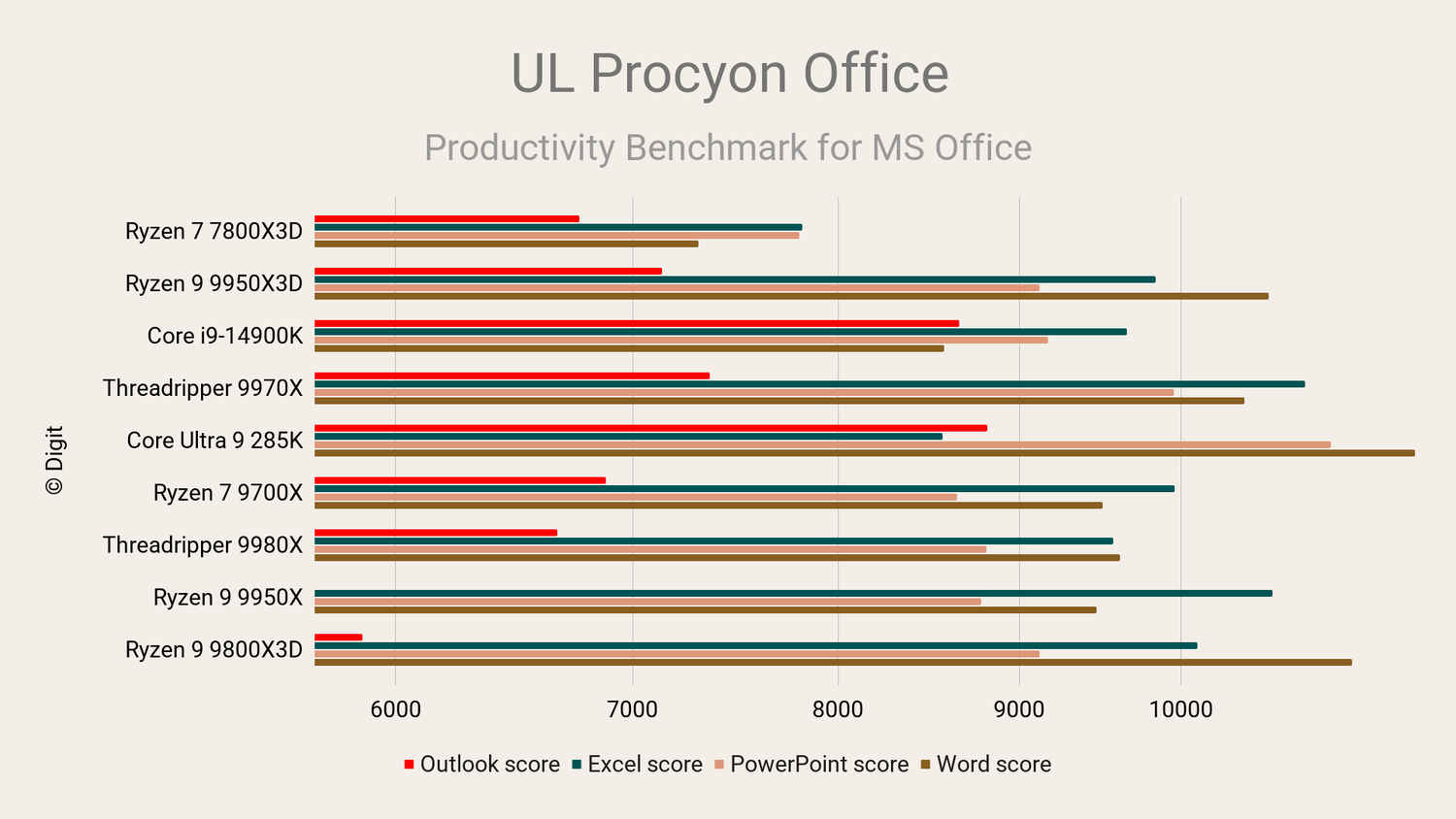
The 9970X posted a score of 9,897 points, outperforming the 9980X’s 8,885. Despite the mostly light-threaded nature of the test, the 9970X’s ability to rapidly juggle parallel low-load operations gave it a visible advantage. Excel-heavy segments that relied on VBA scripting, as well as media-rich PowerPoint exports, completed faster on the 9970X. For professionals who rely on Microsoft Office for daily throughput, the responsiveness gains are subtle but welcome.
Gaming performance
While the Ryzen Threadripper 9970X isn’t designed primarily for gaming, it still needs to demonstrate competence in scenarios where creators and developers expect high frame rates or consistent system responsiveness under load. Thanks to its 32 Zen 5 cores, high base and boost clocks, and leaner CCD topology, the 9970X delivers dependable results in hybrid gaming workflows. These tests focus on synthetic and mixed-use cases where gaming intersects with real-world creative scenarios.
3DMark CPU Profile
3DMark’s CPU Profile offers a tiered breakdown of CPU scaling across different thread counts, from 1-thread performance all the way to full-core utilisation. It’s an effective way to assess both gaming-related responsiveness and multithreaded rendering potential.
The 9970X scored 1,163 at 1 thread, 8,658 at 8 threads, and peaked at 23,826 for maximum thread count. This places it ahead of the Ryzen 9950X3D in most tiers, particularly in the mid-thread performance range which is often most relevant for gaming. While the 9980X outscored it at the top end (thanks to its additional cores), the 9970X held a lead in 1-thread and 2-thread scenarios, which directly correlate to better responsiveness in titles that are lightly threaded.
This result indicates the 9970X is well-suited for gaming tasks that benefit from clock speed and IPC, while still having ample overhead for background encoding, asset loading, or live streaming workflows.
Core to Core Latency
As AMD continues to scale its Threadripper lineup, core-to-core latency remains a crucial metric, especially for workloads that require tight coordination between threads. With both the 9970X and 9980X based on the Zen 5 architecture, latency behaviour has shifted slightly compared to the previous generation.
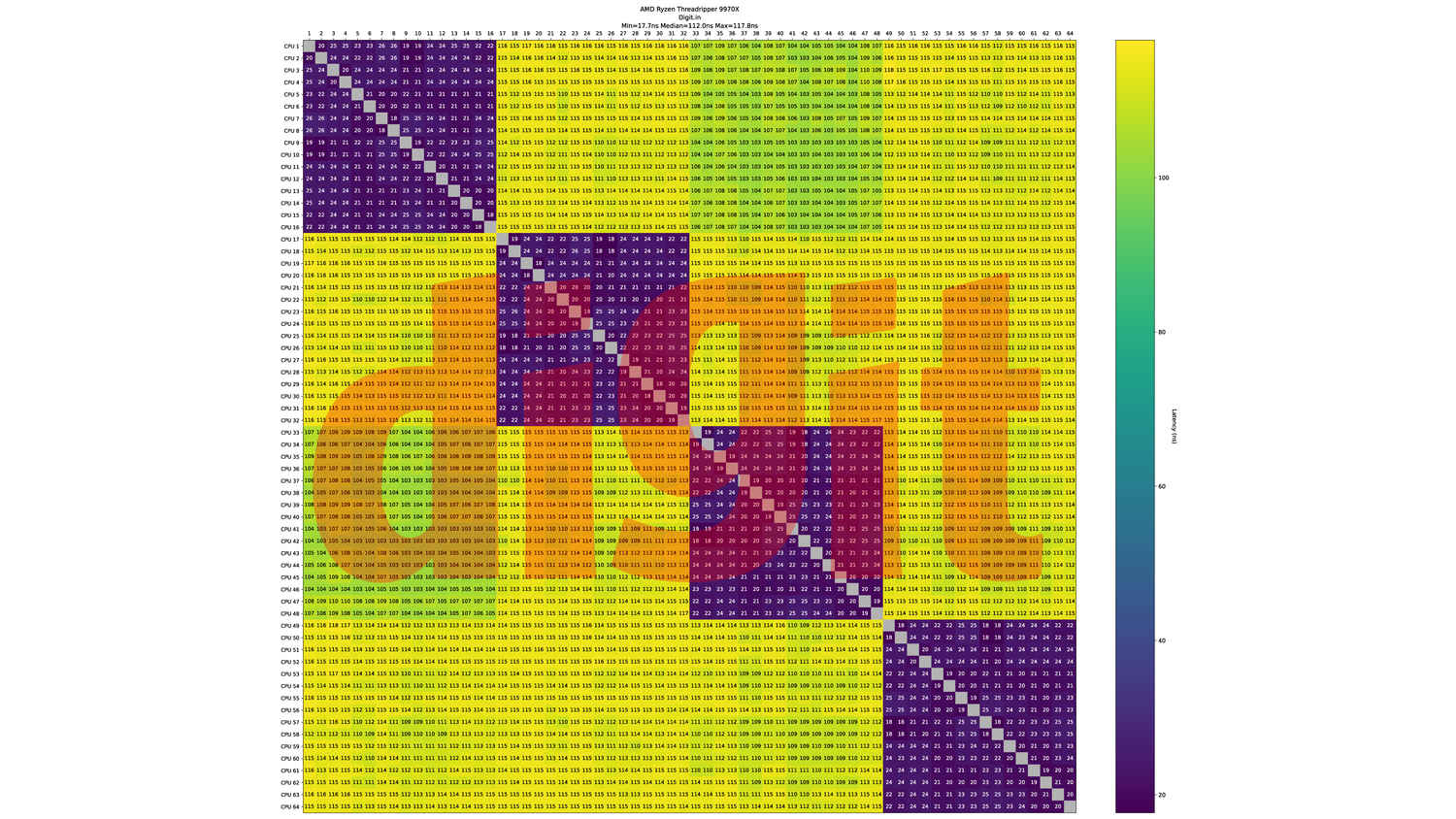
The 9970X reports an intra-CCD latency of around 22 nanoseconds, which is identical to the 9980X. Inter-CCD latency, however, is slightly lower on the 9970X at 111 nanoseconds, compared to 121 nanoseconds on the 9980X. For comparison, the older 7980X based on Zen 4 achieved 18 to 20 nanoseconds intra-CCD and approximately 92 to 94 nanoseconds inter-CCD. These changes reflect the architectural decisions made in the transition to the new platform, particularly in chiplet layout and cache tuning.
In isolation, these latency deltas are unlikely to matter for most users. However, in specific scenarios such as real-time simulation, latency-sensitive audio work, or scientific workloads that depend on low-latency thread synchronisation, the increase could influence performance slightly. Fortunately, the majority of modern content creation, rendering, and data processing applications rely more on wide parallelism than on tightly linked thread interaction.
The reduced inter-CCD latency on the 9970X relative to the 9980X also highlights the efficiency of having fewer chiplets. With fewer hops required between cores, the CPU benefits from quicker communication paths. AMD has clearly tuned the architecture to prioritise bandwidth and overall scalability. For most professional workloads, this design choice results in consistently high throughput without sacrificing responsiveness.
Thermals
Thermally, the Ryzen Threadripper 9970X runs slightly warmer than its flagship sibling, despite featuring fewer cores. Under full load, the 9970X reached peak temperatures of around 75°C, with idle readings near 39°C. In contrast, the 64-core 9980X maintained a cooler profile, topping out at 65.6°C under load and idling at approximately 36°C.
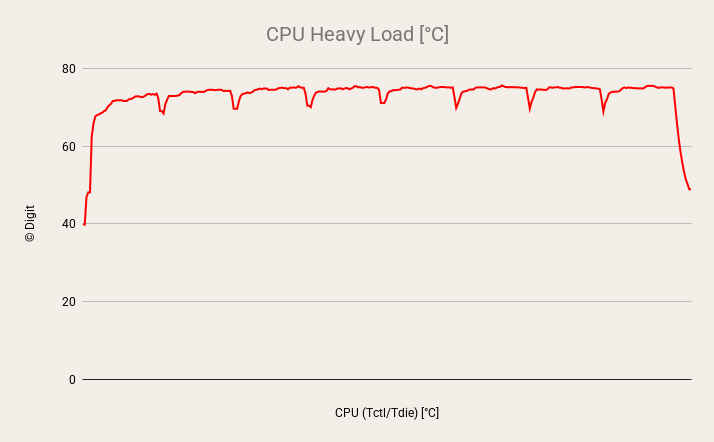
This difference may seem counterintuitive, but it reflects several architectural and behavioural nuances. The 9980X operates at a lower base clock of 3.0 GHz, compared to 3.2 GHz on the 9970X. This allows the 9980X to remain more thermally efficient during sustained multi-core workloads, as it doesn’t need to push voltage and frequency as aggressively to maintain performance targets. Additionally, the 9980X spreads its power across eight CCDs rather than four, reducing the per-CCD thermal density and allowing heat to dissipate more evenly across the IHS.
Both processors were tested using the same SilverStone XE360-TR5 AIO liquid cooler on an open-air test bench, ensuring consistent thermal conditions. Neither chip exhibited throttling, and both maintained stable boost behaviour across demanding rendering, simulation, and encoding workloads. That said, the 9970X’s higher thermal density means users should prioritise a high-end cooling solution, particularly in closed-case builds or warmer environments.
Power consumption
The Ryzen Threadripper 9970X draws a substantial amount of power, but it does so with consistent, controlled delivery that suits its workstation-class intent. At idle, the chip consumed roughly 51 watts, which is reasonable considering the platform’s PCIe, memory, and SoC overheads. Under full load, the processor’s CPU Package Power peaked close to 350 watts.
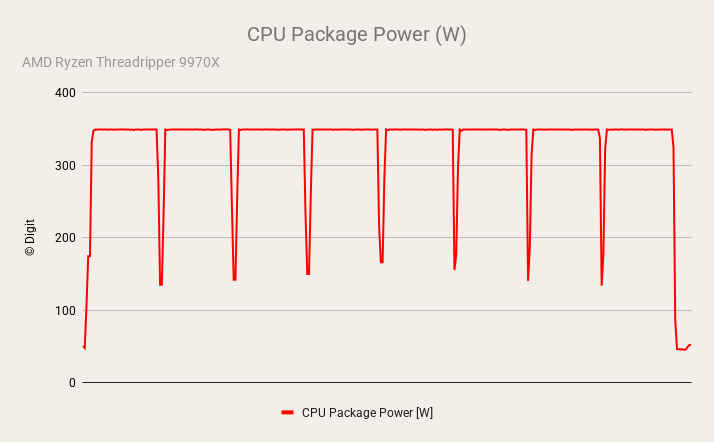
What stands out with the 9970X is how predictably it scales to its limits. Although it has fewer cores than the 9980X, the 9970X tends to maintain higher clocks under sustained load and hits its power budget more consistently. Its performance-per-watt characteristics, especially in lightly threaded or burst-heavy workloads, give it an efficiency edge on a per-core basis. There are fewer frequency dips and less thermal headroom wastage, which helps the chip reach its performance targets quickly and reliably.
In comparison, the 9980X benefits from a wider power and thermal distribution across more CCDs. However, the 9970X’s more concentrated power draw ensures a predictable delivery profile, which can simplify power provisioning in professional environments. While this does place more demand on the cooling solution, it allows users to plan their thermal and power budgets with a high degree of confidence.
Value for money
At USD 2,499, the Ryzen Threadripper 9970X sits at the top of AMD’s non-Pro HEDT lineup, but still manages to offer a compelling value proposition for creators, engineers, and power users who don’t require the sheer core count of the 9980X. The 9980X, at USD 4,999, commands double the price for its 64-core configuration, and while that positioning makes sense for heavily threaded workflows like simulation or rendering farms, the 9970X delivers a surprising amount of its performance at a significantly lower cost.
In many of the benchmarks, particularly those involving lightly to moderately threaded workloads, the 9970X not only keeps pace but often surpasses the 9980X, thanks to higher sustained clocks and better efficiency. Even in all-core tasks, the performance gap is often smaller than expected considering the price delta. This makes the 9970X a smarter buy for professionals who need consistently high throughput but don’t necessarily benefit from having twice the number of cores.
The platform costs remain high, given the TRX50 motherboard and quad-channel DDR5 RDIMM requirements, but these are shared across the entire Threadripper 7000 and 9000 series. When viewed in the context of the total system spend, the 9970X represents the sweet spot between performance headroom and long-term usability without venturing into workstation-class pricing.
For studios, engineers, and content professionals who value performance per dollar, the 9970X offers one of the best balances AMD has struck in the HEDT space to date. It brings most of the platform’s capabilities, excellent scalability, and strong thermal and power efficiency, all without the financial leap required for the 64-core flagship.
AMD Ryzen Threadripper 9970X Verdict
The AMD Ryzen Threadripper 9970X stands out as the most balanced offering in the new Threadripper 9000 lineup. With its 32-core, 64-thread configuration, it brings together high sustained performance, excellent thermal behaviour, and architectural efficiency in a way that feels purpose-built for demanding professional workloads. From large-scale 3D renders and data-heavy simulations to high-speed video encoding and multi-layered software builds, the 9970X handles it all with minimal fuss and maximum consistency.
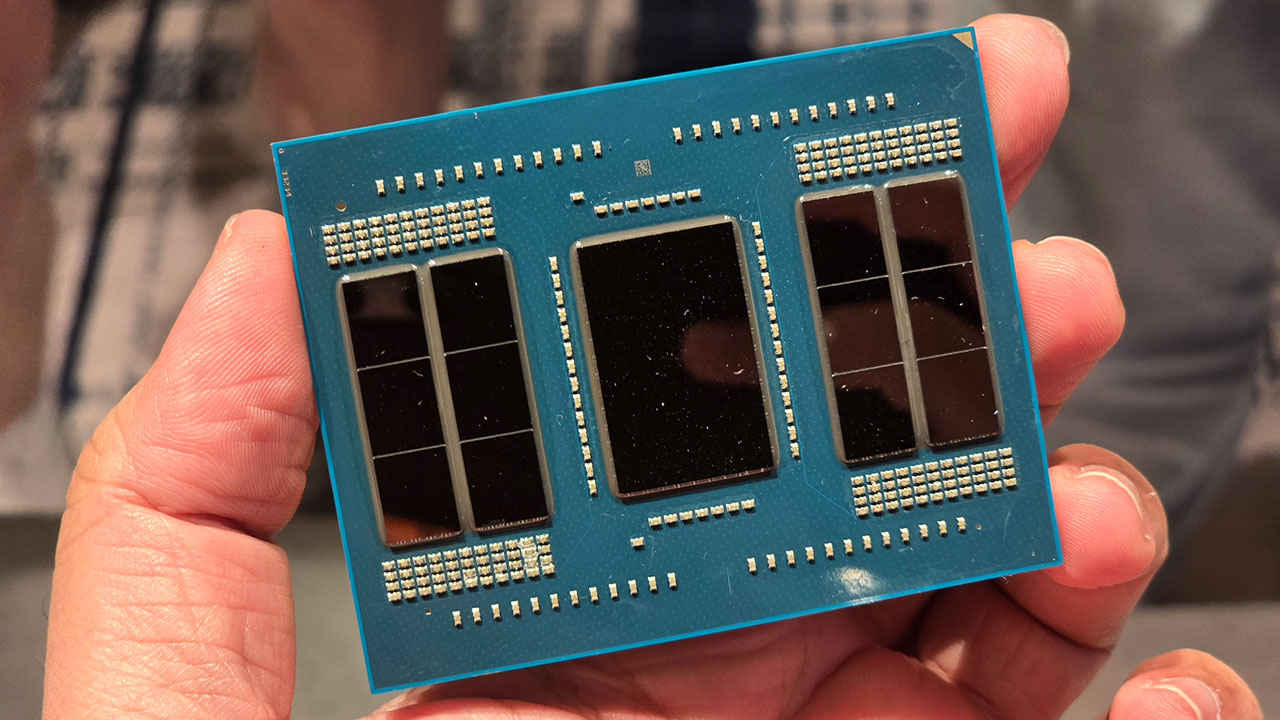
What’s most impressive about the 9970X isn’t just its raw performance, but how gracefully it integrates into complex workflows. The single-thread responsiveness keeps the system snappy under load, while the multi-core throughput ensures that heavy jobs don’t cause bottlenecks or background stalls. Its lower inter-CCD latency and more concentrated thermal profile, compared to the 9980X, allow it to sustain clocks more predictably and make better use of available cooling.
For studios, engineers, content creators, and independent developers looking to invest in a platform that delivers serious muscle without entering workstation extremes, the 9970X makes a strong case for itself. The 9980X still has its place for users with relentless parallel workloads, but the 9970X delivers most of the flagship’s strengths with fewer trade-offs and a significantly more palatable price tag. It may not be the flashiest chip in AMD’s lineup, but it’s likely the one best suited for real-world productivity, the kind that runs day in and day out without getting in your way.
 Follow Us
Mithun Mohandas
Mithun Mohandas is an Indian technology journalist with 14 years of experience covering consumer technology. He is currently employed at Digit in the capacity of a Managing Editor. Mithun has a background in Computer Engineering and was an active member of the IEEE during his college days. He has a penchant for digging deep into unravelling what makes a device tick. If there's a transistor in it, Mithun's probably going to rip it apart till he finds it. At Digit, he covers processors, graphics cards, storage media, displays and networking devices aside from anything developer related. As an avid PC gamer, he prefers RTS and FPS titles, and can be quite competitive in a race to the finish line. He only gets consoles for the exclusives. He can be seen playing Valorant, World of Tanks, HITMAN and the occasional Age of Empires or being the voice behind hundreds of Digit videos. View Full Profile


