
Vivo Buds review: the sub-Rs 2,000 earbuds that get the basics exactly right
 Follow Us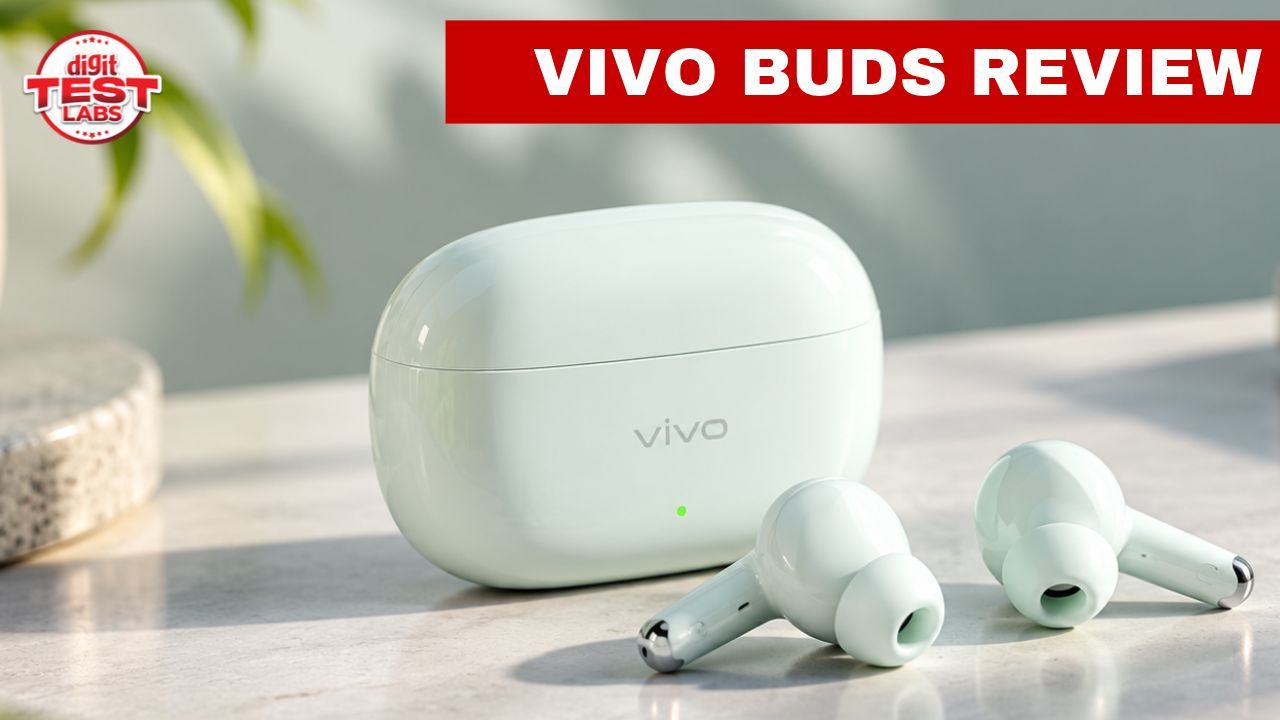

The sub-Rs 2,000 TWS market has a pattern of promising solid specs on the box but a compromised execution everywhere else. We all have had experiences where call quality turns your voice into a muffle, connectivity that drops the moment you walk a few steps from your phone and sound that has been tuned to impress for 30 seconds in a store, fatigues you within the hour. The Vivo Buds set out to break this pattern and in the most important areas they succeed. At Rs 1,999, this pair of TWS leads with an absurd 50-hour total battery life, Bluetooth 6.1 with rock-solid dual-device connectivity and a 10mm driver tuned for everyday listening. There is no active noise cancellation, no transparency mode, no wear detection. Vivo has actually chosen to do fewer things and do them well, which turns out to be the right call at this price.
Design and build
The case has a rounded, compact form factor that fits easily in a pocket. The glossy finish is attractive but a fingerprint and dust magnet so you will need to keep a microfibre cloth handy. The lid opens cleanly with a one-finger motion and the magnets holding the earbuds in are remarkably strong for the price. There is no dedicated pairing button and to enter pairing mode manually, you hold both earbuds simultaneously for three seconds, which works but takes a moment of adjustment. The USB-C port sits at the base.
The earbuds weigh 3.8 g each, which is light enough that they disappear into your ears. The silicone tips are available in three sizes; the medium pair comes pre-installed but the large tips give a more secure seal. IP54 dust and water resistance covers sweaty gym sessions and unexpected light rain without concern.
Sound quality
The Vivo Buds ship with Mega Bass as the default EQ setting. Switch it off immediately. Mega Bass elevates the sub-bass to a degree that buries the rest of the mix: vocals recede, mids become indistinct and the overall presentation feels bloated. However, switching to Standard EQ transforms the listening experience.
In Standard, the Vivo Buds deliver a U-shaped sound signature that leans warm: bass has presence and reasonable tightness, mids are slightly recessed but not absent, and the treble remains controlled without turning shrill. For pop, hip-hop, and electronic music at everyday volumes, the result is engaging without being fatiguing. The mids do step back more than you would want on vocal-forward tracks, and the soundstage is compact rather than expansive, but neither of these is a surprise at this price point.
The ten-band custom EQ in the vEarphones app gives you meaningful control if the Standard preset needs adjustment. DeepX 4.0 also offers preset modes including Clear Voice, Clear High Pitch and an Immersive Audiobook mode that is well-tuned for spoken content. Four spatial audio modes: Theater, Concert Hall, Studio and Live Concert are available, though spatial audio on in-ear buds is more of a novelty than a daily tool. The supported codec are SBC and AAC, so no high-resolution codec at this price, which is expected.
Call performance
The dual-mic AI noise cancellation surprised me. Tested in outdoor environments with traffic and ambient crowd noise in the background, the person on the other end heard my voice cleanly without the surrounding environment dominating. The cross-flow duct design that redirects airflow away from the microphone inlet does measurable work on wind noise: walking in a breeze did not turn the call into a howl. For the price, the call clarity is a genuine strength.
Features and connectivity
Bluetooth 6.1 at this price is very unusual. The dual-device multipoint connection switches between a laptop and a phone automatically when a call comes in, without hesitation or manual intervention. Having tested pairs at significantly higher price points where this handoff stutters, the Vivo Buds handling it seamlessly is notable.
For gaming, the 42ms low-latency mode engages automatically in Ultra Game Mode on Vivo phones or via a manual toggle in the vEarphones app on other Android devices. The audio-to-visual sync is tight enough that it does not distract during fast-paced games.
Vivo-ecosystem users get additional benefits: instant pairing via case opening, in-settings control without a separate app, customisable pet-themed pop-up interfaces, and a Find My Vivo Buds function. Spatial audio is currently available on select Vivo devices only starting with the Vivo X300 Ultra and the Vivo X300 FE, gradually rolling out to other phones too. The ecosystem tie-in is deep and while it works perfectly on third-party Android phones too, the full experience is reserved for Vivo hardware.
Touch controls are customisable for double-tap and triple-tap gestures and are responsive without accidental triggers.
Battery
Twelve hours of playback from the buds on a single charge, with roughly 38 additional hours in the case, giving 50 hours total. At 100% volume with AAC active, real-world playback came in around 9.5 hours, close enough to the claim that it counts. The case charges fully in about two hours via USB-C and a ten-minute charge inside the case gives approximately four more hours of playback.
Verdict
The Vivo Buds do not try to be everything. They do not offer ANC, transparency mode or wear detection, and those absences are felt if you have grown accustomed to them. What they offer instead is a light, comfortable fit, durable build for the price, Bluetooth 6.1 connectivity that routinely outperforms competitors at twice the cost, call quality that holds up outdoors and battery life that puts much more expensive pairs to shame. Change the default EQ to Standard and the sound is balanced and easy to live with across genres. At Rs 1,999, the Vivo Buds are a straightforward recommendation and if you are a Vivo phone user, they are the obvious first choice.


