UNESCO’s study reveals how AI systems can reinforce deep-rooted social biases without transparent training oversight.
With ethical frameworks missing in most sectors, AI deployment risks outpacing regulation and widening existing inequalities
UNESCO highlights AI’s potential to distort historical truth, stressing the urgent need for digital literacy worldwide.
As artificial intelligence (AI) continues to evolve at breakneck speed, UNESCO has released a series of studies and global policy recommendations that lay bare some of the most pressing and uncomfortable truths about its trajectory. While AI promises transformative potential across education, healthcare, and governance, UNESCO’s recent findings serve as a sobering reminder: if left unchecked, this technology could deepen inequality, distort truth, and outpace the world’s ability to govern it responsibly.
 Survey
AI is not neutral: It reflects our biases
Also read: AI vision: How Zuckerberg, Musk and Altman see future of AI differently


Perhaps the most troubling revelation from UNESCO’s latest study is the extent to which AI systems, particularly large language models (LLMs), replicate and amplify existing societal biases. These systems have shown a consistent pattern of stereotyping women, ethnic minorities, and LGBTQ+ individuals due to their training on biased data scraped from the internet. UNESCO’s in-depth testing of popular LLMs found that women were disproportionately portrayed in domestic or caregiving roles, while men were associated with professional and leadership positions. In some instances, responses linked Zulu women to domestic servitude and framed queer people in deeply stigmatizing ways demonstrating how machine learning can reinforce harmful narratives.
This is not a matter of isolated glitches, these biases are systemic and embedded in how AI systems are designed and trained. Even small biases can cause real-world harm and amplify existing inequalities.
Ethics still trail innovation
Another hard truth revealed in the study is the significant gap between AI’s technological advancement and the ethical frameworks designed to govern it. While the technology is advancing rapidly, most countries and even global tech companies are still playing catch-up when it comes to regulation.
UNESCO warns that the lack of clear ethical guidelines poses serious risks to human rights, privacy, and public safety. Despite the 2021 Recommendation on the Ethics of Artificial Intelligence, adopted unanimously by 193 member states, implementation remains patchy at best. In critical sectors like education, justice, and healthcare, only a minority of institutions have formalized how AI can or should be used. Without solid ethical guardrails, AI can entrench discrimination, erode privacy, and operate without accountability.
Also read: Why Google AI Overviews are facing EU antitrust heat from publishers
AI governance is still fragmented
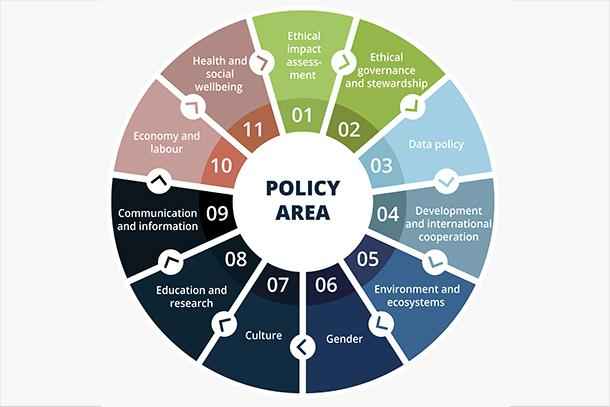
UNESCO’s Recommendation on the Ethics of AI remains the only global standard to date. It provides a structured framework that includes principles such as transparency, fairness, data governance, and environmental responsibility. Yet despite its adoption, the organization emphasizes that meaningful progress depends on how seriously individual governments and corporations take the call for ethical implementation.
Implementation challenges are widespread. Differences in cultural norms, regulatory capacity, and technological infrastructure have created a fragmented global AI landscape. Many countries lack the institutional capability to carry out ethical impact assessments or enforce compliance, leading to gaps in oversight. To address these gaps, UNESCO advocates for international cooperation and robust governance mechanisms, including common ethical metrics and shared regulatory frameworks. Without these, the risk is clear: AI development may benefit a few while exposing many to harm.
In education, AI holds promise for personalized learning, greater inclusion, and expanded access. But as UNESCO’s research notes, the reality is more complicated. A survey conducted across educational institutions found that only 10% have official frameworks governing AI usage. This lack of policy direction leaves schools vulnerable to misuse, digital inequality, and over-reliance on opaque tools. UNESCO cautions that unless AI tools in education are rolled out with clear ethical oversight, they could reinforce existing divides particularly between wealthier, tech-enabled schools and those in underserved regions.
AI and the distortion of history
UNESCO’s findings also warn of AI’s capacity to distort historical narratives. With the rise of generative AI and deepfake technologies, the manipulation of historical content especially around sensitive topics is a growing concern. Misleading content generated by AI not only threatens public understanding but can also be weaponized for political or ideological agendas. To combat this, UNESCO calls for enhanced digital literacy, stronger content safeguards, and international cooperation to protect historical truth in the digital age.
The overarching message from UNESCO’s studies is clear: AI must be designed, deployed, and governed with humanity in mind. The organization stresses the importance of inclusive design, diverse development teams, and national AI strategies grounded in human rights.
As the world navigates the promises and perils of this powerful technology, UNESCO’s research reminds us that the hardest truths are often the most urgent. Without thoughtful intervention, AI may not just reflect our world, it may also magnify its worst traits.
Also read: What is Centaur: AI that mimics human mind, say scientists
 Follow Us
Vyom Ramani
A journalist with a soft spot for tech, games, and things that go beep. While waiting for a delayed metro or rebooting his brain, you’ll find him solving Rubik’s Cubes, bingeing F1, or hunting for the next great snack. View Full Profile


