
 E-Magazine
Inside Ola Electric's battery manufacturing journey: How it makes 4680 Bharat Cells and plans to reduce China's dependence
Ola's Krishnagiri Gigafactory has 6 GWh of commissioned annual capacity, with infrastructure that can accommodate 20 GWh.
The company reported NMC manufacturing yields closer to 80% and says its 4680 cell retained 90% capacity after 1,000 charge-discharge cycles.
Ola is developing LFP, LMFP, sodium-ion and solid-state batteries while working to reduce its dependence on imported materials.
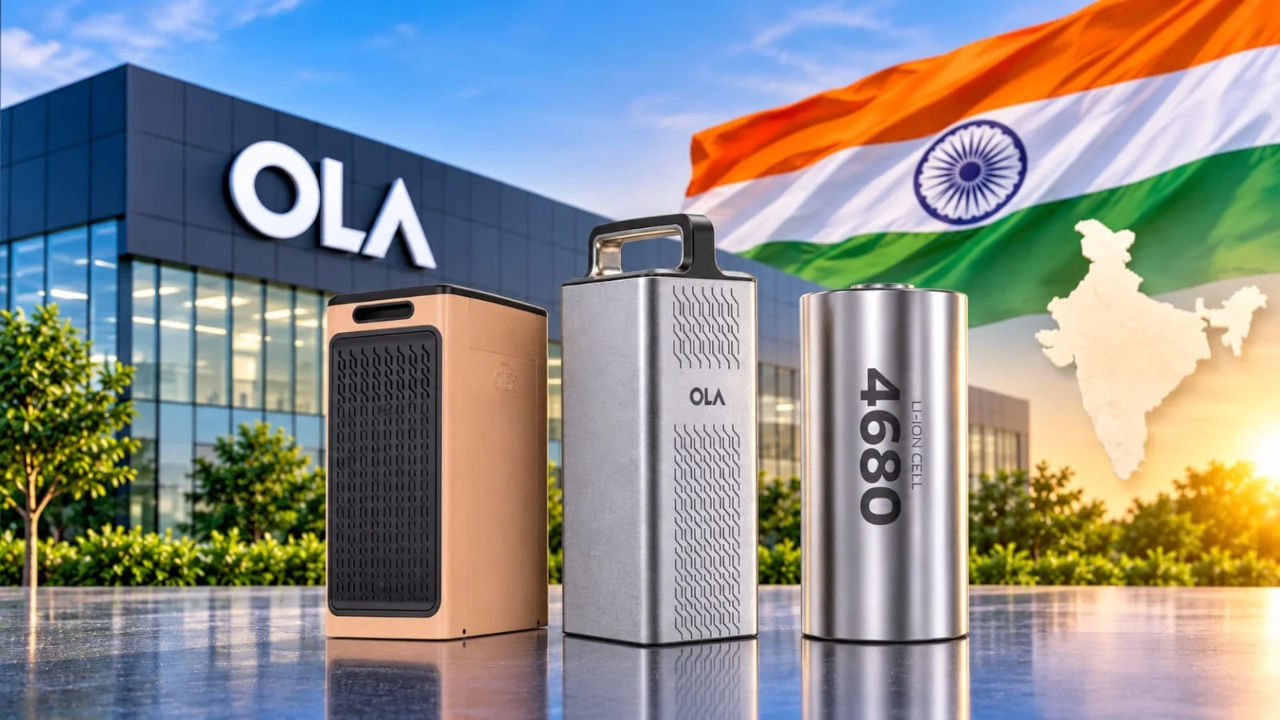
India's ambition to become a global battery manufacturing hub faces a challenge that goes beyond setting up factories: building a domestic supply chain for the materials and technologies required to manufacture cells at scale. While the country has developed capabilities in battery pack design, battery management systems (BMS) and vehicle integration, several critical materials and manufacturing inputs still come from overseas.
Ola Electric is among the companies attempting to address this gap. Its Gigafactory in Krishnagiri, Tamil Nadu, has 6 GWh of commissioned annual manufacturing capacity, where the company produces its 4680 Bharat Cell. It is also developing LFP batteries and researching newer chemistries, including LMFP, sodium-ion and solid-state batteries.
However, manufacturing cells in India does not necessarily mean the entire process is localised. The company continues to import cathode and anode active materials and some precision equipment. In an interaction with Digit, an Ola Electric spokesperson discussed its manufacturing process, dependence on China, battery safety, recycling and what India needs to become more self-reliant in battery technology.
How Ola manufactures its 4680 Bharat Cell
At the Ola Gigafactory, battery manufacturing begins with active-material powders, which are converted into electrode films using the company's dry process. These films are laminated onto metal foils, cut into strips and wound together with a separator between the electrodes. The winding is then placed inside a metal can, followed by welding, electrolyte filling and sealing.
The assembled cells undergo their first controlled charge before being tested and graded. They are subsequently used in battery packs assembled at Ola's Futurefactory.
Explaining the process, the spokesperson said, "At the Ola Gigafactory, we turn active-material powders into electrode films using our dry process. We laminate the films onto metal foils, cut them into strips and wind them with a separator between the electrodes."
However, several inputs still come from outside India. Ola imports cathode and anode active materials and some precision equipment, while separators are sourced from specialist suppliers. The company says it has localised electrolyte and some mechanical components, with a near-term target of achieving more than 60% localisation.
China dependence and the search for alternative suppliers
China remains an important part of the global battery supply chain, particularly in refining lithium into battery-grade chemicals and processing graphite used in anodes. Although countries such as Australia, Chile and Argentina also produce lithium, developing domestic refining capabilities remains important for India's battery ambitions.
Ola says it has qualified suppliers outside China for key raw materials to reduce the risk of supply disruptions. Its electrode materials currently come from China, Japan and South Korea. The company is also validating Indian-made lithium iron phosphate (LFP) cathode material.
The spokesperson said, "We have already qualified suppliers outside China for key raw materials. That gives us a tested alternative before a disruption."
Rare-earth supply concerns have also influenced its motor development. Ola says the situation accelerated the development of its certified ferrite motor, which does not use rare-earth magnets.
NMC, LFP and next-generation battery technologies
Ola is developing different battery chemistries for different applications. Its 4680 Bharat Cell uses nickel-manganese-cobalt (NMC) chemistry, which the company considers suitable for scooters, motorcycles and other vehicles that need higher energy density within limited space.
For affordable electric vehicles and stationary energy storage, Ola is focusing on LFP chemistry because of its lower cost and long cycle life. Its 46100 LFP cell has received Bureau of Indian Standards certification, with vehicle integration targeted around March or April 2027.
The company is also developing higher-energy NMC and manganese-enriched LFP (LMFP) batteries. Sodium-ion and solid-state technologies, however, remain at the laboratory stage.
"Sodium-ion is a candidate for stationary storage, where weight matters less. We have no firm volume-production dates for these programmes," the spokesperson said.
The next challenge for these technologies is demonstrating cycle life and consistent performance on a production line rather than just in laboratory testing.
Why scaling cell manufacturing remains difficult
Moving from laboratory experiments to high-volume manufacturing is one of the biggest challenges for battery companies. Ola says maintaining uniformity across an entire electrode roll while operating at production speed has been particularly difficult.
A roll may meet its average coating target, but a section along the edge of the cathode could still have insufficient active material. Cells manufactured using that portion may consequently store less charge. Identifying such variations early can prevent wasted material, electricity and machine time.
The spokesperson explained, "The hardest step has been keeping an entire electrode roll uniform at production speed."
Ola reported that its NMC manufacturing yield was closer to 80% in November. The company also said its 4680 cell retained 90% of its original capacity after 1,000 charge-discharge cycles, based on its testing.
Improving manufacturing yields will remain important as the company expands production and attempts to compete with established Chinese, Korean and Japanese manufacturers.
Ola's 6 GWh Gigafactory and plans for expansion
Ola's Gigafactory in Krishnagiri currently has 6 GWh of commissioned annual capacity. The existing building can accommodate 20 GWh with additional production equipment. The company has also secured land that can accommodate more than 100 GWh of capacity.
However, available factory space and commissioned capacity should not be confused with actual production volumes. Ola says its immediate priorities are stabilising yields on existing manufacturing lines and integrating LFP cells into vehicles.
"The building can accommodate 20 GWh, with additional production equipment. We have also secured land in our Gigafactory to accommodate 100+ GWh," the spokesperson said.
Battery safety, charging and real-world customer feedback
Cell format, battery pack design and the BMS collectively influence battery safety, thermal behaviour and charging performance. Ola's 46100 cell is taller than its 4680 cell. If it stores more energy per cell, a battery pack of the same capacity could require fewer cells and welds.
However, cell geometry also changes how heat travels through the battery. The pack must manage that heat and provide a safe route for vented gases. Meanwhile, the BMS monitors temperature and cell-group voltage to determine safe charging currents.
Ola says its R&D centre optimises cell chemistry for handling thermal abuse. Customer behaviour has also influenced its vehicle design. Daily riding distances helped the company determine battery pack sizes, while customers' preference for overnight home charging influenced its decision to integrate the charger into the scooter.
From scooters to drones and grid-scale storage
Ola's battery ambitions extend beyond electric two-wheelers. The company is exploring home and commercial energy storage, drones, robotics and defence applications.
Its next Shakti home energy storage system will use LFP cells, while Mahashakti is its planned commercial and grid-scale platform. The chemistry makes sense for storage applications where long cycle life and the cost of electricity delivered over the battery's lifetime are important.
Different requirements apply to other applications. Drones prioritise low weight, robots require uptime, and defence customers need batteries qualified for their operating environments.
The spokesperson also revealed that Ola's 46100 NMC cells are undergoing trials with drone manufacturers. The company believes storage could eventually exceed scooters in cell volumes, although whether it becomes a bigger business in revenue will depend on deployments and repeat orders.
Recycling and what India needs to strengthen its battery ecosystem
Battery recycling could eventually reduce India's dependence on imported materials, provided recovered materials meet battery-grade specifications. Factory scrap offers an initial opportunity because its chemistry is already known. Retired EV batteries could become another source as the electric vehicle fleet ages.
Ola currently sends batteries that fail under warranty to authorised recyclers and is evaluating stationary reuse. It may also explore a commercial recycling loop that returns recovered materials from its batteries to its own cell manufacturing operations.
Beyond recycling, the company believes India needs to prioritise battery-grade refining, cathode and anode materials, and reliable cell production. India is comparatively stronger in pack design, BMS software and vehicle integration, but remains behind China in refining and active-material processing.
Ola also wants the government to retain the Advanced Chemistry Cell production-linked incentive (ACC PLI) scheme, while linking incentives to verified sales of Indian-made cells and domestic value addition. It has recommended funding trials of Indian cathode and anode materials, gradually introducing import duties as domestic suppliers demonstrate quality and volume, and establishing shared pilot lines and independent testing facilities.
The company believes subsidies should not support idle capacity or pack assembly using imported cells as domestic cell manufacturing.
India also needs more engineers capable of taking battery technologies from laboratory research to consistent factory production. Ola says its engineers at the Battery Innovation Centre in Bengaluru and Gigafactory in Krishnagiri have worked on taking the 4680 Bharat Cell from electrode design and pilot trials to commercial production.
Ultimately, India's battery ambitions will depend on more than the number of factories it builds. Localising raw materials, improving manufacturing yields and developing the engineering expertise to produce consistent cells will be equally important. Ola's expansion plans offer one example of that effort, but its continued dependence on imported materials also highlights how much work remains before India can build a truly self-reliant battery ecosystem.

Ashish Singh is the Chief Copy Editor at Digit. He's been wrangling tech jargon since 2020 (Times Internet, Jagran English '22). When not policing commas, he's likely fueling his gadget habit with coffee, strategising his next virtual race, or plotting a road trip to test the latest in-car tech. He speaks fluent Geek.
View full profile