
GPT-6 Astra vs Sol vs Luna: Which One Is for You
 Follow Us

OpenAI recently followed a strategy that auto makers have employed for decades by taking one popular model and creating an entire family of models consisting of “sports,” “standard,” and “budget” variations. Only in their case, performance is measured not by horsepower but by tokens per second and dollars per million. Astra was released at the start of the month as OpenAI’s most powerful model to date. A few days later, Sol and Luna joined the family as more affordable yet fast alternatives. Here’s how they differ from each other.
 Survey
Astra is the one you don’t pick by default
Consider Astra the go-to model if you really care about getting the job done, and if cost is not your concern. OpenAI claims it to be the best available model for computers and the one that fits best in its repertoire. It’s quite an ambitious statement indeed, and it definitely comes at a cost.
For most people out there, Astra would just be an unnecessary extravagance. For most jobs out there, Astra is nothing but a waste of money. Drafting emails, PDF summary, or understanding GST slabs is not what you do with Astra.
Sol is the workhorse
The real story is in Sol. OpenAI says Sol outperforms Anthropic’s Claude Opus 5 in business/workflow applications at about one-tenth the price-per-task when both models are pushed to their absolute limit. Let’s be generous here and take some of these numbers down a few notches for marketing gloss – but either way, the trend is obvious: Sol is designed to make agentic, multi-step processes (which consume large quantities of tokens) affordable enough to actually execute.
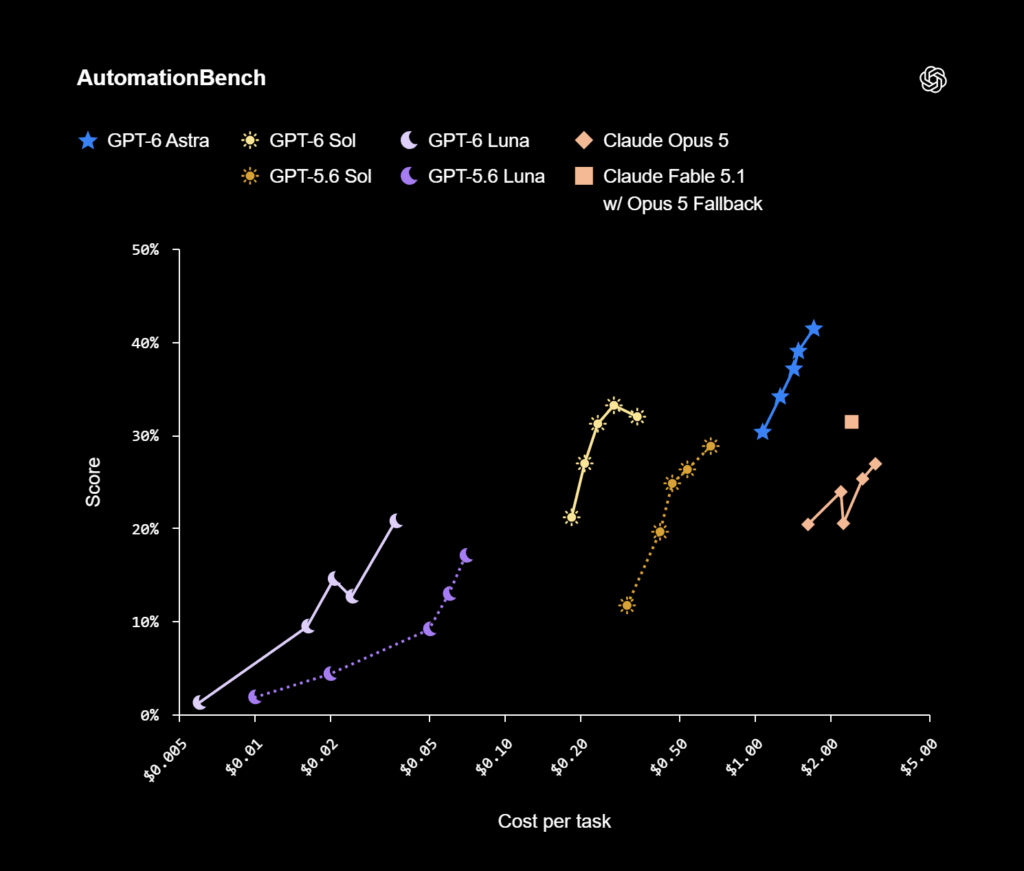
This is how the real excitement shows up in coding. Sol apparently catches up to the higher-priced competition on real codebase problems while remaining extremely cost-effective per task. If you are a startup operating in Bengaluru running an AI coding assistant all day, you aren’t going to miss the distinction between affordable and unsustainable costs.
Sol also benefited from a 50% discount on the API as compared to its predecessor, the GPT-5.6. This is no mere rounding error. It is OpenAI making it clear that it expects Sol to be the go-to option rather than the fall-back one.
Luna is for everything else
The Luna model is the one that handles the less glamorous, high-volume tasks: fast responses, simple automation, the type of tasks which do not require a genius but only speed and cost efficiency. The Luna model costs $0.10 for a million input tokens.
For instance, if you are a software developer and your project involves developing a customer service bot or a basic content assistant, Luna is your best bet. If you use Sol for such a task, it would make no sense, similar to hiring a surgeon for a Band-Aid.
So which one is for you?
As an average user of ChatGPT, this choice is largely unnoticed by you, as you’re probably just sticking with whatever route OpenAI chooses for you, and in most cases, it’s perfectly acceptable.
As a developer or someone creating something via the API, the equation is simpler than you would realize from looking at OpenAI’s benchmarks. Go for Astra only when the complexity of the work demands it. Create your everyday bots using Sol. Route your large volume, less complex jobs to Luna.
It sounds like overkill when described like this. It’s actually very straightforward. Use the right tool for the right job.


