
Gemini 3.7 Flash vs 3.6 Flash: Google’s latest AI upgrade for coders
 Follow Us

Google just did something unusual in the AI race: it shipped a meaningfully better model without waiting for a new training run. The Gemini 3.7 Flash was released only three weeks after the previous version of the software – Gemini 3.6 Flash – and rather than being considered another pretraining of the model, it is described as an enhanced version of the 3.6 Flash based on better algorithms of reasoning.
 Survey
What’s actually better
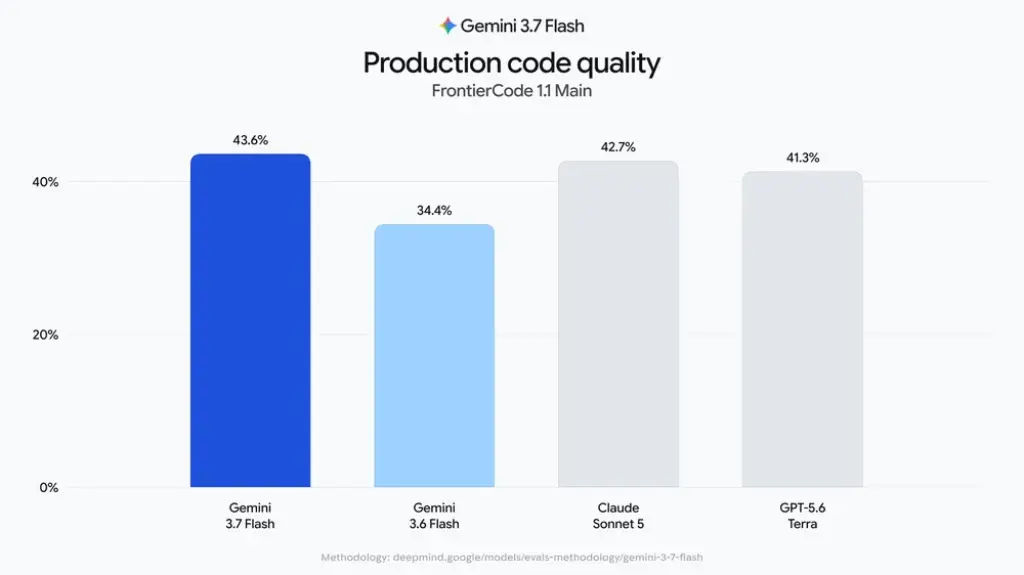
The improvement has been aimed at coders and developers. In the FrontierCode 1.1 Main test of production code quality, 3.7 Flash scores 43.6%, against 34.4% of 3.6 Flash. In the DeepSWE v1.1 benchmark test of long-horizon software engineering, 3.7 Flash scores 65.3%, compared to 49.0% for 3.6 Flash. Google claims that the model demonstrates improvements in debugging and issue fixing, not just in Q&A precision, and creates more feature-complete web applications in fewer prompts.
This is important because independent tests show that the model’s advantage lies in evaluations that demand sustained reasoning through a multi-step process, not in answering one particular question correctly – the type of task that requires an agent to examine files, make edits, and debug its own mistakes, all while maintaining the context. On tasks involving documents, 3.7 Flash scores 34.0%, significantly higher than 3.6 Flash, which scores 22.0% on the GDP.pdf benchmark of complex document processing. On the AutomationBench test of completing business workflows, 3.7 Flash scores 30.4% against 17.0% of 3.6 Flash.
Also read: Top AI features of the Google Pixel 11 series
It’s not a clean sweep, though. On CharXiv Reasoning, a chart-comprehension test, 3.7 Flash actually regresses slightly to 84.5% without tools, down from 85.2% for 3.6 Flash. If your workflow leans on chart-heavy analysis, that’s worth flagging before you switch defaults.
The pricing catch
This is where it gets really exciting for anybody operating agents at scale. Gemini 3.7 Flash will be priced at $0.75 per 1M input tokens and $3.75 per 1M output tokens – a reduction of 50% from the list price of the original 3.6 Flash and more or less equivalent to one-third of the cost of their competitor’s state-of-the-art models. But it should be noted that these prices are introductory prices that will lapse on December 31, 2026. From January 1, 2027, it will be priced at $1.50 per 1M input tokens and $7.50 per 1M output tokens – the same price as the existing 3.6 Flash.
What stayed the same
Besides the fine-tuning of the algorithm, this is not a more substantial or fundamentally new model. It takes text, image, audio, and video input within the context of a 1M token window, producing an output of up to 64K tokens, and both the models have identical restrictions on headline contexts, cost, multimodal input capabilities, caching, code execution, function calling, and use of computer in preview mode. Knowledge cutoff remains unchanged, which is March 2026.
Should you switch?
If you are on 3.6 Flash right now, then the math is pretty simple: 3.7 will just be an upgrade that gives you zero negative cost trade-off during the promotion period, while beating 3.6 by far on the benchmarks of importance for actual development work. The regression on chart reasoning is too small to make people regret going for 3.7, but it is something that should be taken into account in case you use visual data analysis in your pipeline and have a regression testing suite. What is interesting to see is how Google behaves after the expiration of the promotion period in 2027.
Also read: Digit Research: More Indians prefer robot vacuum cleaners, after-sales falls short


