
Claude Opus 5 vs Sonnet 5: 3 ways Opus is worth the upgrade
 Follow Us

Anthropic just dropped Claude Opus 5, and it’s now the default model on Claude Max and the strongest option on Claude Pro. If you’ve been running on Sonnet 5 and wondering whether the jump is worth it, here’s the case for upgrading.
 Survey
Also read: Exclusive: Nothing to exit 12 markets as global shipments decline, despite India growth
Coding and agentic performance
Opus 5 comes close to the frontier intelligence of Claude Fable 5 at half the price, and it’s the new state-of-the-art on coding and knowledge-work benchmarks like Frontier-Bench and GDPval-AA. That’s not incremental. On Frontier-Bench v0.1, it surpasses every other model and more than doubles its predecessor Opus 4.8’s score at a lower cost per task. On CursorBench 3.2, at max effort, it lands within half a percentage point of Fable 5’s peak score, but at half the cost.
For anyone running agentic coding workflows through Cursor, Devin, or Claude Code directly, this matters more than raw benchmark bragging rights. Devin’s team found Opus 5 shows particular strength on difficult debugging and root-cause analysis, while Lovable’s co-founder noted it came in 22% ahead of Opus 4.7 on their hardest agentic tasks, with far less run-to-run variance. Sonnet 5 remains solid for everyday coding, but Opus 5 is built for the harder, messier, multi-step jobs where Sonnet starts to wobble.
Thinking and verification
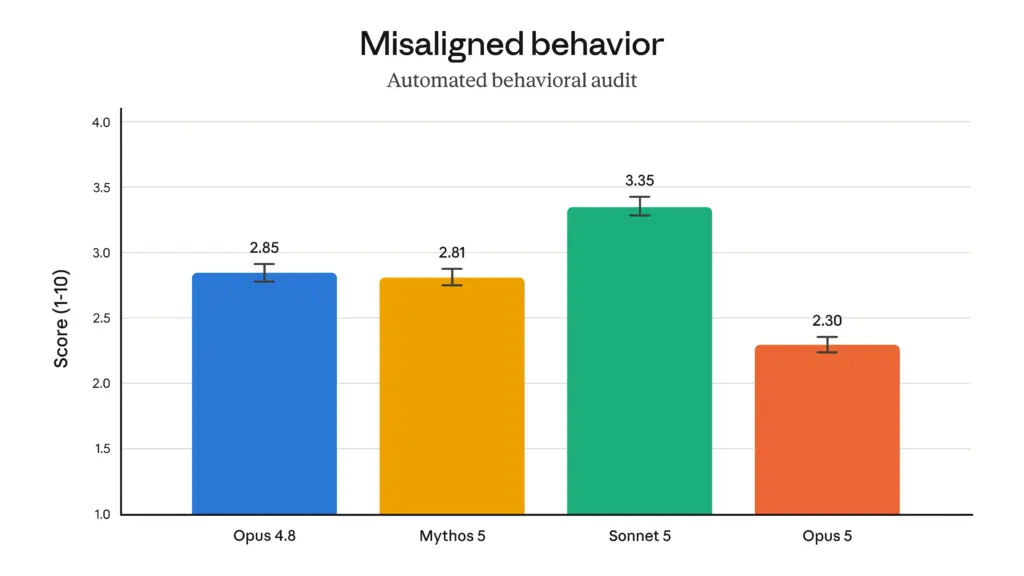
This is the real differentiator over Sonnet 5. Opus 5 is much stronger at verifying its work and iterating carefully until it succeeds. Anthropic’s own example: given a machine-part drawing and asked to rebuild it as a 3D FreeCAD model with no direct way to view the image, Opus 5 wrote its own computer vision pipeline to extract the geometry from raw pixels and reconstructed the part, succeeding repeatedly where no competing model could solve it in five attempts.
This “checks its own homework” behaviour shows up across real deployments too. One CEO described Opus 5 opening its own pages in a browser at desktop and phone widths, catching a product hidden below the mobile fold and an off-screen checkout button, and fixing both before handing the work back. Sonnet 5 will do what you ask; Opus 5 is more likely to catch what you didn’t think to ask for.
Judgment-heavy work
Where Opus 5 separates itself most is in tasks that run long and demand actual judgement, not just pattern-matching. On Zapier’s AutomationBench, which measures whether models can complete business tasks start to finish, Opus 5’s pass rate is around 1.5 times the next-best model for the same cost, and even at its lowest effort setting it outpasses every other model.
It also pushes back intelligently rather than just complying. One engineer described a rearchitecting session where Opus 5 pushed back on a proposed design, didn’t fold when challenged, and instead narrowed its objection to a single design question before proposing a compromise that kept the good part of the idea while fixing the flaw. That’s the kind of collaborative reasoning Sonnet 5 isn’t built for – it’s a faster, cheaper model, tuned for volume rather than depth.
The catch
Opus 5 isn’t cheap in absolute terms – it’s priced at $5 per million input tokens and $25 per million output tokens, the same as Opus 4.8 – and it’s still not the top of Anthropic’s stack. It remains behind Mythos 5 specifically on cybersecurity tasks and long-running autonomous biology research. For most journalists, developers, and knowledge workers though, that’s a non-issue.
Also read: Portable AC vs desert cooler vs tower cooler: Which one is more practical for your room


