
 E-Magazine
Blinkit app decompiled: What Android lets apps see and what the code can't prove
There was a recent viral post that decompiled Blinkit and claimed that Blinkit reads your battery, your Wi-Fi name, the size of the fonts used and the installed apps in order to determine your age, your family size and your level of desperation to get a delivery. We covered the claims and Blinkit's reply here.
We contacted an IT expert to decompile the Blinkit app. They built a local Android test app to find out what your OS allows your app to do and then compared that with what the decompiled Blinkit code showed. Here is what was found.
How the test worked
The test application is targeting API 37 and supports phones starting from API 24. We didn’t connect it to the internet so everything stays on device. The test application runs the same Android APIs like the decompiled Blinkit does and gave us the results.
Keep in mind that the test application shows what can be read by the app. It is impossible to tell what they do in Blinkit's servers using this information.
Installed apps
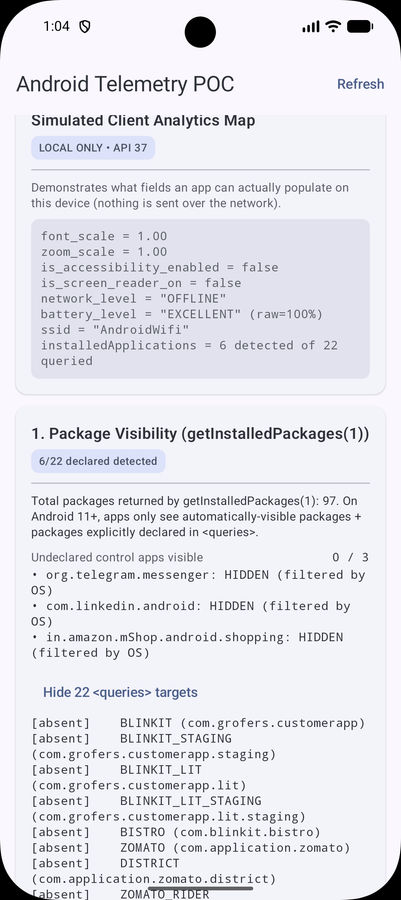
As per the reel, Blinkit checks 21 installed applications on your phone including Slack, Instagram, Zomato and more. In the test application, 22 target applications were declared and inquiry was performed. Six were detected. 97 packages in total were returned by Android, but three undeclared control applications – Telegram, LinkedIn, and Amazon Shopping – were not detected.
An app can only see the packages it names in the manifest, atleast with restricted permissions. Thus, the check is real and affects only the applications chosen by Blinkit. Can they figure out where you work just from Stack access though? For now, that is just speculation.
Font size and accessibility
The claim behind checking the font scale and screen reader settings to spot which customers are older was a little loose. It was found that any app would be able to check the values of font scale, display zoom, accessibility status, and screen reader status without needing any permission.
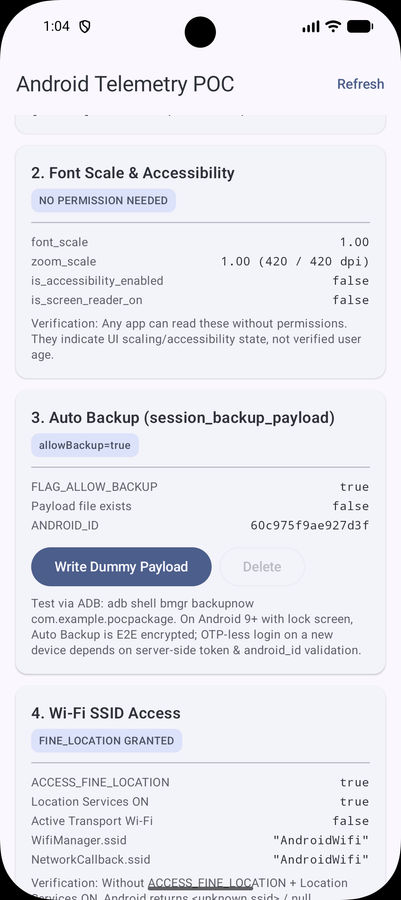
The values show your screen’s configuration rather than the user. The font scale and other values are checked when performing layout and accessibility tests. It is legitimate to do so. It is still unproven if this is being used to guess the user’s age and change prices.
Wi-Fi name
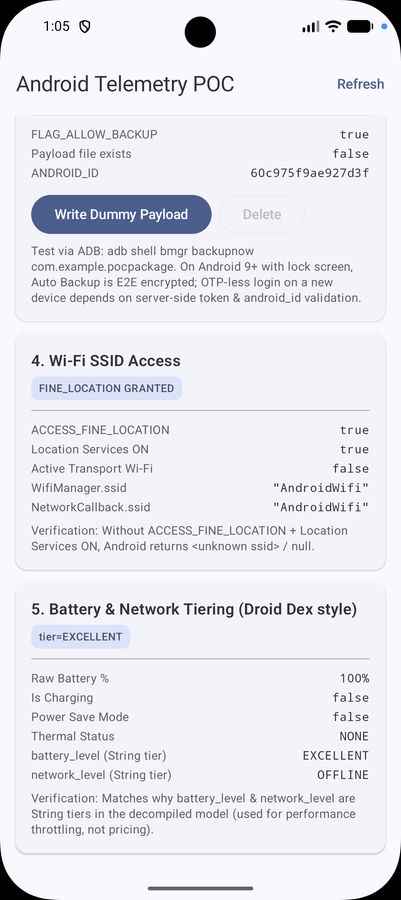
As for Wi-Fi, it was found that the network name is not shown by Android unless the app has fine location permission, and location services are active. With both on, the app was able to get the network name using two different approaches.
Caching a network’s name paired with a location is a normal way to skip slow GPS locks, and this is what Blinkit claimed. Working out households from those pairs would need analysis on a server.
Battery and network level
One of the allegations was regarding people choosing to pay surge prices depending upon the battery level. In the decompiled code, there is no direct number for the battery level or the network level; these are tiers such as EXCELLENT, HIGH, AVERAGE, and LOW, and these are just like the scheme of Droid Dex, which is an open source performance library used by Blinkit.
In the test application, these same tiers have been recreated using raw battery percentage, charging status, power save mode, and thermal condition. According to the findings, these tiers are evaluated on the device to reduce background polling and animations on the weak device.
Login token in the backup
This is a concerning find. Blinkit backs up a file holding the session token linked to your Google Account so technically, a new phone can log in without ever asking for an OTP.The test app had the same backup flag switch flipped on.
Android versions after 9 encrypt these backups and logging in without OPT would depend on if the server is checking the token and device ID. Leaving these tokens in a backup is a digital hygiene problem. So the best thing to do is completely remove them or move them to the Credential Manager.

Vyom Ramani
Vyom Ramani A journalist with a soft spot for tech, games, and things that go beep. While waiting for a delayed metro or rebooting his brain, you’ll find him solving Rubik’s Cubes, bingeing F1, or hunting for the next great snack.
View full profile