Massive tech layoffs contrast sharply with soaring demand for elite AI talent
Tech companies cut routine roles while offering millions to top AI engineers
Workforce shift favours AI skills, leaving many unprepared for new demands
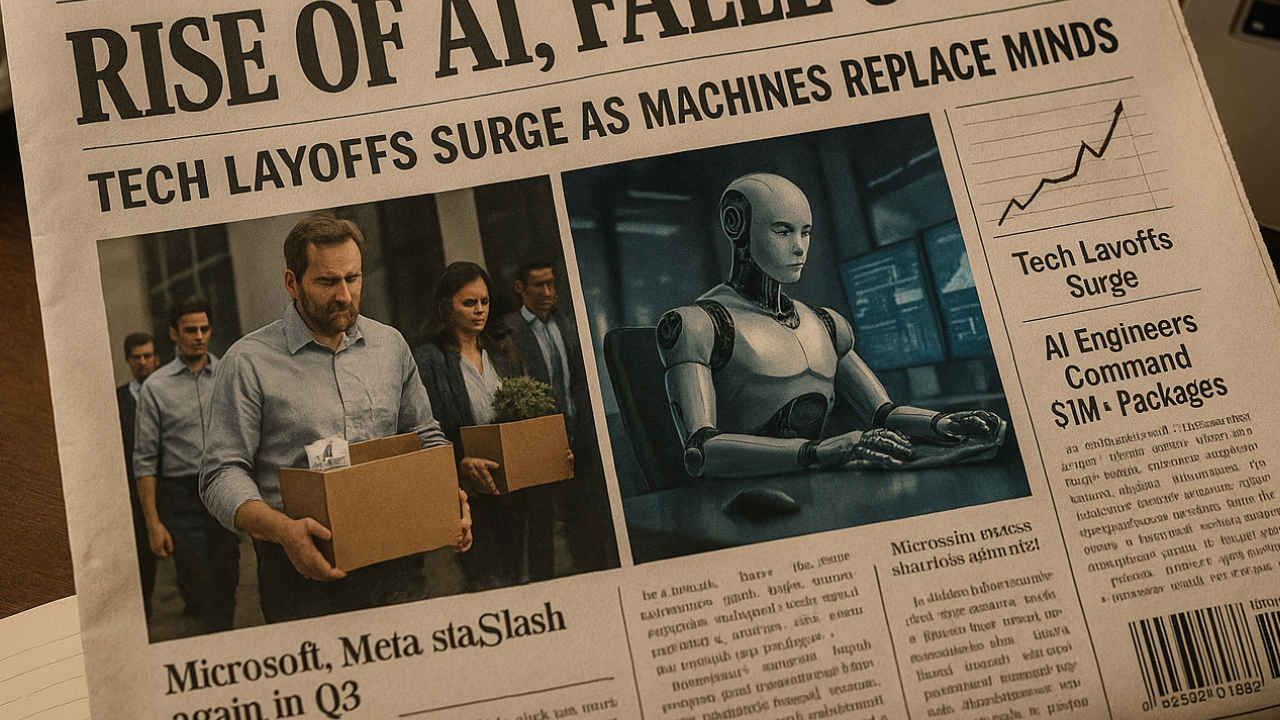
Something doesn’t make sense to me, thanks to a strange paradox unfolding in the world of tech right now. One side of the equation reads like a pink slip factory, where more than 80,000 tech jobs have been lost in the US alone this year, with another 20,000 slashed across Indian IT giants like TCS and Infosys. On the other side, is a bidding war for AI talent so unbelievably bonkers that it’s making Wall Street bonuses look like peanuts in comparison. Meta’s reportedly dangling $100 million offers to poach the best AI minds out there. Ditto Microsoft, Amazon, Google – everyone’s recruiting like there’s no tomorrow.
 Survey
It’s a tale of two job markets. One collapsing. One exploding. Can both be true at once? Or are we witnessing a tech industry that’s racing blindly into the future, in their FOMO to paint the town red with AI, leaving behind not just people… but logic?


AI is impacting tech jobs

Let’s start with the bloodshed, in a manner of speaking. In the first seven months of 2025, over 100,000 tech workers globally have been laid off, including more than 80,000 in the US alone. Just Microsoft by itself has let go of 15,000 employees – Intel, twice that globally. India’s usually resilient IT sector wasn’t spared either, with TCS’s 12,000 layoffs marking its largest-ever cull, even as silent layoffs are happening below the radar.
Also read: Meta layoffs: Thousands lose jobs as Mark Zuckerberg-led platform bets big on AI talent
Much of the damage has come dressed in euphemisms like “realignment,” “operational efficiency,” “right-sizing.” But make no mistake, what’s happening is structural. Repetitive coding, IT support, QA, customer service, basically jobs and roles that once formed the engine room of tech operations are now being gutted. Simply because generative AI is now doing those jobs faster, cheaper, and, in some cases, better.
A crude form of Darwinism is at play within the broader tech industry, where companies are shedding skin and muscle in pursuit of a leaner, AI-powered future. But this is what’s adding insult to injury of sorts. Even as thousands are being let go, another, smaller group is being chased with blank cheques and private jets.
AI researchers, LLM engineers, generative AI specialists – they’re not just being hired, they’re being hunted, and for over a year now. In March 2024, Microsoft scooped up Mustafa Suleyman and most of Inflection AI in what industry watchers called a “reverse acqui-hire.” Amazon followed suit, snagging top talent from Adept. Meta, meanwhile, is hoovering up PhDs like it’s pre-2008 Google all over again – other than poaching top talent from big AI startups with hundreds of millions of dollars for their signature.
Salaries are surging too. AI-focused roles in the US are offering up to 43% more than their non-AI counterparts, with premiums averaging $18,000 annually. Some high-stakes recruits are being offered packages north of $100 million – yes, you read that right. This is not hiring, it’s akin to warfare.

Also read: Meta offered billion-dollar deals to poach AI talent from Mira Murati’s startup, but failed: Report
India presents a more complicated picture. On one hand, global tech firms are ramping up AI hiring here, as Capgemini alone plans to hire 45,000 in 2025, many into “AI-ready” roles. On the other, there’s a growing mismatch – while demand for AI skills is skyrocketing, less than 20% of India’s IT workforce is currently AI-proficient.
Fresh graduates with the right AI credentials are commanding 3-4x the usual entry-level salaries, even as mid-level engineers without these skills are being laid off. NASSCOM estimates India needs 1 million AI professionals by 2026. We’re nowhere close. The gap between those who can build the future and those being displaced by it is widening dangerously.
The bigger picture isn’t clear yet
All of which brings me back to the central absurdity I outlined at the top of this article. That tech’s current labour market is acting like a zero-sum game where the winner takes all. AI is far from just automating jobs, as it reshapes the value of labour itself.
The problem isn’t that companies are investing in AI. It’s that they’re doing so while simultaneously offloading tens of thousands of employees without an adequate bridge in place. No meaningful upskilling. No realistic career transition programs. Just a guillotine on one end and a golden staircase on the other.
Also read: Top Meta engineers are joining xAI without massive compensation, claims Elon Musk
It’s hard to overstate how bizarre this looks. Imagine a hospital laying off all its general practitioners to hire neurosurgeons, and then wondering why the waiting room is on fire. That’s how it seems to me, reading all the hiring and firing headlines in tech over the past few weeks and months

Yes, AI is a productivity miracle. There’s no understating that. It can code, write, design, summarize, analyze. But AI’s also still flawed, and it needs human supervision, guardrails, context, and ethics. Not just cruel, the current approach – lay off your base to fund your moonshot – seems short-sighted.
More importantly, it reveals a deeper ideological shift in tech. Away from the old ethos of team growth and toward simply hiring the winner. Startups that once wore their hiring sprees as a badge of honour now view talent as modular, disposable. Meanwhile, big tech players are busy reshuffling their workforce like a poker deck, betting big on a few hands to fulfill their AI ambitions. As audacious as the current AI-fuelled hiring wave is, where companies are paying crazy money to attract a handful of brilliant AI minds, you have to ask who’s building the scaffolding that holds the rest of the company up?
Until then, the headlines will keep playing this split-screen drama: engineers losing their jobs one day, only to read about their peers being poached for millions the next. And we’ll keep asking the same question. Why does any of this make sense?
Also read: Bill Gates says AI is moving at “great speed” on the jobs market: Here’s why
 Follow Us
Jayesh Shinde
Executive Editor at Digit. Technology journalist since Jan 2008, with stints at Indiatimes.com and PCWorld.in. Enthusiastic dad, reluctant traveler, weekend gamer, LOTR nerd, pseudo bon vivant. View Full Profile


