
Aleph Alpha Kolibri explained: Europe’s sovereign open weight answer to the US
 Follow Us

Europe was promised that Europe could never develop any serious AI. Aleph Alpha responded with Kolibri, an AI anyone can download, use and train. With 78 billion parameters, it activates only a small portion of them with each token. It was trained on European soil using European languages – German and English. Kolibri’s licence allows everyone to operate it on their own devices. A revolutionary development? Not really. Does it matter to us? Most certainly.
 Survey
Also read: Microsoft launches new voice agents: MAI-Transcribe-2-Streaming and MAI-Voice-2.1 explained
What is Kolibri?
Kolibri is an open-weight architecture for German and English language models published on 3 October 2026 under the Apache 2.0 license, with weights hosted on Hugging Face and trained from scratch in Germany and Finland. The technical documentation of Kolibri mentions that the developers held the rights to the entire pipeline – from data gathering to evaluation. However, open weight is different from open-source.
This model was based on Kolibri Origin, a 30-billion-parameter model created by Aleph Alpha to test their training pipeline and not made public. This model comes equipped with explicit reasoning functionality and tool calling capabilities, making it agent and retrieval system-friendly.
Big model, small bill
The key figure is 78.1 billion parameters. The important figure is 3.46 billion, which is what Kolibri employs per token, approximately 4.4% of the total. This is the mixture-of-experts approach. There are 50 layers in total, and each layer has 384 expert sub-networks alongside one common expert, with all the tokens being routed to six experts. It is like going to a hospital with 384 doctors on the roster, but only seeing six of them.
Calculations are not costly. Memory is. The whole network must reside in memory, which comes out to 78GB when using FP8 format, hence requiring two H100s or one H200. The context window exceeds a million tokens, although Aleph Alpha advises staying below 262,144 tokens for complicated tasks.
Why the tokenizer is the sleeper feature
The tokenizer used by Kolibri uses 15 percent fewer tokens compared to that used by GPT-5. In the case of the word “Bundesverfassungsgericht,” which translates to “federal constitutional court” in German, GPT-5 tokenizes it into six separate tokens, while Kolibri tokenizes it into two tokens. This translates into cost savings as well as improved performance in terms of speed.
What sovereign means here
Aleph Alpha uses the term in two different ways. First, the way Kolibri is built: German team, European infrastructure, European law. And second, how it gets to its users: open weights that can be deployed anywhere. It was built with the EU AI Act, GDPR, and the EU’s General-Purpose AI Code of Practice in mind. It was designed with governments, businesses, and defence clients in mind who cannot send sensitive information to an American API and cross their fingers.
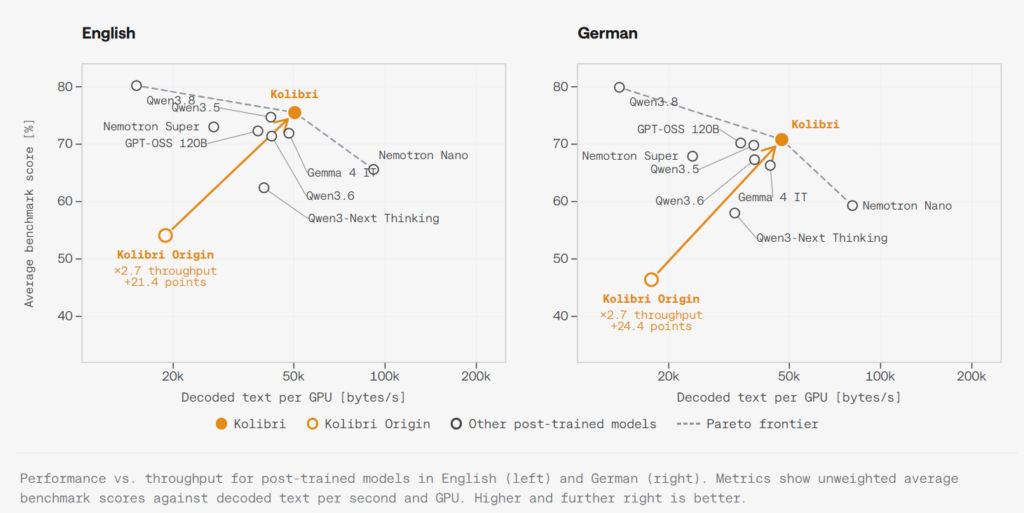
Take the scorecard with a grain of salt. Aleph Alpha conducted its own evaluation, and according to that, Kolibri outperforms all 12 mixture-of-expert models it evaluated by getting 75.5 in English and 70.8 in German. It claims 96.9 percent on AIME, a math competition benchmark, beating larger mixture-of-experts models. Let’s wait for independent numbers.
Early observations about the community highlight some of the shortcomings: Kolibri performs worse than Qwen when it comes to memorizing factual knowledge, using tools in lengthy conversations and coding the agent’s tasks. It also requires Aleph Alpha’s proprietary add-on for vLLM and hence is not plug-and-play ready.
Eliminate the German aspect, and the playbook becomes transferrable. Choose a language, build the tokenizer based on it, train the model locally, and release the weights. This would help address the token tax problem that India is facing in its quest for sovereignty in the AI space. Europe may not rival America in terms of sheer numbers. But in stacking the ownership case, it has done it emphatically.
Also read: What is Tavus Griffin: The Human Interaction Model that passed the Turing Test


