NASA rover uncovers Martian rock with potential biosignature hinting ancient life
Perseverance discovery raises hopes Mars once supported microbes in watery environments
Scientists cautiously examine minerals that could be signs of Martian biology

When NASA’s Perseverance rover touched down in Jezero Crater in 2021, the mission had one ambitious goal above all others: to search for signs of ancient life on Mars. Now, that goal may be closer than ever. NASA has revealed that a rock sample collected last year, nicknamed Sapphire Canyon, contains what researchers are calling a “potential biosignature” – a tantalizing hint that microbial life may once have thrived on the Red Planet.
 Survey
What exactly did Perseverance find?
The rover drilled into a layered sedimentary rock known as Cheyava Falls, part of an ancient river delta. Sedimentary rocks are prime candidates for preserving biological traces because they form in watery environments, and water, as scientists often repeat, is the foundation of life as we know it.


Also read: From balloons to satellites: Why Esrange is the world’s most flexible space center
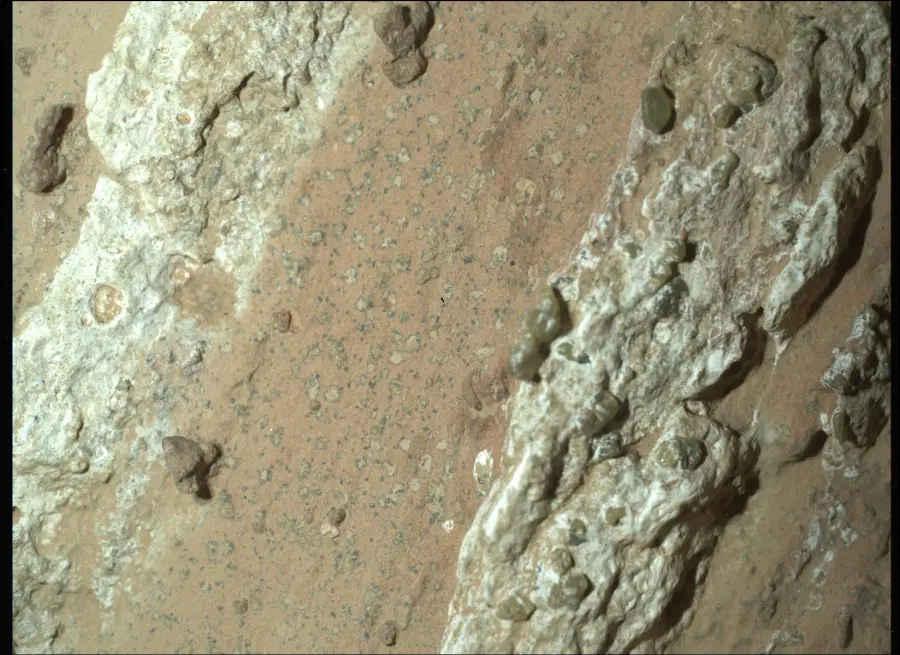
Perseverance’s instruments, including PIXL (Planetary Instrument for X-ray Lithochemistry) and SHERLOC (Scanning Habitable Environments with Raman & Luminescence for Organics & Chemicals), revealed striking chemical patterns inside the rock. The sample showed organic carbon, sulfur, phosphorus, and oxidized iron, along with unusual “leopard spot” textures made of two minerals: vivianite (a hydrated iron phosphate) and greigite (an iron sulfide).
On Earth, these minerals often form in association with microbial processes, hinting at a possible biological origin.
Why scientists are cautious
Despite the excitement, the word “potential” is doing heavy lifting here. A biosignature is not direct evidence of life, it’s evidence that could be explained by biology, but might also result from purely chemical reactions.
Also read: 5 crazy facts about Chile’s Vera Rubin telescope: It has world’s largest digital camera
Some of the observed patterns could theoretically arise through non-living processes involving heat or acidity. However, researchers note that the rock does not appear to have been exposed to those extremes, making the biological explanation harder to dismiss. Still, until samples are returned to Earth for deeper study, uncertainty remains.
Even as a tentative finding, the discovery is significant. If the mineral textures in Sapphire Canyon do turn out to be biological, it would mean Mars hosted habitable conditions for longer and possibly more recently than previously thought. That reshapes the timeline of Mars’ habitability and strengthens the case for the planet once sustaining life.
It also underscores the importance of Perseverance’s ongoing sample-collection campaign. The rover is caching dozens of rock cores that could eventually be brought back to Earth by a future Mars Sample Return mission, where they can be analyzed with laboratory precision far beyond the rover’s instruments.
Chasing life beyond Earth
For decades, the search for life beyond Earth has hovered between possibility and proof. Mars has long been the prime suspect, but definitive evidence has remained elusive. Perseverance’s discovery doesn’t close the case, but it marks one of the strongest leads yet.
If confirmed, these Martian “biosignatures” would represent one of the most profound discoveries in human history: that life is not unique to Earth. Even if the signals prove abiotic, they still deepen our understanding of Mars’ complex chemistry and its potential to host life in the past. NASA’s announcement is both thrilling and cautious. The Perseverance rover may have uncovered Mars’ first real fingerprint of ancient microbes but the verdict will only be clear when these samples make the long journey back home.
Also read: Interstellar Visitor Spotted by Astronomers: What Is It?
 Follow Us
Vyom Ramani
A journalist with a soft spot for tech, games, and things that go beep. While waiting for a delayed metro or rebooting his brain, you’ll find him solving Rubik’s Cubes, bingeing F1, or hunting for the next great snack. View Full Profile


