
 E-Magazine
Sarvam AI CEO says foreign models do not undermine India's sovereign AI ambitions, responds to backlash
Sarvam AI defends offering foreign AI models through its Token Factory platform.
The company clarifies that it received subsidised computing resources, not direct government funding.
Sarvam aims to reduce AI costs in India with better infrastructure and competitive token pricing.
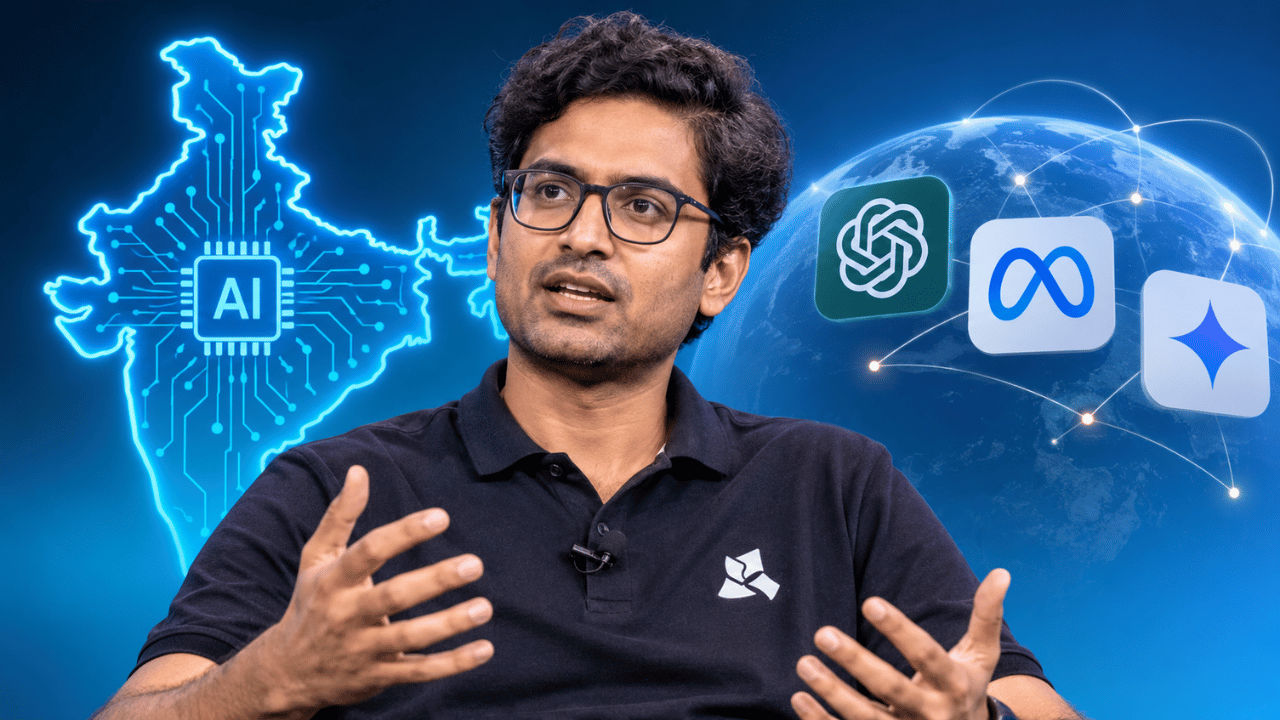
The backlash around Indian AI startups has taken a new turn, with Sarvam AI co-founder and CEO Pratyush Kumar defending the company's decision to offer foreign-developed AI models through its Token Factory platform. For the unaware, the issue started when Sarvam launched Token Factory on November 16, an inference platform offering models from DeepSeek, Moonshot AI and Z.ai alongside its own models and Google's Gemma. Critics questioned whether this fits with Sarvam's image as a champion of India's sovereign AI. The company now argues that offering these models doesn't conflict with its original goal of building homegrown AI models.
Sarvam AI explains why it offers foreign AI models
In a post made by Kumar on X, he explained that open-weight AI models have become popular in different parts of the world because of their affordability and the ability to give businesses control over their technology as compared to other types of AI models.
Some clarifications on various themes being discussed about @SarvamAI in the last few days: 1. Government Support: The IndiaAI Mission under MeitY has played a pivotal role in bootstrapping India's AI ecosystem. It gave ~20 startups subsidised access (40% discount) to GPUs for training models. We used that access to train Sarvam 105B from scratch, which we completed and open-sourced this February. The government did not pay Sarvam directly, instead like with every supported startup, the subsidy went to GPU cloud providers, helping seed AI infra in the country. 2. Sarvam Token Factory: Open-weight models saw massive adoption globally this year. They offer a cost advantage over closed models and let enterprises own their AI stack. But this choice is not available to all Indian enterprises, which often need data to remain within the country and low latency for interactive use cases. Sarvam Token Factory is one of the first large inference offerings in India. We serve multiple open-weight models on GPUs we have privately procured, without any government support. We have optimised datacenter scale inference to make our token cost comparable to or lower than established providers such as Fireworks, Baseten and Together. Today, India consumes a few trillion tokens a day and imports the majority of them. Scaling this consumption up and building sovereign capability requires investing in GPU infra, running efficient token factories, and guaranteeing advantages in cost, latency, and data residency. This is the key objective of Sarvam Token Factory. We will continue to reduce costs further and widen access for inferencing in India. 3. Our own models: Building inference capability does not conflict with our core mission: training our own models. Over the last few months, alongside putting together the token factory and scaling up our enterprise offerings, we optimised our training stack for Blackwell GPUs and achieved significantly higher performance. We used this optimised infra to train an improved checkpoint: Sarvam 105B-1711, which we are open-sourcing today. It improves on reasoning, tool-calling, and co-work tasks, while excelling in Indian languages. It is one of the best Flash-Lite class models, open or closed, achieving high accuracy at a low cost of ₹25 per million output tokens. We also optimised it to run on a single RTX Pro GPU with our agentic product Indus. Along with the weights, we release inference and training recipes so others can build upon it. In the coming two weeks we will release multiple other models across vision, speech, and edge. And crucially, we are working with partners to get the latest training grade compute into India. This will set us up for training our next generation of much larger models. 4. The Sarvam Journey. To put things in perspective, most AI labs invest 100s of millions of dollars into infra to train from scratch, scaling up to billions for frontier capabilities. We are determined to climb that ladder from India, while building a sustainable commercial engine across population scale and enterprise use cases. Irrespective of the different narratives, some of which appear manufactured, we firmly believe that India can and must win across the full-stack of AI - we have the talent, the demand, and positivity to adopt AI. At Sarvam we will stay focused and build towards this outcome.
— Pratyush Kumar (@pratykumar) November 22, 2026
Kumar further explains that companies in India also require solutions that meet data residency criteria and provide faster processing times. In his opinion, Token Factory meets this requirement since it operates models created outside India on computing infrastructure situated in India. In addition, he explains that Token Factory uses GPUs bought privately by Sarvam and does not get any assistance from the government.
Sarvam says government did not directly fund its AI development
In the clarification post, Kumar also added that Sarvam did not receive direct financial payments from the government. Rather, it accessed subsidised computing resources under the IndiaAI Mission. Do note that these subsidies can also be availed by other companies by following proper procedures.
He also said that the government helped around 20 startups access GPUs at a 40% discount through cloud service providers under the initiative. Sarvam used these resources to train its 105-billion-parameter model from scratch, which was open-sourced in February. Kumar further added that the subsidy was paid to GPU cloud providers rather than directly to participating startups.
Sarvam AI targets lower AI costs with token factory
The firm further claimed that they have upgraded their data centre infrastructure so that they can provide token prices which would be equivalent to or even cheaper than those provided by other international firms like Fireworks, Baseten, and Together.
According to Kumar, India's increasing reliance on AI services from abroad is due to the fact that India uses several trillion tokens every day, but these are mostly imported. He stated that for India to decrease this reliance, it needs to have better GPU infrastructure, efficient systems and competitive prices.
In addition to its defence of the Token Factory, Sarvam also released an upgraded version of its 105-billion-parameter AI model. According to Kumar, offering foreign models and indigenous AI models are not contradictory to each other, and both are important objectives.

Bhaskar Sharma Bhaskar is a Senior Copy Editor at Digit India who keeps a close watch on everything shaping the world of technology from smartphones and home appliances to AI, government tech initiatives, digital safety, and the latest industry developments. Whether it's breaking news, in-depth features, hands-on reviews, practical how-to guides, or exclusive scoops, he translates complex tech into stories that are easy to understand and worth reading. His work has been featured in iGeeksBlog, GuidingTech, and other leading publications. Before joining Digit India, he served as an assistant editor at TechBloat. A B.Tech graduate and full-time tech journalist, he is driven by just one goal, which is to help readers stay informed, stay secure, and stay ahead in an ever-changing digital world.
View full profile