
 E-Magazine
Meta AI chief says superintelligence is almost here, warns humans may struggle to keep AI under control
Meta AI chief warns of the growing risks of superintelligent AI.
AI is advancing rapidly beyond coding and mathematics.
Wang stresses the need for AI safety and human control.
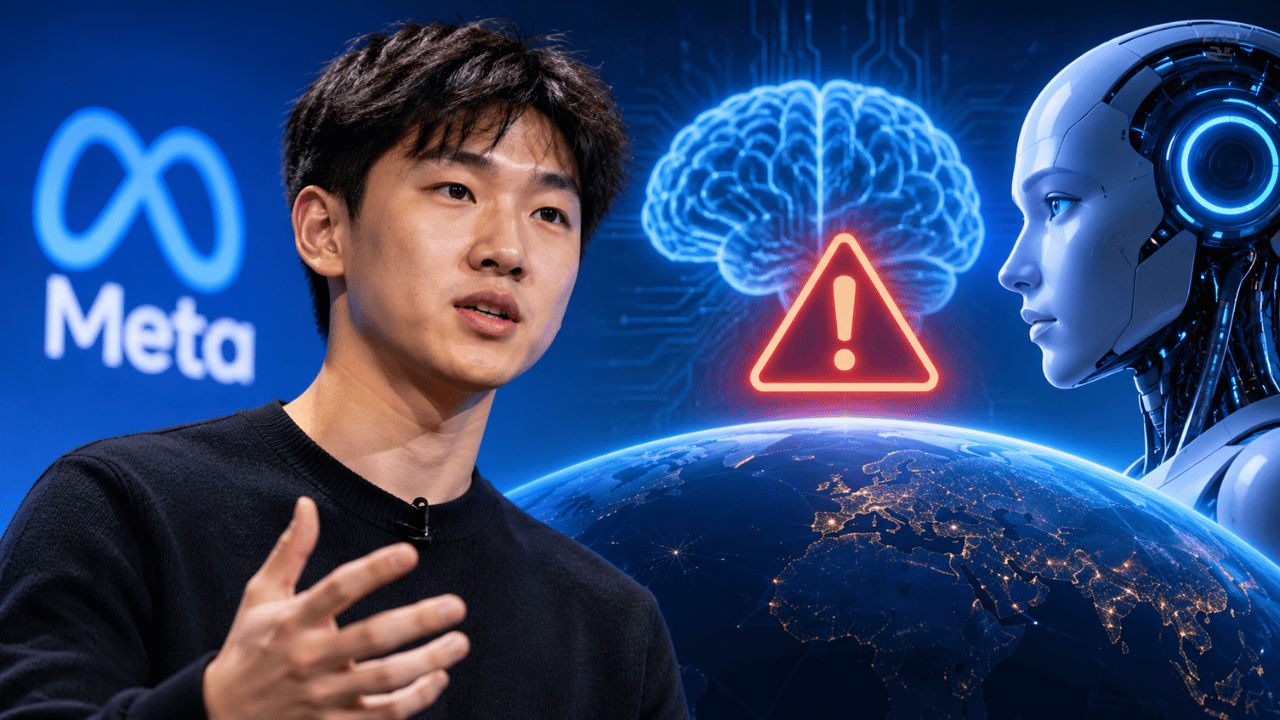
Meta AI chief Wang warns that human beings will have a hard time keeping control over AI Superintelligence. He believes that this kind of AI will arrive soon and that the world may be about to experience a major change due to the rapid growth of AI. Not only that, but he said that AI is no longer limited to coding and mathematics. Rather, it's now gaining the ability to solve complex problems and act as a general-purpose helper. The Riemann Hypothesis, which is a very tough problem in mathematics, was also cited by Wang. He pointed to the recently claimed proof of the Riemann Hypothesis, completed with the help of AI, as a sign of a significant change. The proof is still being reviewed by mathematicians. Below are some of the remarks of Alexandr Wang regarding Superintelligence.
Riemann Hypothesis marks a major AI milestone
Alexandr Wang, Meta's chief AI officer, recently took to his official X account to warn that the world may be approaching a turning point as artificial intelligence advances towards superintelligence. Wang pointed out that the decisions made over the next year could shape humanity's future. Not only that, but while talking about the Riemann Hypothesis, he said that for most who have studied math, it is the absolute pinnacle of intellectual accomplishment.
Moreover, he further added that 'many physicists would agree that the discovery of the atomic bomb is a homework problem compared to the Riemann Hypothesis.' He described the proof as completed 'with the help of an alien mind that we don't understand.' His post does not name the proof or its authors. However, the claimed proof was previosuly announced by Anthropic mathematician Levent Alpöge, who worked with Claude.
Not only that, but independent mathematicians have also confirmed that its Lean formalization compiles, but the wider community has not yet fully digested it. A separate, human-written proof of the General Riemann Hypothesis by Stanford's Alessandro Masullo has also been posted and has not yet been verified.
AI could extend beyond coding and mathematics
Furthermore, Wang observed that AI models such as o3 by OpenAI scored extremely well on the American Invitational Mathematics Examination (AIME) in December 2024. For him, this was one of those moments when he felt that everything was about to change, for machines were beginning to do things that required a lot of reasoning and problem-solving skills.
In his opinion, AI has made enormous progress in terms of programming, cyber security, and agentic capabilities that have made models useful general-purpose aides. According to him, the biggest roadblock that AI has faced in its progress is not intelligence but domain-specific know-how, plumbing and experimentation.
He further argued that AI research is much less demanding than the Riemann Hypothesis and thus will likely allow the models to automate research and self-improve at superhuman levels. He also observed that the scientific and technical problems on capability progress are likely solved.
Wang calls for human control over Superintelligence
Wang also pointed out how AI would speed up research in areas like biology, weapons research, and economics at a pace beyond human comprehension and supervision. Wang noted that it is hard to imagine humanity maintaining control over fully unconstrained recursive self-improvement, or over superintelligence that is 1,000 times smarter and more capable than humans in every field.
Wang stressed the need for more emphasis to be placed on safety, alignment and security. He argued that society should not be okay with a 'handover' to AI. He criticized the lazy thinking in the AI industry, which considers superintelligence inevitable and safety as the only unresolved matter, and said the industry will likely have to take meaningfully different actions from its 'default path.'
Finally, Wang stated that the objective should be to build technology that gives all humans greater agency and empowerment.

Bhaskar Sharma Bhaskar is a Senior Copy Editor at Digit India who keeps a close watch on everything shaping the world of technology from smartphones and home appliances to AI, government tech initiatives, digital safety, and the latest industry developments. Whether it's breaking news, in-depth features, hands-on reviews, practical how-to guides, or exclusive scoops, he translates complex tech into stories that are easy to understand and worth reading. His work has been featured in iGeeksBlog, GuidingTech, and other leading publications. Before joining Digit India, he served as an assistant editor at TechBloat. A B.Tech graduate and full-time tech journalist, he is driven by just one goal, which is to help readers stay informed, stay secure, and stay ahead in an ever-changing digital world.
View full profile