
Applied for Mudra loan recently? It could be fake: Here is how to spot them
 Follow Us
Fake Mudra loan website found; government warns users.
Loans are only given by authorised banks, no agents involved.
Don’t share personal details or send money to unknown sources.
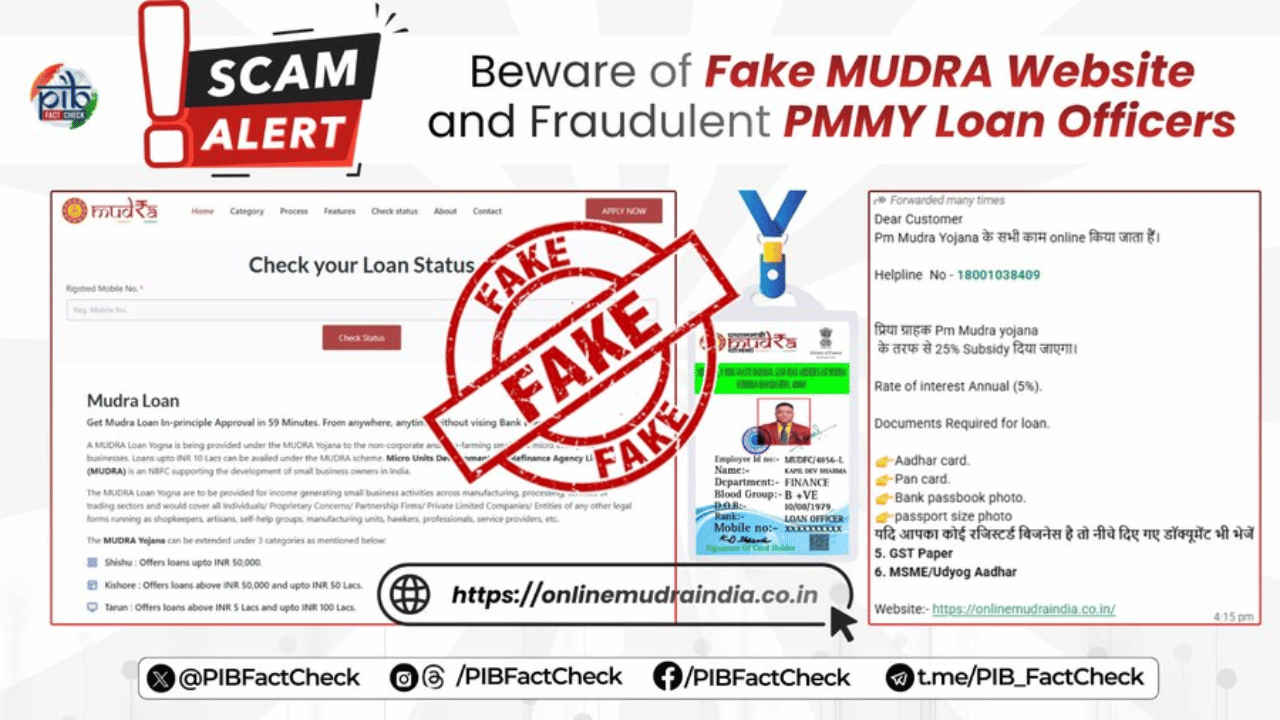

Pradhan Mantri Mudra Yojana (PMMY) loans are collateral-free loans of up to Rs 20 lakh provided to non-corporate, non-farm small and micro enterprises. However, the government has recently identified a fake website that has been misleading users across the country in the name of the scheme. Authorities said that the site claims to offer easy loan approvals and presents itself as being linked to government authorities. Officials have warned citizens that such websites are created with malicious intent to trick people into sharing their personal and financial details or transferring money. Learn everything about the Pradhan Mantri Mudra Yojana and how to stay safe.
 Survey
Fake Pradhan Mantri Mudra Yojana website
The government’s agency, the Press Information Bureau, under its PIB Fact Check initiative, reported that the website at https://onlinemudraindia.co.in falsely claims to act as an agent for the Pradhan Mantri Mudra Yojana. It promotes loan approvals through unofficial means and attempts to build trust by using government-related language and design elements.
Authorities have clarified that no agents or middlemen are allowed under the scheme. Any platform or individual claiming to fast-track loans in exchange for money is misleading the public.
How MUDRA loans are provided
Loans under the Pradhan Mantri Mudra Yojana (PMMY) are provided through Indian government-recognised Member Lending Institutions (MLIs). These include public and private sector banks, regional rural banks (RRBs), small finance banks (SFBs), and cooperative banks, as well as RBI-registered non-banking financial companies (NBFCs) and microfinance institutions (MFIs).
Moreover, there is no provision for the third-party agents or private websites to approve or process such loans independently. Hence, officials have urged people to go straight to trusted banks or lenders to get the right information and to make sure everything is done safely.
Also read: Oppo Find X10 series leaks: Display, camera, processor and other details
How to stay safe
Here are the easy ways following which you can be safe online:
- Don’t send money to strangers, even if they say they’ll give you a loan.
- Never share personal details like your Aadhaar number, bank info, or OTP with anyone.
- Be careful of random calls, messages, or websites that promise quick or guaranteed loans.
- Always double-check details through official bank or government sources.


