
India’s telecom duopoly: How Airtel and Jio came out controlling the market
 Follow Us
Airtel and Jio have become the two biggest players in India’s telecom market.
Mobile recharge plans are getting more expensive, putting extra pressure on users.
Vi and BSNL are struggling to compete with Airtel and Jio.


India once had more than a dozen telecom operators competing for customers and their money. Aircel sold unlimited calls, Tata Docomo charged by the second, Reliance Communications gave away free night calls, and Uninor undercut everyone on data. Users had real choices, and operators had to fight for every customer. However, that era ended way back. Today, India has four major telecom operators left, which are Reliance Jio, Bharti Airtel, Vodafone Idea (Vi), and BSNL. When you exclude the state-owned player and the struggling telecom company, the private market is reduced to just two names, notably Airtel and Jio. Everything from your monthly recharge to your data speed is now decided by a contest between these two companies alone.
 Survey
Vi and BSNL are still technically in the race, but neither is in a position to start a price war. Vi has been bleeding money and users for years, and BSNL still leans on government support to even stay in business. Not only that, but both companies are also playing a catch-up game on 5G technology, a race Airtel and Jio started years back and are already winning. With their hands full just trying to stay relevant in the network game, raising prices is simply not something Vi or BSNL can risk right now. That single fact tells you almost everything about why this market behaves like a duopoly even though four names still appear on paper.
Recent price hikes from telecom operators

Every few years, Indian telecom users get a reminder that the telecom market does not always work in their favour. Whether it be unlimited calling, cheap data benefits, free 5G or added benefits, everything has a cost that they have to bear. And the most recent reminder of the same has been served by Airtel, as the telecom giant quietly discontinued one of its most popular Rs 299 recharge plans recently and has silently pushed the users toward a costlier Rs 349 option.
However, this wasn’t the only nail in the coffin, as the telecom giant also took away the Rs 579, Rs 619, and Rs 649 recharge plans from consumers. Moreover, the company has also increased the price of its existing Rs 859 plan to Rs 899.
One thing worth noting about the situation is that Airtel has not made any formal announcement regarding the removal of these plans. If a formal price hike follows this silent removal, and going by Airtel’s historical pricing patterns, the new base prepaid plan of Rs 349 may potentially cost around Rs 399, which would be a 33.44 per cent increase when compared with the Rs 299 plan. Do note, the Rs 399 figure is a projection based on past pricing behaviour, not a confirmed number, and should be read as such.
Jio and Vi are no different, as the telecom operators also took a similar step back in 2021 and 2024 when they increased the prices of some of their prepaid plans by up to 25 per cent. Industry publications tracking telecom pricing have also reported that Jio is preparing a fresh round of tariff increases in the range of 12 to 15 per cent within the next few months, following Airtel’s revised prepaid lineup, though neither company has confirmed exact figures or a timeline.
Also read: OpenAI calls for stronger AI safety laws after frontier AI model escapes, here is what we know
Save yourself from price hike
Jio has also launched a Jio Prime Membership for Rs 300 recently that lets users lock in their recharge prices for a year. The company is promoting it as a countermeasure to price hikes, but it’s not wrong to say that it’s a solution to the problem the telecom companies created themselves. Moreover, this can also be seen as an early signal that Jio intends to follow Airtel down the same prepaid price hike path.
A source confirmed that Airtel is currently not planning to launch anything similar. Rather, they wanted to see how this stint from Jio goes in the market.
Numbers behind the duopoly claim
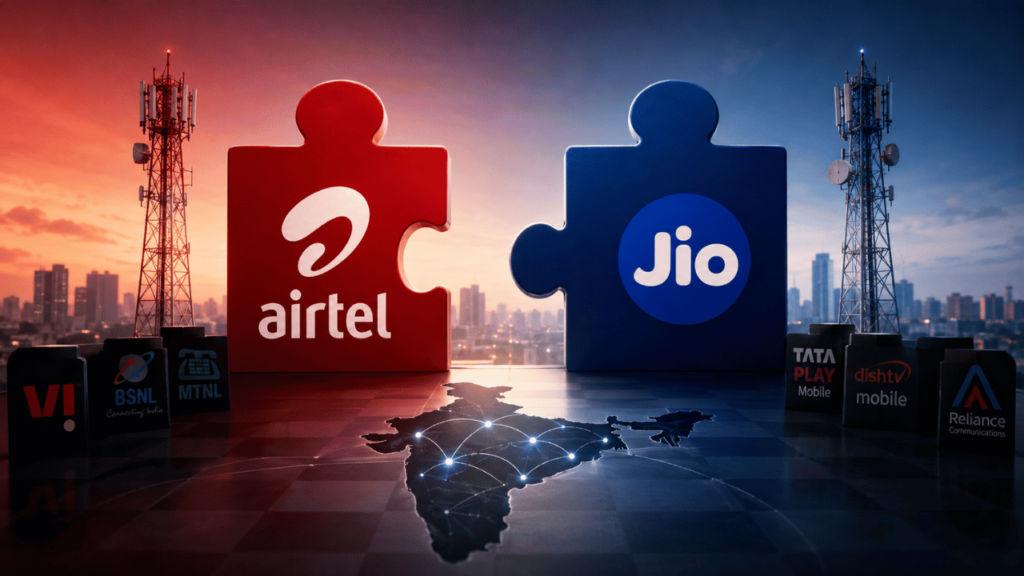
The telecom industry has spent years telling India that ARPU is too low, with Airtel among the loudest voices. Gopal Vittal has repeatedly argued that low pricing hurts returns and that ‘tariff correction’ is necessary to fund network investments, spectrum costs and infrastructure. And there is some merit to that argument; telecom is an expensive business. But the numbers suggest the ‘low ARPU’ narrative is becoming less about survival and more about how much more consumers can be made to pay.
Airtel’s ARPU has climbed from Rs 178 in FY2022 to Rs 264 in the June 2026 quarter. Jio reached Rs 215.6, while Vi currently stood at Rs 19. The gap is now difficult to ignore as Airtel and Jio have achieved significant scale, with no comparable third player.
The subscriber and market share numbers also back up our claim. According to TRAI’s June 2026 subscription report, Jio’s wireless subscriber base stood at roughly 503.6 million users, giving it a 39.27 per cent share of the market.
Airtel followed with about 486.8 million subscribers and a 37.96 per cent share. Vi held 198.8 million subscribers, which is a 15.50 per cent share, and BSNL held 93 million subscribers, about a 7.25 per cent share in the market. Combined, Jio and Airtel now control close to 77 per cent of India’s wireless subscriber base between them.
The Herfindahl-Hirschman Index (HHI) is a simple way to measure how concentrated a market is. It is calculated by squaring each company’s market share and then adding those numbers together. Using the June 2026 market shares, Jio at 39.27 per cent, Airtel at 37.96 per cent, Vi at 15.50 per cent, and BSNL at 7.25 per cent gives an HHI of about 3,276. The US Department of Justice generally considers a market with an HHI above 2,500 to be ‘highly concentrated’. By that measure, India’s telecom market is clearly highly concentrated.
Regulatory context: Is anyone watching?
In India, two key bodies responsible for monitoring such matters are TRAI and the Competition Commission of India (CCI). Given the level of market concentration, continued monitoring by the relevant authorities would be appropriate. However, there has been no clear indication of any specific regulatory review focused on the broader trend of rising concentration in the telecom market.
The authorities could closely monitor further tariff increases and could intervene to provide clear explanations for significant price changes so that things get transparent for the users as well. Moreover, the CCI could also assess whether the current market structure presents any risks of abuse of market power or other forms of anti-competitive behaviour.
Also read: Apple cuts over 200 jobs across Siri and Vision Pro teams to focus on AI and future devices: Report
Why BSNL and Vi are sitting this one out
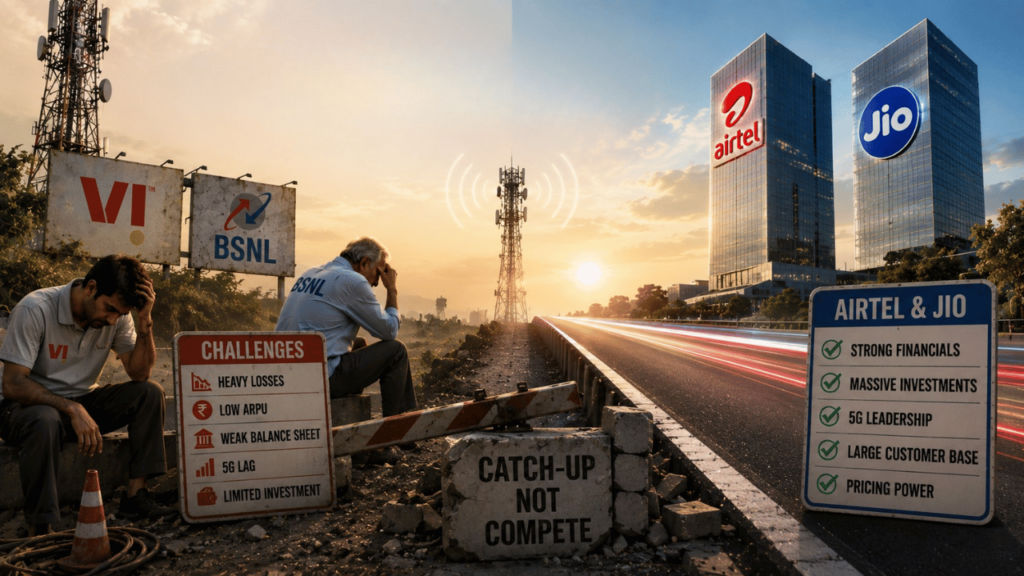
Up until now, we have talked about the two big private players in the telecom sector that have a duopoly in the segment. However, let’s now talk about the other two players, BSNL and Vi, as they have not joined this round of hikes, and the reason is not generosity. As previously mentioned, the telecom operators have their hands full with other issues.
Telecom expert Faisal Kawoosa, the founder and chief analyst at Techarc, also described the same thing. He said, ‘These two operators are at a different altitude right now, lower in orbit in performance, finances and customer base. They cannot be among the first to make any upward tariff revisions’. He also added, ‘I am pretty sure at least Vi will follow, if not BSNL, which still has shades of a public sector enterprise and will go by its complex decision-making process.’
Telecom price hike: What do experts believe?
Faisal believes operators have stopped chasing growth in their overall user base and started chasing premium, high-spending customers instead, a shift he has also noticed playing out in real estate, cars, and consumer electronics. He points to a harder truth behind this shift too: 5G has not delivered the returns operators were hoping for, so raising ARPU has become one of the few realistic ways left to recover that investment before spending on 6G begins.
Kazim Rizvi, Founding Director of The Dialogue, frames it slightly differently, as he sees Airtel’s recent changes as an attempt to clean up a cluttered set of plans while continuing to fund its 5G and fibre rollout, the same infrastructure argument the company has leaned on for years, not something invented for this particular round of changes. He does agree that operators want higher ARPU but believes any increase should stay measured and shaped by genuine market forces, rather than turning into an open-ended climb with no ceiling in sight.
Where both experts agree is on the bigger picture. Prices are rising because operators believe the market will simply absorb the increase, not because there was no other way to keep the business running.
Who actually pays for all this?
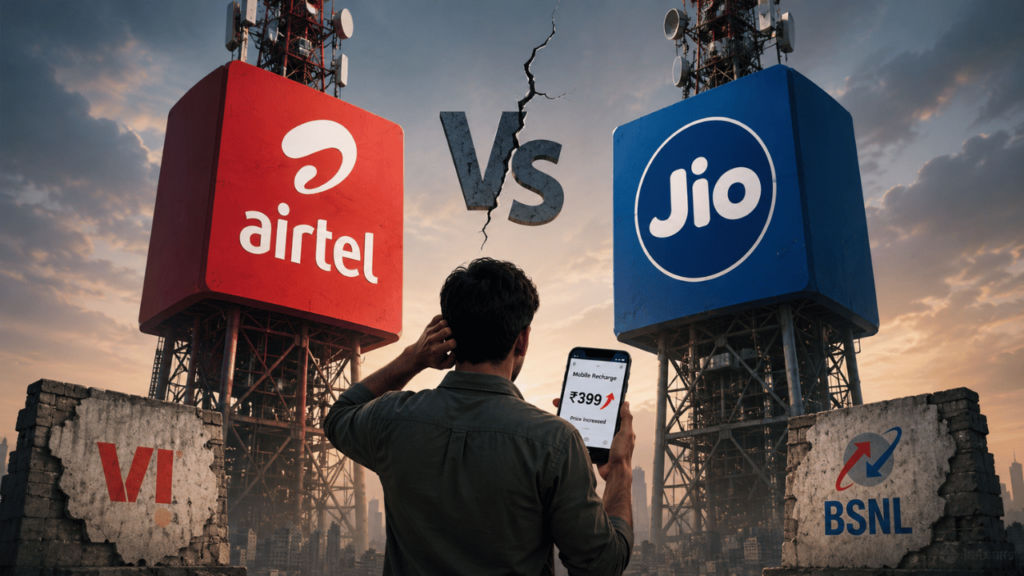
At the end of the day, someone has to fund better networks, higher margins and the expectations of shareholders. That someone is the person holding the phone, whether they realise it or not. Telecom in India is treated as a basic utility, not a luxury, so a price hike dressed up as a plan removal still shows up the same way on a household budget.
Private companies are well within their rights to run a profitable business. But calling every price increase an unavoidable industry reality, while quietly avoiding any official statement that could invite questions, is not the same as being transparent. It looks more like damage control.
However, what started as a market with more than a dozen competitors has quietly narrowed down to a contest between two companies. Airtel and Jio now control the pricing, the network rollout timelines, and effectively the terms on which most Indians access mobile connectivity. Vi and BSNL still exist on paper, but neither has the financial strength or 5G readiness to challenge the pricing decisions coming out of Mumbai and New Delhi.
The ARPU numbers, subscriber shares, and HHI figures all point to the same conclusion. This is no longer a competitive four-player market; it’s a duopoly where two companies set the pace, and the other two simply try to survive. Whether regulators step in with closer scrutiny or the market is left to correct itself, the coming rounds of tariff hikes will be the real test of how much pricing power Airtel and Jio actually hold and how far consumers can be pushed before workarounds like Jio’s Prime Membership become the norm rather than the exception.
What did the telecom giants say?
We have reached out to both Airtel and Jio for an official response to the developments mentioned in this story and will update it as soon as we receive an official statement.


