
Buying a laptop can get confusing, we are trying to change that: Snapdragon’s Sumit Sonal
 Follow Us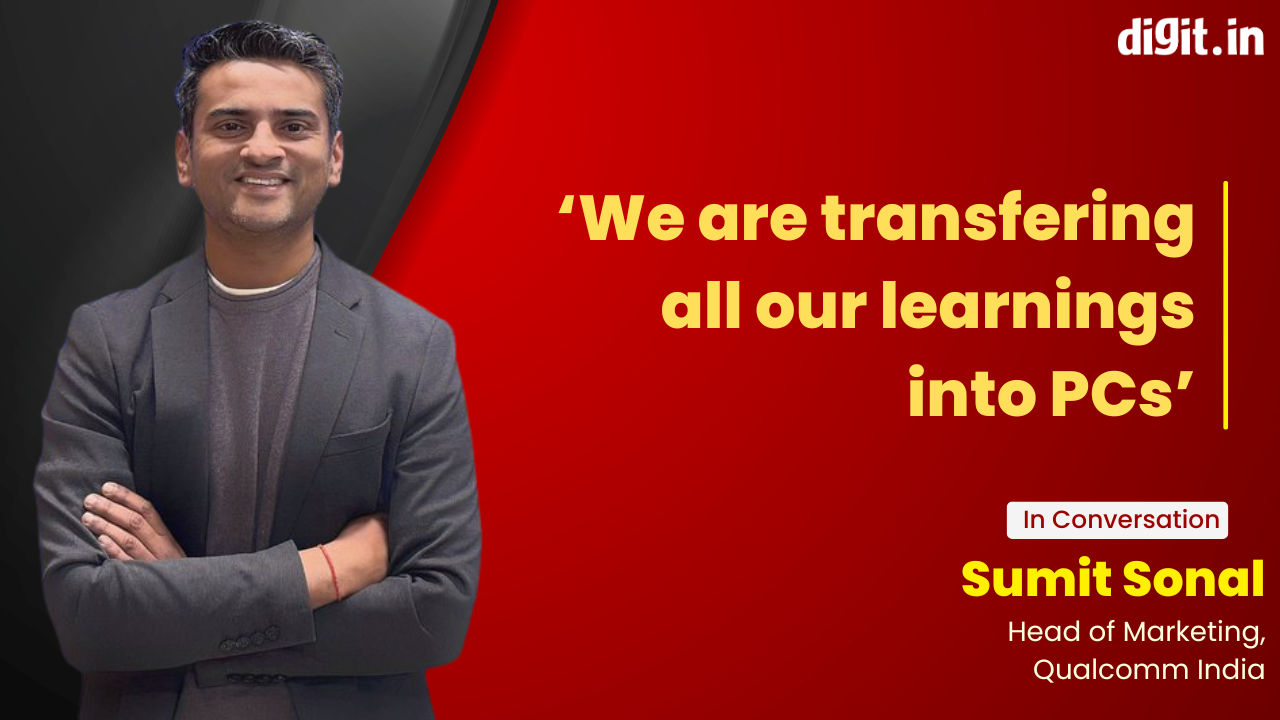

There is a good chance that the next laptop you buy will come with AI features. But chances are, you won’t buy it because it has AI. Let me explain. It isn’t a secret that most people who walk into a store to buy a laptop don’t really ask for an AI-powered device. Depending on their purpose, they want a machine with long battery life, a slim design, solid performance and a price that fits their budget. AI simply comes along for the ride. And it is only after they start using the laptop that they realise how useful those AI features can be, whether it’s removing background noise during a video call, improving camera quality, transcribing meetings offline or helping with everyday tasks. And according to Snapdragon, that’s exactly how AI should work. It shouldn’t be the reason you buy a laptop, but be the reason you enjoy using it.
 Survey
In a candid chat with Digit, Sumit Sonal, Head of Marketing at Qualcomm India, talked about the Windows PC market, AI devices, and the misconception around Snapdragon-powered laptops that should finally be put to rest. Here are the key excerpts from the conversation.
Also read: AI is super capable, but cannot replicate human emotions: Nitin Kumar, Qualcomm
How does Qualcomm define the modern PC experience, and how is Snapdragon delivering on those expectations?
Sumit: You know us as Qualcomm. If you divide the word itself, we are Quality Communications. Think of us as a mobile company first. Now when you pick up a mobile device, there are a few things you are very used to. There is an always-on experience, great battery life, no thermal throttling and no fan noise. So we understand compact and portable devices very well, and now we have ported that experience into your PC as well.
We moved away from the older x86 architecture, which a lot of competing brands still use. And when you move to an ARM architecture, there are multiple benefits, and that is what we are prioritising.
A consumer today is looking at those experiences while buying devices and not only looking at brand names. If the device beautifully fits into my workflow and helps me in being always on and ready, those nuances actually help us. The customer buying your smartphone is also buying your PC. They understand the Snapdragon value, and we are transferring all our learnings from the last 40 years into PCs as well.
Which Snapdragon feature do you think will have the biggest impact on mainstream users?
Sumit: On-device AI. Because when you have it, you are not dependent on the cloud all the time, which means the data you are working on remains within your system. Moreover, every cloud computation has a cost. You might not be the one paying for it, but somebody is. You cut that cost because you are processing everything locally.
Think of someone sitting in a rural area in Uttar Pradesh or somewhere in the northeastern part of this country. Having on-device AI means large language models can run completely on your device without internet connectivity, without latency issues and without privacy issues.
Today AI has become part of your workflow. You might not even see it, but it is working for you in the background.
AI laptops are still seen as premium devices. Will these features become accessible to more users?
Sumit: We believe that AI will be required by everybody, and it cannot be defined by price points. When we started this journey, we used flagship models to showcase the scale of AI. But there are features which can always be trickled down.
You might not require the entire feature set, but users should get that trickle from the flagship tier into the tier they are actually using.
Several brands have launched Snapdragon-powered laptops over the past year. What kind of consumer feedback has surprised Qualcomm the most since the Snapdragon X series launched?
Sumit: I would like to tackle a rumour first. A lot of misinformation was spread in the market that several apps do not run on Snapdragon. That case is gone, quite honestly.
Any architecture change requires a new set of developers, and ecosystem maturity is also something we need to be cognisant about. With ARM now maturing, you are seeing more and more players adopting it, and more apps are now working natively on the device.
We have worked very closely with Microsoft through this transition. Even apps like Winamp run beautifully on Snapdragon machines today. Spotify, Winamp, WhatsApp, Tally, everything works beautifully. You do not need to be worried or concerned about that.
Second thing is that the younger customer really appreciates slim and light designs and absolutely loves fanless architecture. People do not want loud humming noises wherever they are working.
Third, the always-on experience has also become a big advantage. It may seem like a small thing, but people really appreciate that the moment they open the lid, the PC is ready. People do not want to wait. Whether you are in a meeting room or a classroom, you need your PC to be ready instantly.
So, people are finally moving towards Snapdragon. They remember the brand attributes we bring in and are now trusting us on the PC side as well. I am very positive about the upcoming festive season.
If someone switches from a traditional x86 laptop today, what is the first thing they would notice?
Sumit: The first thing is the responsiveness of the machine itself. The second thing is the great AI feature suite. You might not even know it is working in the background, but it is making you look good and helping you do better.
The third thing is slim and light designs. People are looking for multiple things in one package, and that is where Snapdragon and our OEM partners come together.
What is the biggest misconception consumers still have about Snapdragon-powered laptops?
Sumit: We are a challenger brand in this space. We are maniacally focused on the productivity user space. We are not looking at gaming. We are looking at people who use their machines to create and excel at work.
Our entire last year went towards establishing the distribution channel for Snapdragon PCs in India. Now we are building awareness and helping consumers understand what Snapdragon PCs can offer.
A great product always wins, and that is what we are trying to prove in the market.
Do you think the next era of personal computing will be defined less by benchmark scores and more by AI, efficiency and real-world experiences?
Sumit: It’s already happening, and I’m glad that we are a part of that movement. People are now looking at whether their laptop is fast enough, prompt enough and delivering the best experiences. They are buying laptops for experiences.
Now, when you look at the spec sheet and see Snapdragon, there is a credibility attached to the brand because people already know it from their phones and even their cars. When we work with our partners, we add that credibility to all the features they are bringing to their devices. So the moment you see Snapdragon, you know this is a PC you would want to consider.
We are also trying to simplify the entire consumer journey. Buying a laptop today can be very confusing. We are trying to simplify that by offering a limited set of SKUs targeted at different audiences, giving consumers enough choice without overwhelming them.
One of our biggest intentions is to minimise that confusion and help people buy the things that actually matter to them. We want it to be a more educated purchase rather than one driven purely by brand names.
Also read: Apple will rely entirely on Samsung for OLED MacBook screens, says report


