
Our most intelligent machine: Dyson’s Tim Hare on V16 Piston Animal vacuum cleaner launch in India
 Follow Us

Dyson V16 Piston Animal has launched in India at Rs 79,900. The cordless vacuum uses a new 900W Hyperdymium motor that delivers up to 315AW of suction, along with the All Floor Cones Sense cleaner head, which automatically adjusts suction and brush bar speed based on the floor type. It also comes with built-in tools, a new Hair Screw Tool 2.0 for long and pet hair, and a CleanCompaktor bin that compresses dust and debris.
 Survey
At the event, we got to interact with Tim Hare, Dyson’s Design and Development Engineer, Floor Care. He explained how the V16 Piston Animal’s sensing system works, why Dyson designed the cleaner head to work across different floor types, and how the company approached weight distribution, pet hair, and battery runtime. He also discussed the machine’s maintenance requirements and how Dyson’s design choices are intended to reduce the amount of manual intervention needed during cleaning.
Q: Dyson has years of experience engineering vacuum cleaners, and for this particular product, you must have spent months developing it. What’s one thing that people might not notice initially, but would appreciate after using it for a while?
Tim Hare: One of the key things is that the biggest cleaning mistake people make is only cleaning the dust they can see. When we do our research, we find that there are a lot of dust mites, pollen, and even microscopic dust that people can’t see.
With this machine, we designed it to adapt automatically to make sure you’re picking all of that up. So, even though they might not know it, we’re capturing all of that pollen and skin cells with this machine.
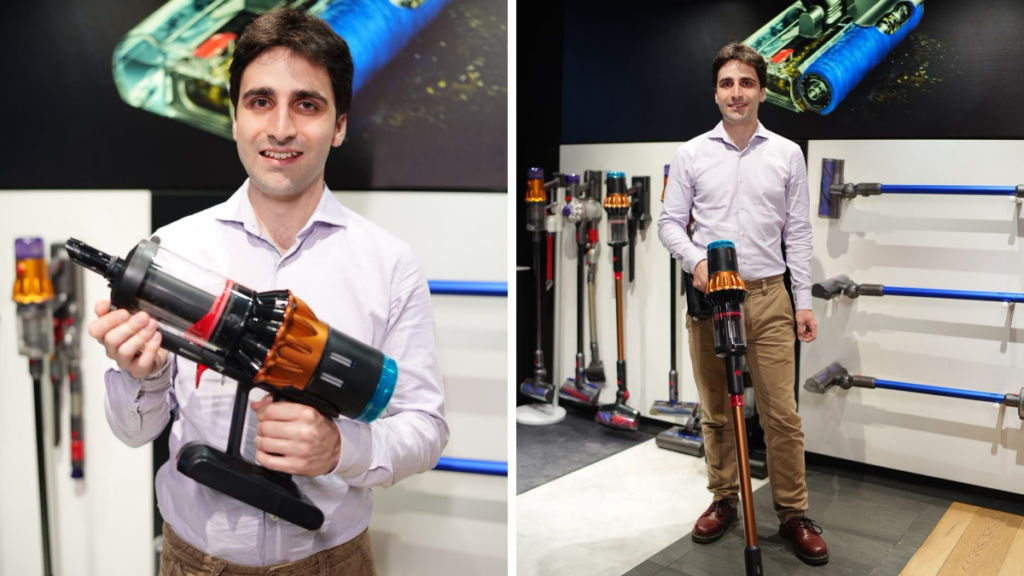
One example is the cleaner head. It’s an all-floor head. If you look at the box, it’s got stiff nylon bristles here, which are designed for carpets to agitate the pile. Then you have this softer fluff, which is for hard floors and provides a polishing effect.
For the customer, it means they don’t have to change the head like they would on a traditional machine. You can just use this one.
As well as that, it senses the surface. We’re detecting the pressure inside the cleaner head, and we’re also detecting the current drawn by the motor. That means the machine can adapt its settings based on the surface you’re cleaning.
It’s all automatic. That’s the beauty of it.
On hard floors, you need lower power and lower suction, along with that polishing effect. So, we reduce the speed and make it quieter.
You’ll see that once we move onto the carpet, if you give it a second, it detects the change. You can hear the pitch change. It’s increasing the suction power, and it’s also increasing the speed of the brush bar for more agitation.
It is also important that the vacuum cleaner can move between surfaces without ever having to change the head.
Q: Are there any other attachments that we can attach to this head?
Tim Hare: Yes, of course. The first thing, which is quite useful, is that we really didn’t want people to have to bend down or change attachments. So, we’ve built attachments into the machine.
You can pull this one out, and you’ll see that there’s an inbuilt crevice tool on the end. You can use it to clean corners or reach higher areas.
And when you’re done, you just push it back in.
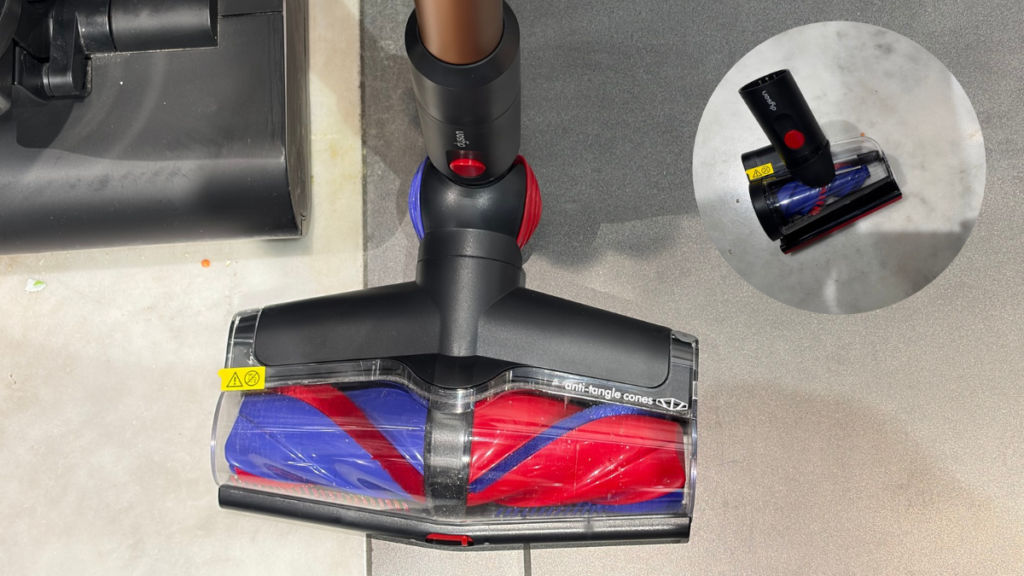
For pet hair, we’ve got a very special new tool called the Hair Screw Tool 2.0.
This one is quite interesting. It is brand new for this machine. We know a lot of customers have dogs and cats, and that really fine hair can be quite difficult to remove.
This tool has two new features. First, it has these rubber bristles on the front, which means you can scrape up all of that hair.
Second, people often struggle with dog beds and loose fabrics because the fabric can get sucked inside. We’ve got these bars here, which means the fabric doesn’t get pulled inside and jam the tool.
So, this one is great for dog beds.
And in total, there are 4 such attachments.
Q: One thing I’ve noticed based on my experience with these products is that elderly people, especially, may find them a little heavy to use. From an engineering perspective, how do you balance adding features while also keeping the product lightweight?
Tim Hare: It’s a good question. It’s always a balance between power, runtime, and weight. But our key focus is putting the weight in the right places.
You’ll notice that the battery pack is placed underneath the wrist. What that means is that you feel much less weight in your hand.
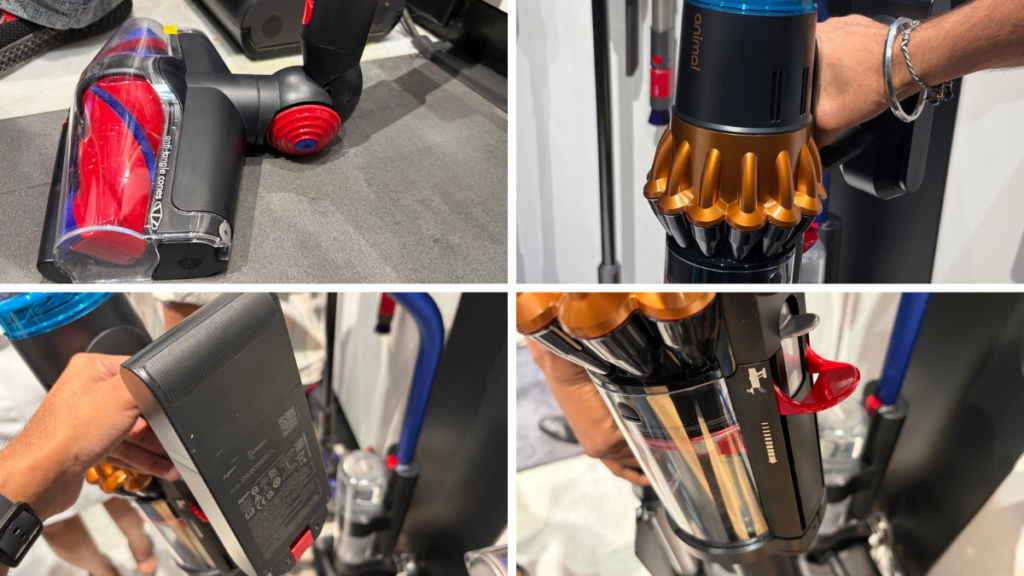
The second one is another Dyson patent. We call it the V-Ball. These wheels on the bottom are designed to carry the weight into the floor instead of into your hands.
So, even though this weighs 3.5kg, it feels much more manoeuvrable in the hand than some other machines.
Q: What were the engineering challenges involved in developing these attachments for this product?
Tim Hare: The key one is anti-tangle performance, getting it to work reliably. We tested it with 25 types of hair and made sure there were zero hairs left on the brush bar, even under the most abusive conditions.
It required a lot of fine-tuning. For example, the brush bar is set at exactly 12.5 degrees. If you go any steeper or narrower, hair can get stuck. So, there’s a lot of fine-tuning involved in getting that to work reliably.
Q: You mentioned that it can detect the surface automatically. How does that work? Could you explain the automatic sensing system?
Tim Hare: This is our most intelligent machine because we’re sensing so many metrics. The key ones are the pressure inside the cleaner heads and the current drawn by the motor inside the cleaner heads.
Then we’ve got a piezo sensor, which is acoustically listening to the dust.
We take those three inputs and feed them into an algorithm that combines them. That then adjusts the suction and brush bar speed depending on the conditions.
Q: Were any specific changes or tuning made for India? Indian homes may have uneven floors, different floor types, and rugs. How do you account for that while developing the product?
Tim Hare: We do a lot of studies. We recently conducted one specifically in India that looked at floor types and cleaning habits.
The takeaway that reaffirmed the approach behind this machine was that homes here are multi-surface, with predominantly marble floors. So, this machine will adjust to marble or wood floors.
We also found that people struggled when moving to a rug. They weren’t changing the attachment or the settings because they might only need to clean a small rug before moving back to the hard floor.
The fact that they can move seamlessly from the predominant floor type to a rug and then back again is going to make their lives a lot easier.
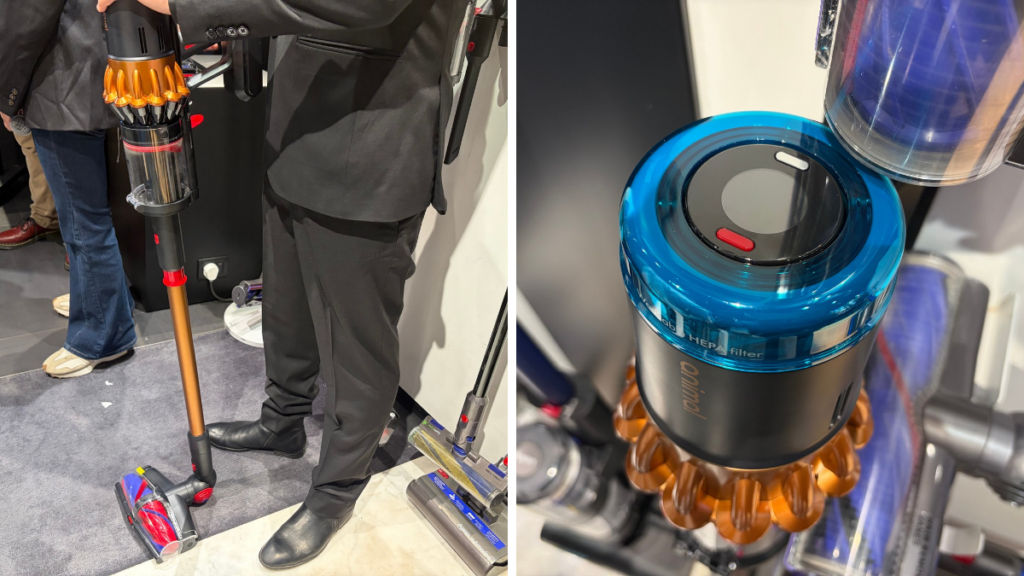
Q: While using these products, I’ve also found that battery life can be a challenge. The battery life can be short, while charging times can be long. How have you balanced that with this machine?
Tim Hare: This leads to another nice feature. It’s always a balance between raw suction power and runtime.
With this machine, we wanted the best of both worlds. We’ve got something called Dynamic Cones. When you’re in Eco mode, the machine actually shuts off a section of the cyclone. A third of the cones are shut off, which means you have reduced airflow and higher efficiency, giving you up to 70 minutes of runtime.
But when you need all that suction power, you need more airflow. So, it automatically actuates inside, opens up the whole cone array, and powers the 900W motor.
You’re getting that maximum power when you need it. Because of the sensing, that power is deployed when you need it rather than all the time, which helps preserve runtime.
Q: What components or parts of the machine does the customer need to take care of from a maintenance standpoint?
Tim Hare: I think the cleaner head and the filter are the key ones.
First, we’ve got a HEPA filter. The machine will tell you when it needs to be maintained. You need to wash it thoroughly under the tap and then leave it to dry until it’s completely dry, which takes about 24 hours. Then you put it back in.
The second thing is the cleaner head. This is another area we’ve refined, particularly the maintenance process.
You can remove this whole brush housing like this and wash it under the tap.
Then there are the brush bars. You can see that they pop out, and you should clean those under the tap as well.
But those are the only two key areas that need regular maintenance.
And there are videos on Dyson’s YouTube channel helping people understand how to handle and maintain it.
Keep reading Digit.in for similar interactions.
Also Read: Consumers today are not price sensitive; they are more value-centric: Cellecor CMO Jubin Rawal


