
We are designing monitors according to how Indians actually work: BenQ’s Rajeev Singh
 Follow Us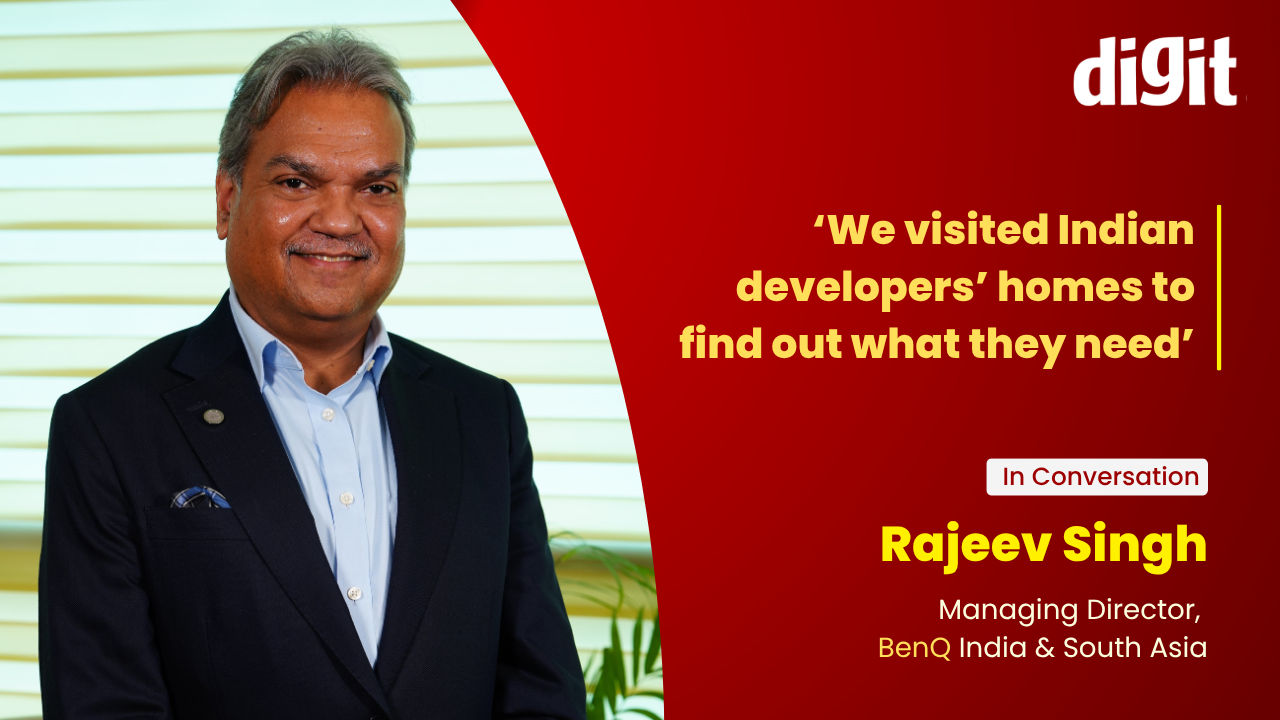

There are monitors for gamers, and there are laptops for office goers. Even students have certain types of monitors they can choose from. But have you ever stopped to think how developers, who spend hours in front of their screens, don’t really have many monitors that are tailor-made for their needs? BenQ thought of that. And that is why it rolled out the RD series of monitors, which are designed especially for coders and programmers. The most recent addition in this lineup, the RD270Q, was launched recently via a close-knit event hosted at BenQ’s office in Gurugram, India. On the sidelines of the event, we got a chance to sit down for a candid conversation with Rajeev Singh, Managing Director at BenQ India & South Asia.
 Survey
Also read: BenQ just unveiled a monitor for Indian programmers, here is what it offers
From how Indian programmers influenced the development of the RD series to where AI could take monitors in the future, the conversation covered a wide range of topics. Here are excerpts from the interview.
Q. BenQ has launched the RD series specifically for software developers. What made you believe developers now need a dedicated monitor instead of a standard productivity display?
Rajeev Singh: All that we have done has come out of our deep consumer research, which was purely targeted at Indian programmers and coders. The research was done in cities like Bangalore and Hyderabad, where we actually went to the houses of a number of coders and programmers from different age groups and with different levels of programming experience.
We tried to understand the setups they were using and the pain points they were facing with their monitors. We also asked them, if you could make a wish, what would you want your monitor to have? What would make it much better for you?
Based purely on that research, we came out with the programming monitor series. The current model that we have launched is the RD270Q, where we have tried to address all of those pain points as well as the wishes of programmers in India.
We have converted our technological prowess into these kinds of features and benefits for programmers. This is a tailor-made monitor for programmers from the ground up.
It’s not an adaptation of anything that we were having. It’s completely newly designed for programmers based on the feedback that we got from them, and that too from India.
Q. AI is changing the way people write code, with tools like GitHub Copilot and Cursor becoming mainstream. How do you see AI reshaping the kind of monitors developers will need over the next few years?
Rajeev Singh: Going forward, you will have requirements for monitors where there will be more use of AI in the monitor itself, but that is not the case right now.
As of now, the use of AI in monitors is limited to certain kinds of functionalities, which are more related to their ability to sense the brightness all day and adjust the monitor automatically with respect to that.
But I’m sure as things develop, there will be more usage of AI in monitors, and it will give the kind of performance that a programmer needs.
All of this is very recent and progressing fast, so it’s very difficult to really comment on what could come next. I would not like to speculate on that. But the fact is, the use of AI in monitors has already started.
Q. You have spoken about reaching the Rs 1,000 crore revenue milestone in India. Which product categories do you expect to contribute the most to that growth over the next couple of years?
Rajeev Singh: I think there are two product categories. In terms of overall scale, our monitor business is the biggest contributor to this kind of growth.
In monitors, we are growing at a rate of almost 35 per cent year on year, while the overall market in India is stagnant. But BenQ is growing like this because of the kind of monitors we have and the kind of segments that we focus on.
The second category that is growing really fast is going to be our home or consumer projector business. That is where we see a very big upside potential because the current penetration rate is very low.
Today’s consumers, who are more Gen Z, really like those portable projectors. For them, a portable projector is not a second large display device after a TV. It is the TV. In fact, they don’t even want to buy a TV. They want to buy a projector because it’s so much more handy for them to use and so much more flexible and practical because you can project on any surface. You don’t even need a special screen for that.
Plus, you can move it from room to room. When you’re going on holiday, these projectors have an inbuilt battery, so you can project even without connecting them to electricity. They offer tremendous flexibility of use, which is the requirement of Gen Z today.
Q. Premium monitors are becoming more popular despite economic uncertainty. What is driving Indian consumers and professionals to spend more on specialised displays instead of cheaper alternatives?
Rajeev Singh: The first reason is market maturity. The majority of these guys are not first-time buyers. They have used more of a general-purpose monitor in the past and have certain requirements for displays, which they have realised their current monitor cannot meet.
So now, when they are replacing the existing monitor with a new one, they are going for monitors that are larger in screen size. Plus, they are looking at a lot of specific functions that are useful in their day-to-day primary or secondary use of monitors.
So basically, the customer is not buying a general-purpose monitor anymore. They are buying a large-screen, specific-purpose monitor.
So everywhere it is all about specialisation. Today’s consumer wants to buy things with that level of customisation as per their requirements. And that’s what is driving the demand right now in the market.
Q. BenQ has a presence across gaming, creators, enterprise, education, and home entertainment. Which of these segments do you think will see the fastest growth in India over the next few years?
Rajeev Singh: The fastest growth in India, according to me, is going to be from monitors for creators.
When I say creators, I mean a number of different kinds of professionals. On one side, you have graphic designers and motion graphic designers. Today, motion graphic design has become an integral part of overall graphic design.
Then you have a huge amount of content being created by YouTubers and Instagrammers because they are monetising this content. After capturing it on whichever device they are using, they need to refine and edit that content, and that is where a monitor becomes important.
This is a very big upcoming market because the programmer, YouTuber, and Instagrammer communities are growing, and so is the amount of content they are monetising.
The third part of this category is monitors for video post-production. Whether it is for TV or movies, you need to do colour grading, post-production, and VFX. India is such a big VFX market that the majority of Hollywood movies also have VFX work happening in India.
So I think the productivity side of monitors, across all these creative applications, is where we will see the biggest growth. And this will be primarily driven by the huge demand coming from YouTubers and Instagrammers.
Q. With India’s push towards local manufacturing, how important is the Make in India initiative for BenQ’s long-term strategy? Should we expect more localisation or manufacturing investments in the country?
Rajeev Singh: We are already doing Make in India for all our three product categories. For our monitors, projectors, as well as our interactive flat panels, we have certain parts of our range that are being made in India.
However, the current level of localisation is still on the lower side. That is primarily because of the unavailability of suppliers for the other parts. The electronics ecosystem in India at the component level is yet to develop.
We live with this constraint that beyond a point, we are not able to increase our local content right now. We would really like infrastructure to develop much faster so that we can increase it.
Currently, the local content is about close to 20 per cent. We would like it to go up to 40-50 per cent. But for that, the electronics ecosystem is yet to develop.
Q. There is a lot of competition today from other brands. What do you think BenQ is doing differently that gives it an edge in India?
Rajeev Singh: This is exactly what we are doing with these programmer monitors. You can see the programmer community in India. There are almost 70 lakh programmers in India. It’s a substantial and massive community, so it’s definitely not a small segment.
We are the only brand which focused on the needs of these programmers and came out with a programming monitor. We have been in this field for two to three years, and no other brand has come yet.
We have also taken a similar approach with gaming. Gaming monitors today account for almost 20-30 per cent of the total monitor market, and gaming monitors as a category were invented by BenQ. There were no gaming monitors until we did our research and launched them.
We have also launched monitors specifically for the Mac ecosystem. There is a complete range of monitors, and they offer features that no other brand provides in its monitors.
So competition will catch up in some time. But the difference is in how deeply we are going into our consumers’ actual usage, what they would like to have in the future, and the pain points they face. We are taking that understanding and using it to develop products, and I think that’s where BenQ is ahead in this game compared to others.
Also read: Microsoft merges Copilot and Copilot365 in a single app: All details


