
Stuffcool Nido: How good is India’s first Qi2.2 wireless power bank?
 Follow Us
India's first Qi2.2 power bank promises 25W, delivers considerably less
Thermal throttling prevents even Qi2.2 supported phones to charge slowly
Well built at Rs 4,999, but the cable outperforms its wireless magnets
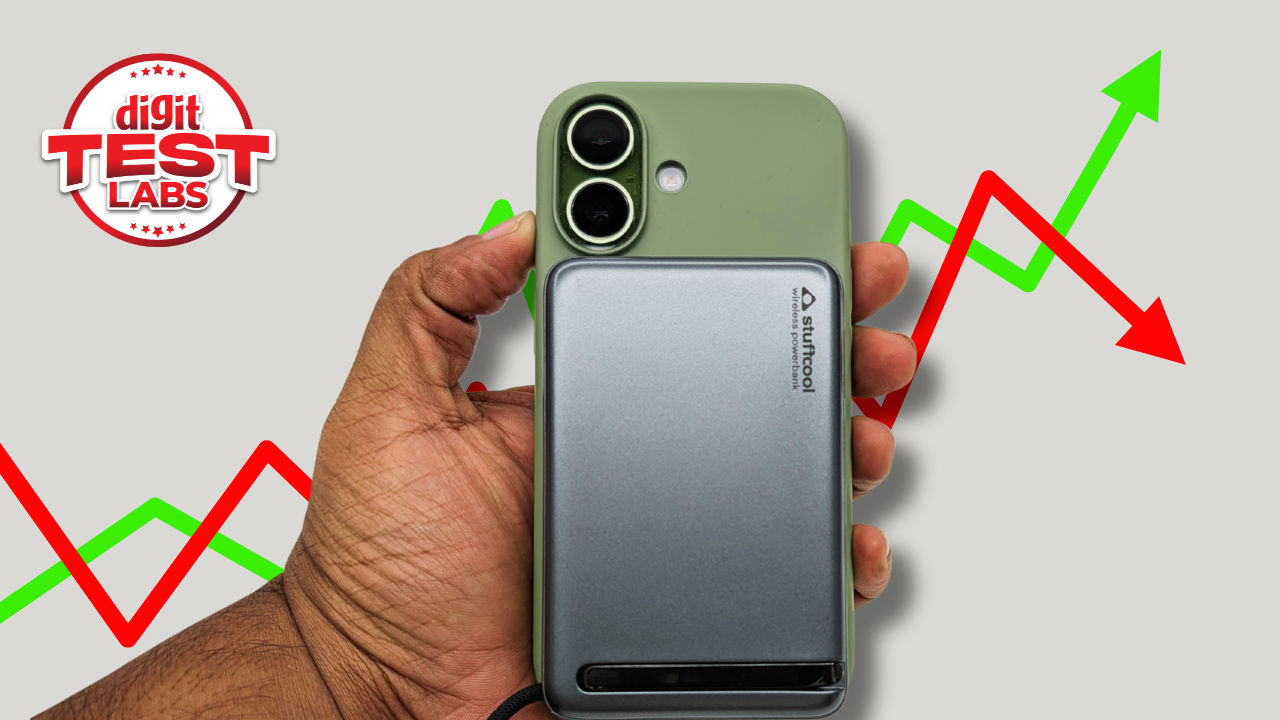

Believe me when I say this that magnetic power banks that charge a smartphone wirelessly are one of the best things to have happened. True freedom from charging cables is a joy you can only feel when you experience it. But magnetic power banks don’t equal fast charging, at least wirelessly. And that’s been largely my experience with the Stuffcool Nido.
 Survey
Marketed as India’s first Qi2.2-certified power bank, the 10,000mAh battery packed Stuffcool Nido promises to deliver up to 25W of magnetic wireless charging on compatible smartphones – most iPhones, Pixels, Samsung Galaxy S-series flagships – with the added bonus of 45W of wired PD.
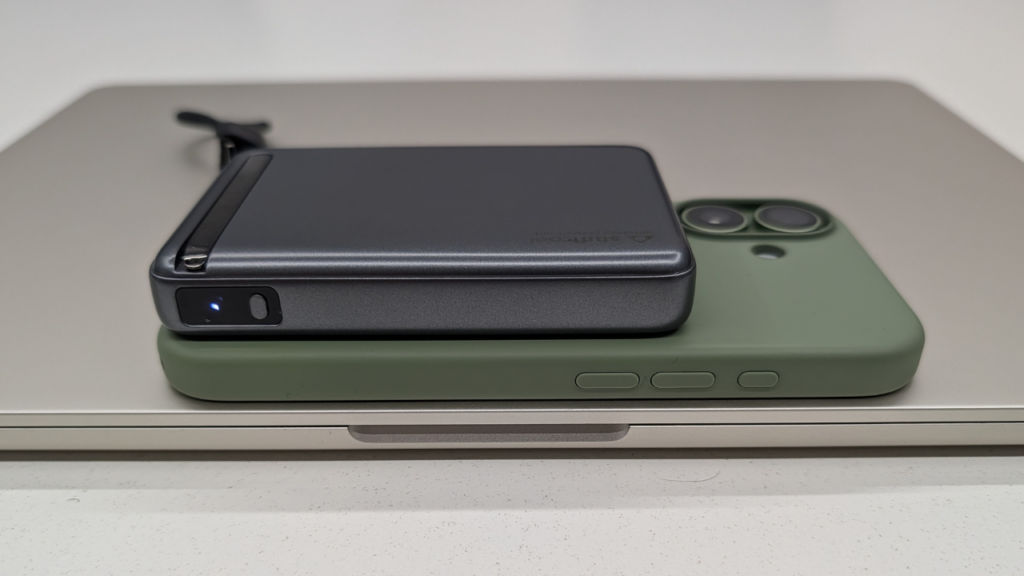
It’s a pretty little thing, the Stuffcool Nido. Easy to grip, with a premium look, weighing just 194 gm and barely 1.67-cm thick. It’s small enough to sit comfortably in your jeans pocket or hide neatly inside your backpack – you won’t even notice it.
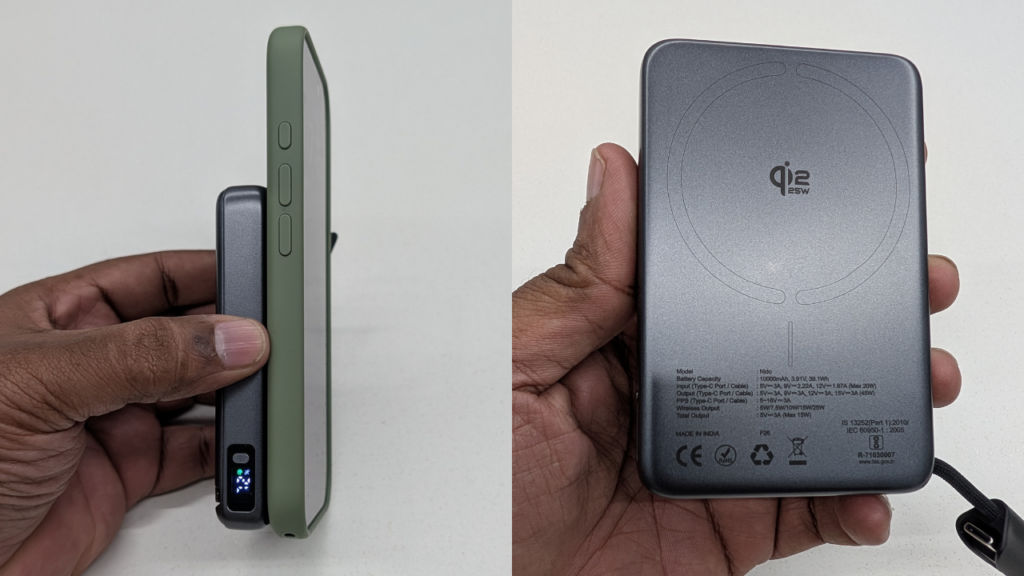
It’s built well, too. It survives shakes, minor drops without any visible damage on the outside. The Stuffcool Nido’s integrated kickstand is a neat addition to the powerbank, allowing it to prop up a phone in portrait mode for video calls easily, among other things. I found it a useful feature on most days for idle browsing on the phone, keeping it propped up on the desk instead of holding it in my palm.
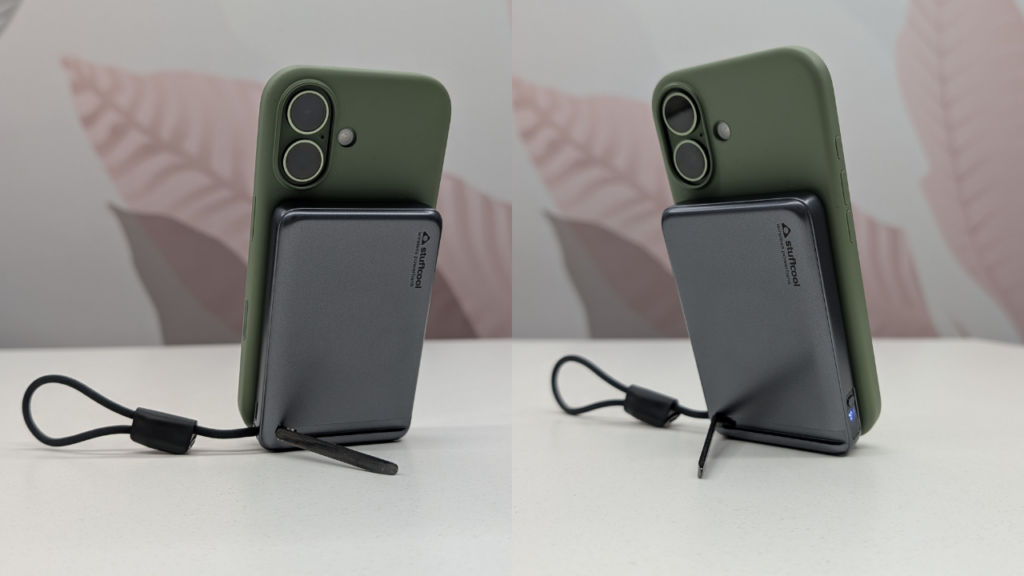
Another useful feature of the Stuffcool Nido is its built-in USB-C cable, where a clever design decision allows it to tuck itself and form a loop which can give you extra grip on the powerbank and smartphone combo when they’re magnetically attached.
Beyond design and features, when it comes to brass tacks, I tested the Stuffcool Nido extensively for a couple of weeks on an iPhone 15 Pro, Samsung Galaxy S25, and very briefly on an iPhone 17 (barely a day before writing this review). Stuffcool Nido’s performance is a bit of a mixed bag, if you ask me.
I started off charging an iPhone 15 Pro at 1%, with the Stuffcool Nido at 100%. Twenty minutes into the charging run, and the iPhone read 21% which was pretty good. I finally thought, yes, this is what the Qi2.2 is supposed to feel like. But that’s where the highs ended, I’m afraid.
The next 30% points took as much as 95 mins or 1 hour 35 mins in total. After two full hours of being charged wirelessly through the magnetic latch, the iPhone 15 Pro had reached up to 53% of charge while the Stuffcool Nido had given up 29% of itself.
Do the math and you’ll quickly realise that the pack’s rated to deliver 39.1Wh, but only about an average of roughly 5.4W actually ends up reaching the phone’s battery, with a short peak burst of 9W in the opening few minutes, before heat throttles the charging rate down. That’s less than what the iPhone 15 Pro’s rated peak of 15W over Qi2 wireless power.
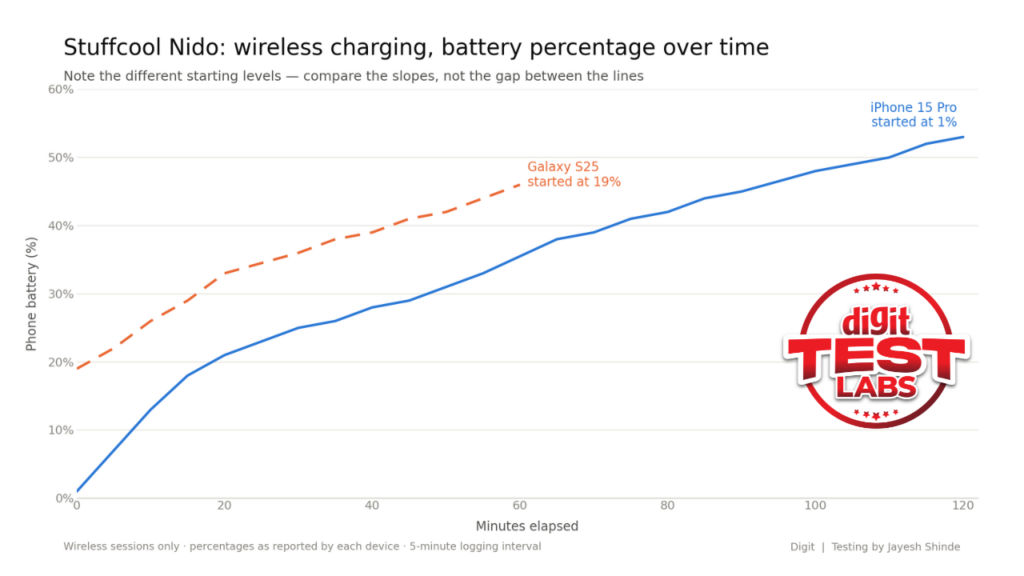
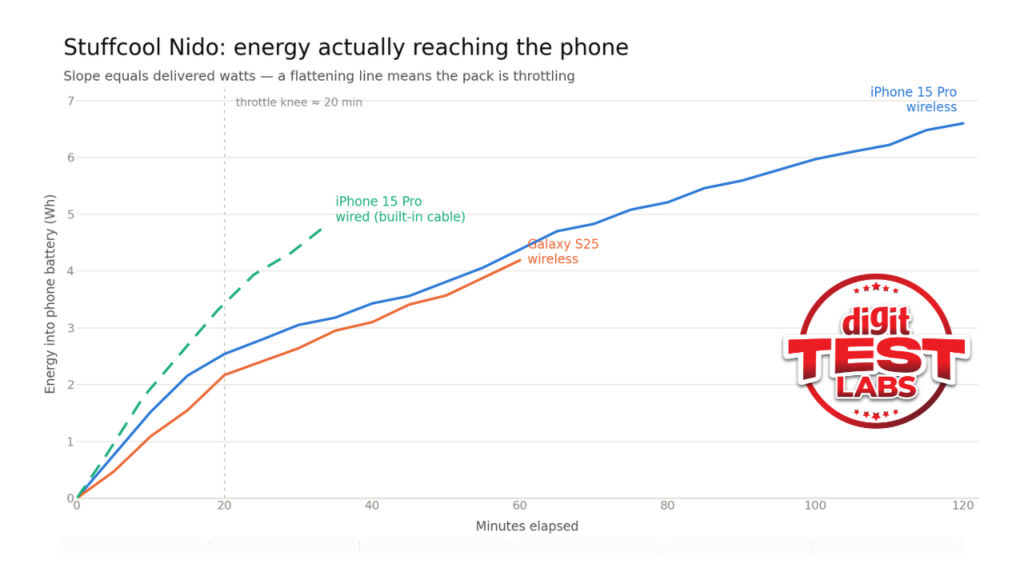
The wireless charging experience on the Samsung Galaxy S25 was decidedly worse, and I won’t blame the Stuffcool Nido entirely for it. Samsung doesn’t build magnets into the S25’s back, so alignment is a factor of the phone’s case. Why does that matter? Because imperfect alignment leads to power dissipating as heat. Therefore, 60 minutes trying to get charged by the Stuffcool Nido moved the Samsung Galaxy S25’s battery from 19% to 46% at barely 51% efficiency. That means half the energy leaving the pack simply didn’t arrive at the phone.
Then I plugged in the iPhone 17 at 5% battery, the Stuffcool Nido at 71% battery left. Finally, a smartphone that’s Qi2.2 certified, and how did the Nido fare?
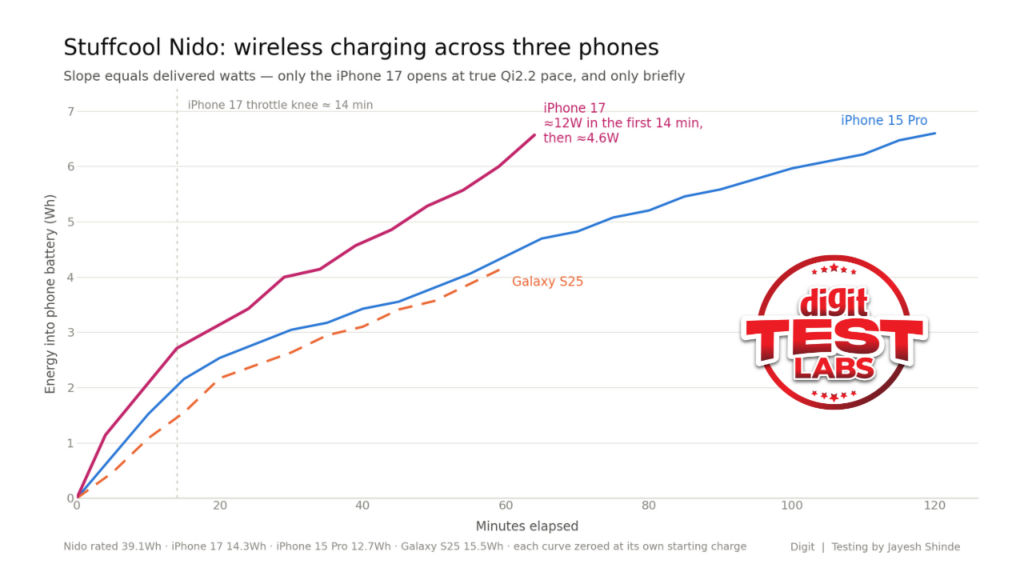
The first 14-15 mins were genuinely good, absolutely no complaints. The iPhone 17 quickly jumps to 24% with the Nido delivering power at a rate of 15W – real Qi2.2 behaviour, and comfortably ahead of charging times on the iPhone 15 Pro or the Samsung Galaxy S25.
Then the familiar thermal throttling kicked in. The iPhone 17 crossed the 50% charge mark at around 1 hour 3 mins of charge time – which is more than double the half hour Stuffcool advertises. Yes, peak power draw did touch 16.4W in one ten-minute burst mode, which was nice. But ultimately, to deliver 25W to a phone, Stuffcool Nido needed to dispense at 30W, which it never really reached.
Of course, the Nido isn’t only about Qi2.2 wireless charging, it comes with a built-in USB-C cable attached. While charging the iPhone 15 Pro with the built-in cable, it jumped from 46% to 80% in just 29 mins – that’s about 74% charging efficiency. The charging curve was pretty consistent until I unplugged it, with no visible thermal throttling, no fade, no warm brick in my hand.
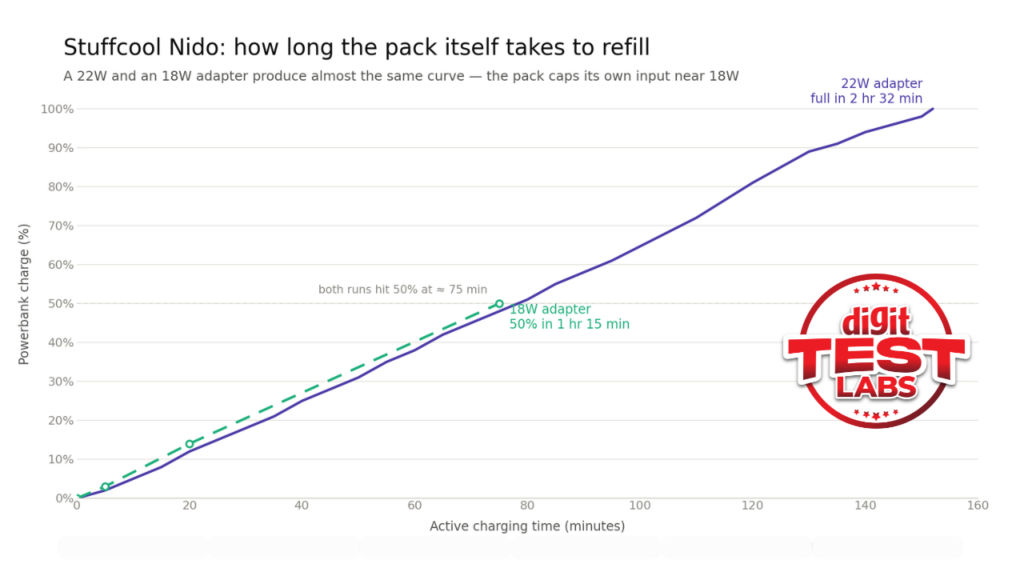
Refilling the Nido itself takes about two and a half hours. I tried it on a 22W adapter and an 18W one and the curves were nearly identical – the spec sheet caps input at 20W, so a beefier brick buys you nothing.
So who is this for?
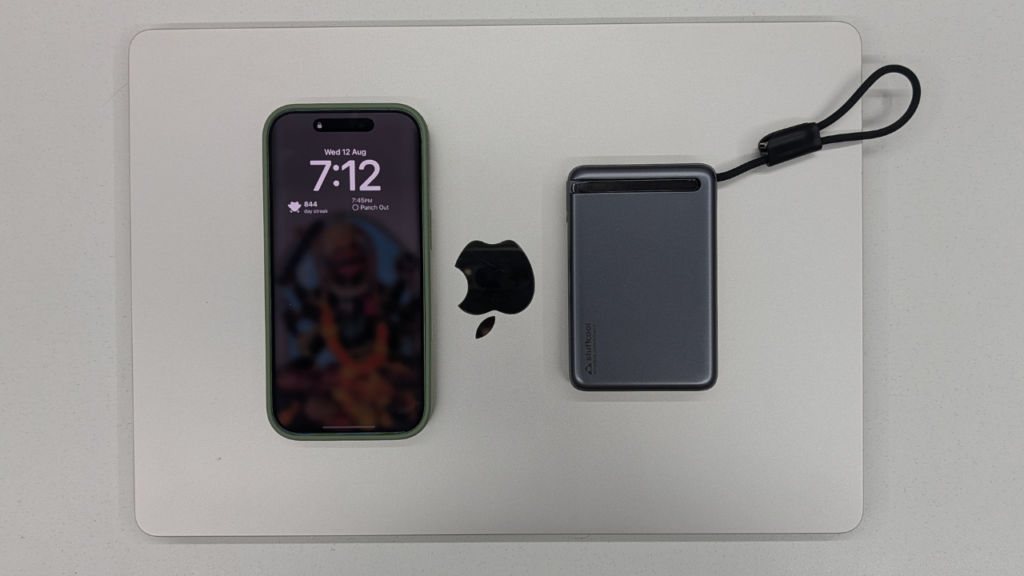
At Rs 4,999, the Nido sits above Stuffcool’s own Odin wireless charger, which supports Qi2 at 15W and sells for Rs 4,299. For the newer Stuffcool Nido, you’re paying the difference for the newer Qi2.2 wireless charging standard which is supported by newer phones like the iPhone 17 and beyond
Definitely buy the Nido for its good build quality, thoughtful design, the kickstand and that excellent captive cable. Just don’t buy it thinking it will charge your phone faster wirelessly than the built-in cable and you won’t be disappointed.
Also read: Best power banks for phones in India in 2026


