It started with a nagging question: Why do cars get all the fancy collision warnings and autopilot features, while two-wheelers – motorcycles and scooters – remain comparatively exposed, especially in a country like India where 44% of road fatalities involve two-wheelers?
 Survey
That’s the question that led me to a conversation with Andrew Fleury, CEO and Co-Founder of Luna Systems. For months, I’d been getting persistent emails about this little-known AI (computer vision) mobility safety company, culminating in a pitch about a demonstration at EICMA 2024, “the largest motorcycle show in the world.” In an email interview, Fleury opened up about Luna’s Advanced Rider Assistance Systems (ARAS) technology, the difficulties of scaling it in emerging markets like India, and how it might actually help reduce thousands of preventable road deaths every year.


“When we consider road safety on a global level, we primarily think of cars. However, according to the World Health Organisation, while cars represented 25% of global road fatalities in 2023, as much as 30% were two-wheeler related,” Fleury explained, without mincing any words and getting straight to the point.
“This is in spite of a higher volume of cars versus two-wheelers being sold each year (80 million cars versus 56 million two-wheelers in 2023). At Luna Systems, we are monumentally inspired by the safety challenges faced by two-wheelers and also by our belief that everyone has the right to safe transport – regardless of the vehicle they choose,” Fleur said further.

Reading that stark statistic drives home the urgency that Fleury and his team feel about bridging the massive gap between typical car-based ADAS solutions and the near absence of advanced safety technology for motorcycles and scooters – something that should be a prerequisite on Indian roads, especially.
Two-wheelers in India: A unique challenge
Few places could use this technology more than India. The country is rapidly becoming the epicentre for two-wheeler usage, with enormous sales volumes and, unfortunately, staggering fatality numbers. “In 2023, 76,000 people died on Indian roads due to two-wheeler accidents – almost nine people every hour,” Fleury pointed out, referencing official data. “This was 1,000 people more than the year previous and 7,000 more than 2021,” he further pointed out.
Also read: How computer vision and AI will automate toll booths on Indian roads and highways
One major barrier to ARAS adoption in India had been the historically high cost and complex integration. Cars get the full ADAS suite because each vehicle’s price can absorb that extra cost. Motorcycles, on the other hand, often cater to a more price-conscious market. Another challenge is the chaotic nature of Indian roads. “From an ARAS perspective, India has indeed one of the most unique and therefore most challenging sets of road and traffic conditions,” according to Fleury. Scooters, auto-rickshaws, pedestrians, stray animals – there’s no shortage of unpredictable variables that can invade Indian roads, which are simply a whole another level of crazy than anywhere in the world.
How do you train an AI to cope with all of that craziness, I wonder? “We have an established partnership network in India, enabling us to continually build and expand our data sets and conduct real world testing and validation… We strongly believe that while speaking from a global perspective, there are commonalities in the nature of accident use cases, that the accident profile of every country is different,” Fleury explained. That means collecting footage and telematics from Indian roads, labeling it meticulously, and refining the AI to handle bizarre situations – like an overloaded tractor crossing the wrong side of the median or a herd of goats occupying the highway.
AI in road safety
Behind Luna Systems is a belief that if they can outfit bikes with sensors and intelligent software, the effect could be as transformative as installing seat belts and airbags in cars decades ago. And if the concept of ARAS for motorcycles sounds new, it’s because it practically is. “While ADAS for cars is very commonplace with features such as Forward Collision Warning, or Lane Keep Assist, the same level of life-saving innovation for two-wheelers has been much slower,” Fleury told me.

To that effect, at EICMA this year, Luna Systems showcased a “Smart Cluster” they built in partnership with JMO Tech and CODICO, featuring a 10.25-inch touchscreen display, along with multiple cameras: “Essentially, this cluster provides an interface for our warning systems,” Fleury said.
The interface might flash an alert if a pedestrian suddenly appears in your lane, or if you’re trailing an SUV too closely. The system even includes something called “AI Reverse Blind Spot Detection,” which Fleury believes could be a game-changer: “It ensures that riders are aware when they are within the blind spot of a larger vehicle, such as a truck.”
To meet the performance needs required to run real-time AI on a two-wheeler display, one might think you’d need an expensive, power-hungry chipset. But Luna’s synergy with Qualcomm is all about making sure that’s not the case. “Our partnership with Qualcomm enables us to democratise access to ARAS with its scalable solutions,” Fleury said. “One of the core USPs of our team at Luna Systems is AI model optimisation and with that the ability to deliver extremely high functionality on entry-level hardware.”
Also read: Osmo’s scent teleportation: How AI is digitising scent for the first time
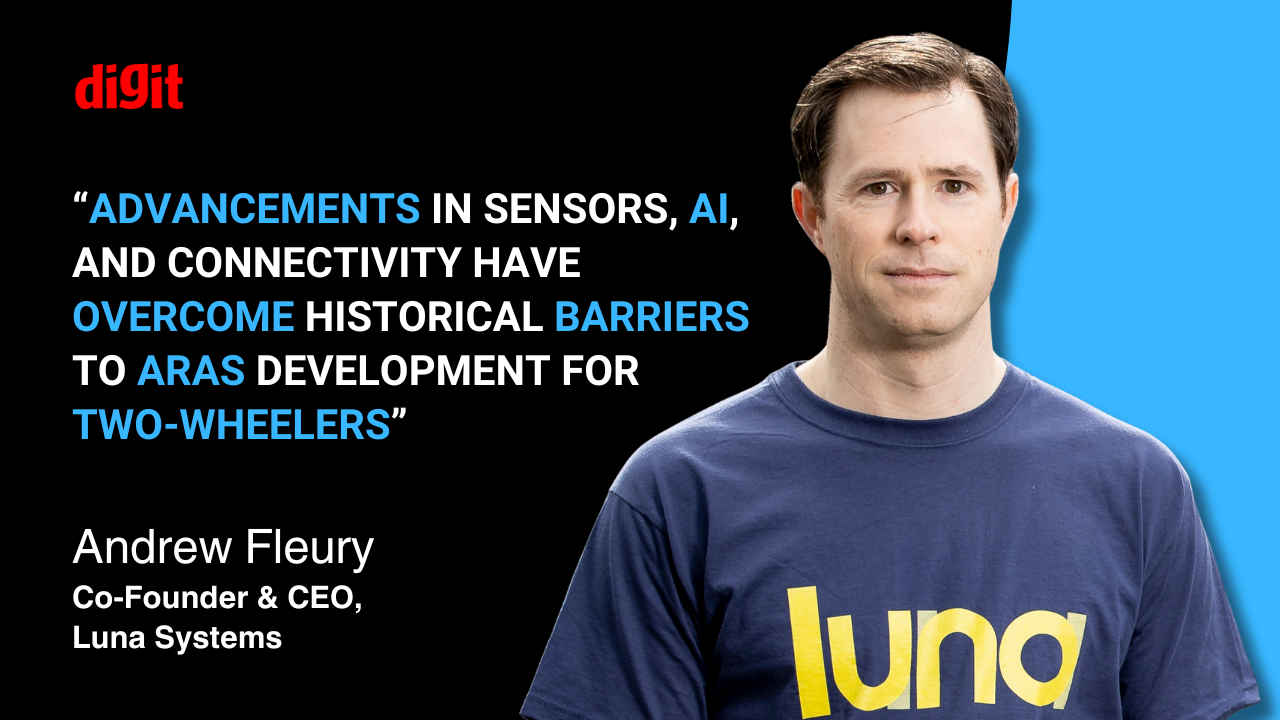
In other words, you won’t need a supercomputer on your handlebars. By optimising how data is processed, they can run advanced vision algorithms on mainstream SoCs, which is crucial for cost-sensitive markets. “From a technological perspective we are also now at the point where advancements in sensors, AI, and connectivity have overcome historical barriers to ARAS development for two-wheelers,” he added.
This technology isn’t some futuristic notion reserved for high-end sports bikes. Luna’s explicit aim is to push their ARAS out at scale so everyday riders – even on lower-cost commuter bikes – can benefit. “Safety is not just a premium feature,” Fleury insisted.
Making Indian two-wheeler riders more responsible
Perhaps the most intriguing and amazing aspect of Luna’s solution is that it’s not just about real-time collision warnings. It also provides post-ride safety analysis via an app. “Really our approach to making an impact on safety is both in-ride, as it happens risk prevention, but also giving brands the tools they need to effectively communicate/incentivise riders to be more mindful of their riding style,” Fleury explained.
With the camera-based approach, the system can identify potholes, read road signs, track passing vehicles, and more, bridging a gap that radar-only systems for bikes haven’t fully addressed. Radar is great at measuring distances, but it doesn’t interpret the environment in detail. A well-trained camera, by contrast, can “see” and understand the difference between a child crossing the road and a stray dog meandering about. The more context, the better the warnings.

“Our solution focuses on fostering safer riding practices in-ride, such as maintaining safer distances, being aware of road positioning versus larger vehicles, being aware of the presence of pedestrians, but also helping them to perfect their riding skills overtime with AI ride coaching,” Fleury reiterated.
If a rider frequently brakes late, speeds recklessly, or hovers in a truck’s blind spot, the system logs that data. Then, once the ride is over, the accompanying app’s AI can deliver insights – like a personal driving instructor reviewing your performance. “We also believe a ride safety coach is something which will be welcomed by parents who buy their children their first bikes,” Fleury mused. Although some might find it intrusive, it’s easy to see how such a tool could be a life-saver – literally.
Mass adoption in a cost-sensitive Indian market
To truly make a dent, especially in a budget-conscious Indian automotive market, you can’t just equip premium bikes priced at half a million rupees – a fact that isn’t lost on Fleury. “Many ARAS solutions built to date come from companies who initially developed ADAS for four-wheel vehicles. Here compute is everything and therefore cost is high. Our ambition is to scale affordable safety, to try to make the biggest impact we can on these fatalities,” Fleury said.
Also read: Meet Prithvi, NASA & IBM’s free AI model for better weather prediction
He’s right, as far as I’m concerned. Without affordability, ARAS becomes a fancy perk for well-off hobbyists, not a mainstream safety revolution that two-wheelers so desperately need. And if we’re serious about that horrifying 76,000 fatalities number, we need mainstream adoption. So Luna’s forging deals with manufacturers who serve the mass market, enabling them to put a relatively inexpensive cluster or an add-on module into new two-wheeler models.
“Feedback from the market is that scalability and high functionality is key,” Fleury shared, referencing his meetings at EICMA with various Indian brands. Some have tried radars, others have dabbled in lower-end dashcam solutions, but Luna’s pitch is that you need a robust AI approach that can handle Indian roads. “Radar can see further, but it cannot contextualise warnings or interpret the scene in the same way that camera can,” he argued.
But hardware is only half the story. For the technology to matter, riders must want it. That’s where the app-based approach might excel. By showing tangible evidence of risky behavior, it can encourage a shift in riding habits – especially if insurers or fleet owners start offering discounts for safe riders. “We also want to create an ecosystem around these solutions to support wider local engagement on rider behavior change,” Fleury noted. If it all comes together – manufacturers, insurers, riders themselves – maybe we’ll see a cultural shift in how people perceive two-wheeler safety.
Future of affordable ARAS: What lies ahead
In official statements, India aims to reduce the number of road accidents by 50% by 2030, aligning with broader global sustainable development goals. Is it realistic? Fleury was cautious but optimistic in his response. “Again, scale will be key and we are ready to work with manufacturers and tier one suppliers to make this a reality… Everyone recognises the seriousness of the situation.” He cited how in the automotive world, ADAS technologies like lane departure warnings have saved countless lives. If we replicate even a fraction of that for bikes, the difference could be enormous.
But it won’t be easy. “We have an established partnership network in India, enabling us to continually build and expand our data sets and conduct real world testing and validation,” Fleury said, referencing the University of Pune and other local partners. That means more on-road tests, more machine learning refinements, and eventually, more trust from manufacturers to put the system onto brand-new models at scale. With the cost factor hopefully addressed and a robust data pipeline for localized AI training, the stars may finally be aligning for ARAS to go mainstream.
If you’d told me two years ago that a camera-based system would offer car-like collision warnings on bikes, I might have raised an eyebrow. Yet here we are, with big demos at EICMA and real-world talks with Indian OEMs. Will it revolutionize safety overnight? Probably not. But as Fleury puts it, “Technology is now small enough to be used on bikes, but also cheaper, more powerful, and better connected. This convergence makes ARAS not just possible, but more practical and affordable.”
Behind every heartbreaking statistic – like nine Indians losing their lives to two-wheeler accidents every hour – there’s a powerful motivation to push forward. And if Luna Systems or any other ARAS pioneer can help bring down that number, even by a bit, it’ll be worth the effort.
Also read: From AI to safety: Indian Railway’s tech transformation blueprint by Alstom
 Follow Us
Jayesh Shinde
Executive Editor at Digit. Technology journalist since Jan 2008, with stints at Indiatimes.com and PCWorld.in. Enthusiastic dad, reluctant traveler, weekend gamer, LOTR nerd, pseudo bon vivant. View Full Profile


