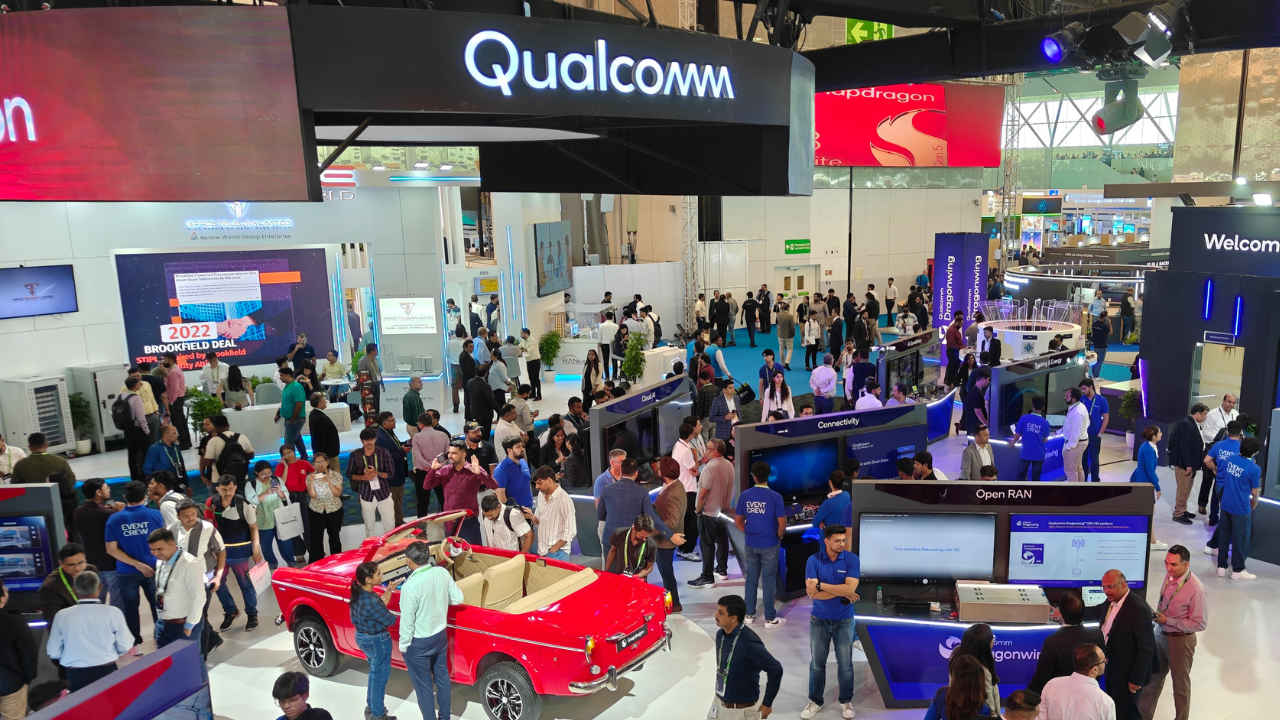
Every year, India Mobile Congress offers a snapshot of where the country’s digital imagination is headed. Some years, it’s all about faster networks, but in IMC 2025, the hum inside Yashobhoomi felt different. It was less about speed, more about understanding. Artificial intelligence wasn’t being presented as the future anymore; it was being treated as infrastructure. And within that crowded ecosystem of ideas, Qualcomm’s pavilion offered a quiet but deliberate story about how India’s intelligence layer is beginning to take shape.
 Survey
Fresh from its global Snapdragon Summit, Qualcomm India used IMC to expand on its long-term thesis: that the next era of connected intelligence will be driven by Personal AI, Physical AI, and Industrial AI. The company’s demonstrations ranged from industrial handhelds capable of running generative AI models locally to drones navigating GPS-denied environments with real-time precision. Nearby, wearables and smart glasses responded to multimodal inputs without needing to ping the cloud.


This push toward on-device and edge computing could prove especially relevant in India. In a country where connectivity quality and latency vary drastically, the ability to process data locally brings both performance and privacy advantages. It also aligns with the government’s growing emphasis on data sovereignty. The message was implicit: India’s digital transformation will increasingly depend on how intelligently data is processed, not just how fast it moves.
Also read: Inside Amazon’s festive surge: Premium tech, AI devices and India’s changing shopper mindset
Qualcomm also demonstrated its smart power metering solutions powered by its IoT platforms that can transmit usage data in real time to a smartphone or central grid, enabling remote monitoring, accurate billing, and better energy planning. It flips the process of representatives from state electricity boards visiting households every month to note readings and calculate bills, and doesn’t just modernise infrastructure but quietly makes life simpler for both utilities and households.
Beyond hardware, Qualcomm’s narrative leaned heavily into ecosystem building. The newly launched Qualcomm AI Upskilling Program introduces students and engineers to the Qualcomm AI Stack and AI Hub, giving them the tools to build and deploy AI models directly on Qualcomm platforms. The AI Hub is already being used by Indian developers to test on-device machine learning applications, hinting at the beginning of a developer ecosystem that can innovate independently within the country’s hardware realities.
Partnerships on display subtly reinforced this localisation theme. A connected Lloyd air conditioner, developed with Havells, showcased Qualcomm’s Dragonwing tri-radio platform, enabling Wi-Fi 6, Bluetooth 5.4, and Zigbee interoperability. IdeaForge’s drones, also powered by Qualcomm’s Dragonwing SoC, offered a glimpse of autonomous navigation built for industrial and agricultural terrains. Meanwhile, Coredge’s collaboration on AI infrastructure demonstrated how Indian enterprises are beginning to handle AI workloads securely within national data boundaries.
The booth also featured the Royal Enfield Flying Flea C6, the company’s first electric two-wheeler, whose instrument cluster runs on Qualcomm’s automotive platform. The XR zone, meanwhile, featured devices like Snap Spectacles (5th Gen) and Xreal’s Project Aura, highlighting the expanding overlap between personal computing and extended reality, both reliant on efficient on-device AI.
When it came to 6G, Qualcomm’s tone was measured and more about groundwork with research collaborations, testbeds, and standardisation efforts that will shape the next generation of wireless technology.
As Savi Soin, President of Qualcomm India, noted during the event, the company’s focus remains on “India-first, scalable, and secure solutions”, a continuation of its long presence in the country’s digital evolution. Qualcomm’s fingerprints are already embedded in India’s wireless history, from 3G to 5G, and this year’s showcase felt like an acknowledgement that the next chapter won’t just be about connectivity, but cognition.
 Follow Us
Siddharth Chauhan
Siddharth reports on gadgets, technology and you will occasionally find him testing the latest smartphones at Digit. However, his love affair with tech and futurism extends way beyond, at the intersection of technology and culture. View Full Profile


