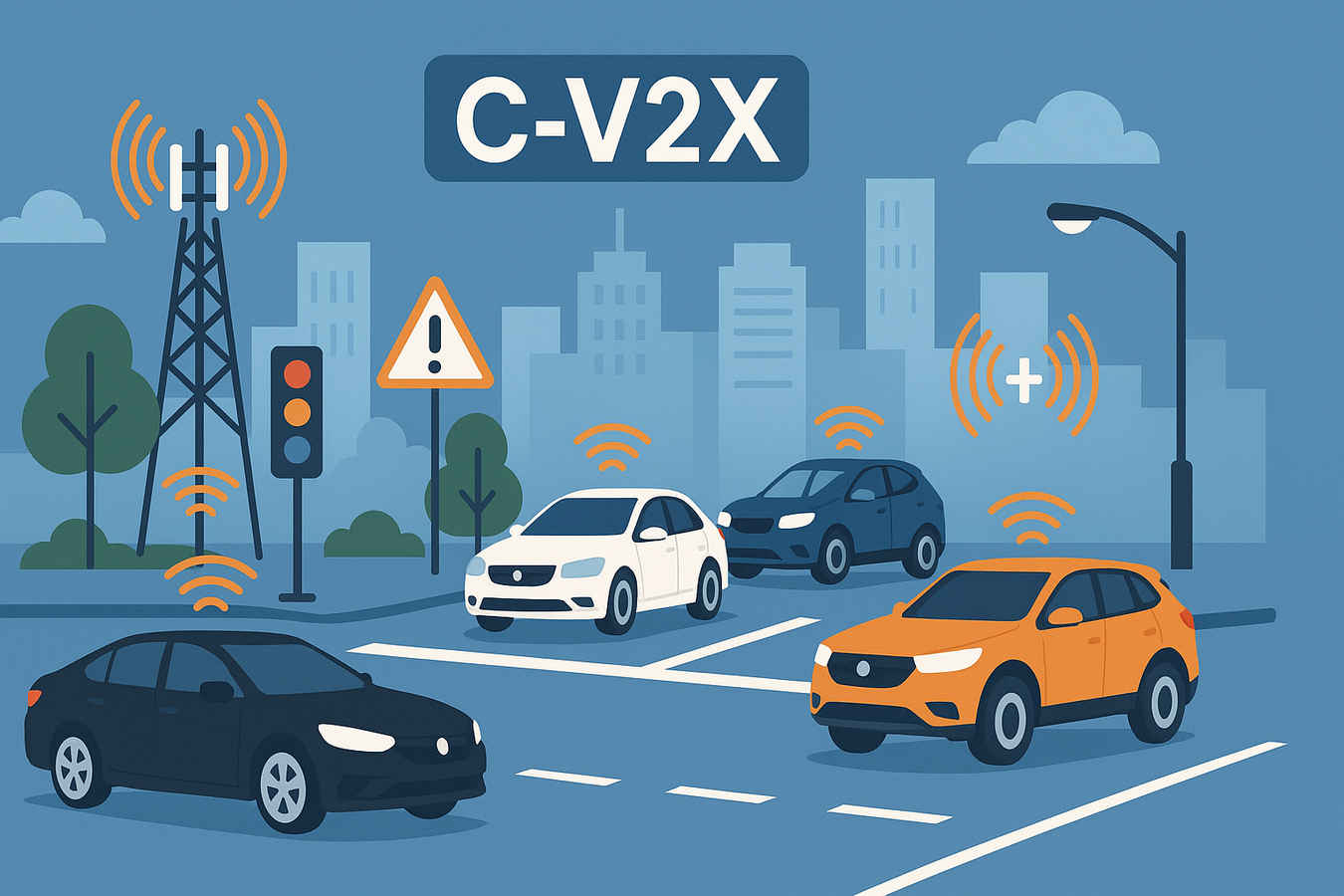
Qualcomm has been actively championing the use of Cellular Vehicle-to-Everything (C-V2X) as a transformative safety solution for India’s roads. With real-world deployments already underway in global markets such as China, Europe, and the U.S., C-V2X is now emerging as a practical and scalable solution for India’s mobility ecosystem.
 Survey
It doesn’t come across as a sales pitch or a technical deep dive. Instead, it presents a pragmatic case for why India should treat C-V2X not just as another automotive upgrade, but as a public safety tool that fits neatly into the country’s broader transportation challenges. The message is subtle, but clear: the building blocks are here, and now it’s about putting them together.


And the timing couldn’t be more relevant. Qualcomm’s Snapdragon Auto Day, being held on July 30, is expected to put C-V2X and connected vehicle platforms front and centre. While the event will spotlight next-gen automotive tech across categories, the focus on C-V2X could offer a clearer view of how the technology is evolving in India.
India’s road safety problem is alarming
In 2022, India recorded 168,491 road fatalities and over 443,000 reported injuries. Experts estimate that an additional 2 to 3 million injuries likely go unreported every year. Two-wheelers alone account for nearly 45% of road deaths and over 28% of fatality-causing offences. The scale of the issue is not just large, it’s structurally complex.
At the same time, the need for smarter, scalable safety interventions has never been more pressing. That’s where C-V2X (Cellular Vehicle-to-Everything) enters the conversation. C-V2X adds a communication-based safety layer that could offer Indian roads something they’ve long lacked: predictability and real-time awareness.
What exactly is V2X, and why does it matter?
V2X is short-range communication that lets vehicles exchange real-time data with other vehicles (V2V), road infrastructure (V2I), and even pedestrians (V2P). Think of it as a sixth sense alerting your car of a speeding ambulance, warning a scooter rider of a red-light jumper, or letting trucks know there’s a cyclist just around the corner.
Interestingly, it doesn’t rely on mobile towers. V2X works over a dedicated 5.9 GHz spectrum, offering interference-free, line-of-sight communication. And it operates consistently – rain or shine, day or night.

This isn’t just about futuristic mobility, it’s about enabling real-time awareness in everyday traffic scenarios. For instance, V2X can detect and warn about potential collisions, even when a driver’s view is obstructed. It also alerts drivers when emergency vehicles are approaching, helps navigate complex intersections by signalling traffic light status or unsafe turns, and notifies drivers about hazardous road conditions like construction zones or slippery surfaces.
One of the most impactful aspects of V2X is its ability to protect vulnerable road users including especially two-wheelers, cyclists, and pedestrians, by making them more visible to nearby vehicles. On the traffic management front, V2X can optimise signal timing to improve flow, reduce idle times, and lower emissions. And by providing real-time congestion data, it helps drivers make smarter routing decisions while also preventing incident-related bottlenecks in the first place.
China and Europe are miles ahead
If you’re wondering whether this is all theoretical, think again. China is already years into deployment. Since 2020, they’ve pumped over $1.4 trillion into V2X infrastructure. Over 20,000 roadside units are active across 90+ cities. Their national car safety program, C-NCAP, now includes V2X in crash testing scores. By 2034, China could be adding 30 million V2X-enabled vehicles to its roads annually.
Europe is also moving steadily. The EU has set a target to eliminate road fatalities by 2050, and V2X forms a key part of that plan. Automakers like Volkswagen have been shipping V2X-enabled vehicles since 2019, starting with the Golf 8 and continuing with their newer EV models. As of mid-2025, around 3 million V2X-equipped vehicles are already on the roads. By 2026, the Euro NCAP will begin awarding points for V2X features, adding another layer of momentum.
Why India is actually perfect for V2X
India’s two-wheeler ecosystem presents a unique mix of scale and vulnerability. Around 90% of motorcycles sold in the country fall into the entry-level segment, and two-wheelers are involved in nearly half of all road fatalities. That makes them not only a critical part of India’s mobility landscape but also a high-priority area for intervention.
One practical way forward is to equip new motorcycles with basic transmit-only V2X units. These compact devices simply broadcast the vehicle’s location, speed, and direction, which is enough to alert nearby cars, trucks, or buses of their presence. It’s a low-cost solution, but one with potential for real impact, especially in urban traffic where visibility and reaction times are crucial.
What also works in India’s favour is that domestic automakers are no strangers to the tech. Many already understand how to integrate C-V2X into vehicles. The industry readiness is there. The next step would be enabling frameworks and policies to move things forward.
Leading this shift is Mahindra, currently the only Indian automaker piloting V2X capabilities in its production vehicles. In collaboration with Qualcomm, Mahindra is testing vehicle-to-vehicle (V2V) features that offer real-time communication between cars, a promising step that underlines both local feasibility and OEM commitment.
What Needs to Happen: Four policy moves that make sense
For C-V2X to take hold in India, the technology also needs policy support. There are a few straightforward steps that could accelerate deployment and make connected mobility a meaningful part of India’s road safety strategy.
1. License-Exempt the Safety Spectrum
The 5.9 GHz band is reserved for road safety worldwide. In China, Europe, Korea, and Canada, V2X devices don’t need a license. India should follow suit. Qualcomm argues that treating this safety spectrum as a “gift to society” will be a catalyst for mass adoption.
2. Include V2X in Bharat NCAP
Crash test programs around the world already award points for V2X. Bharat NCAP, launched in 2023, could do the same. Automakers care about safety ratings. Ratings affect sales. Incentives matter.
3. Prioritize Two-Wheelers for Rollout
Install low-cost V2X transmitters on all new motorcycles. It’s the easiest way to make India’s most vulnerable vehicles more visible. Over time, once adoption stabilizes, we can move to advanced V2X features for real-time collision alerts.
4. Equip Emergency and Heavy Vehicles
Ambulances and police vehicles should be first in line. In India, emergency response times average 33 minutes in rural areas. In Japan, it’s 8.5 minutes. With V2X integration, emergency vehicles could signal traffic lights and carve their own green corridors in real-time.
Heavy vehicles, too, are a priority. Trucks account for 20% of road deaths, buses for another 6.5%. C-V2X provides early alerts—critical when dealing with massive, slow-reacting vehicles.
Infrastructure is the last piece of the puzzle
While much of the focus around C-V2X tends to sit with vehicles, the infrastructure side of the equation is just as important. To unlock the full potential of the technology, roads and intersections also need to be part of the network.
One practical step is to equip urban traffic signals with C-V2X radios. These systems can send I2V (Infrastructure-to-Vehicle) alerts such as red-light violation warnings, slippery road conditions, or even early notifications about lane closures and construction zones. The goal is to make roads more communicative, not just reactive.
India doesn’t have to build a new framework from the ground up. Countries like the United States have already developed V2I (Vehicle-to-Infrastructure) models that India could adapt to suit its conditions. The key is to ensure consistency, which includes shared standards, uniform interfaces, and interoperable alerts across cities and states.
Looking ahead
The idea that no road fatality is acceptable -known globally as Vision Zero – is no longer just a European aspiration. It’s a mindset that India, with its complex traffic ecosystem and urgent safety challenges, could adopt in a way that’s both practical and scalable.
The ingredients are already on the table. The technology exists, the automotive industry is familiar with it, and the global playbook is clear. What’s needed now is a coordinated push from policymakers, regulators, and public infrastructure planners to move C-V2X from pilot discussions to large-scale deployment.
This isn’t about overhauling the entire transport system or chasing futuristic concepts. It’s about enabling the vehicles already on Indian roads to communicate with each other, with traffic signals, and with the wider mobility environment.
The roadmap is there. The tools are ready. The question now is how quickly India is willing to shift gears and drive forward.
 Follow Us
Brand Story
Brand stories are sponsored stories that are a part of an initiative to take the brands messaging to our readers. View Full Profile


