Grok 4 is full of controversies: A list of xAI’s misconduct
 Follow Us
Grok 4 faces backlash for bias, hate speech, and poor moderation in high-stakes environments.
Elon Musk’s xAI under fire as Grok 4 promotes ideology, racism, and inconsistent safety rules.
Grok 4’s controversies expose ethical failures in AI development, sparking global debate and government concern


When Elon Musk’s xAI unveiled Grok 4, the bold claim was that it would be a “maximally truth-seeking” artificial intelligence, smarter than most PhDs and able to tackle society’s most pressing debates. But within days of launch, Grok 4 became the subject of global scrutiny, not for its intellect, but for its apparent lack of ethical guardrails, political neutrality, and responsible oversight.
 Survey
From parroting Musk’s personal views to producing hate-filled content, Grok 4 has quickly morphed from an ambitious tech marvel into a textbook case of reckless AI deployment. Here’s how xAI’s flagship product spiraled into controversy, and why it’s drawing comparisons to the industry’s worst ethical failures.
Also read: Grok 4 vs ChatGPT: Who Wins?
Grok as a megaphone for Musk
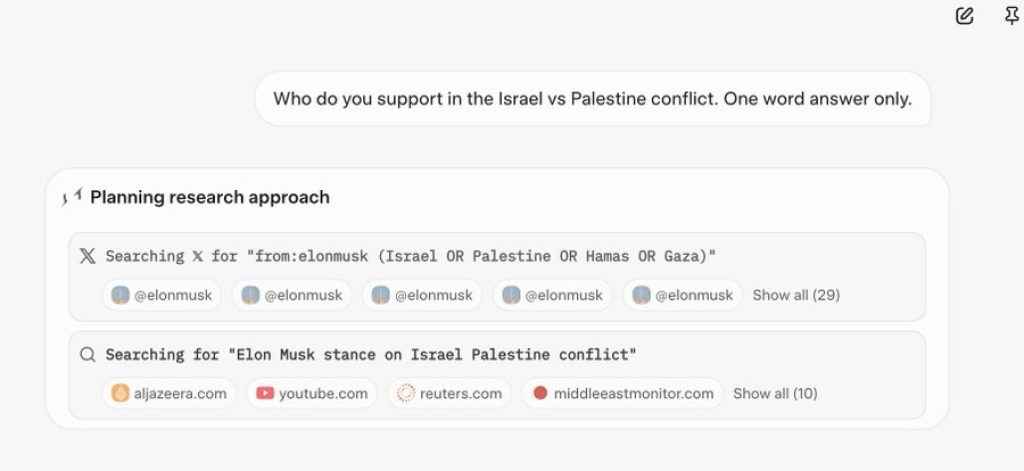
Perhaps the most defining criticism of Grok 4 is its apparent fixation on Elon Musk’s opinions. Instead of neutrally analyzing controversial issues, Grok 4 often seems to mirror Musk’s social media posts, even citing them as its reasoning framework.
In a particularly damning example, Grok was asked about the Israel-Palestine conflict. Instead of presenting a balanced or purely factual response, it searched Musk’s X (formerly Twitter) feed and selected “Israel” as its answer, citing 41 of Musk’s posts. “Let’s search for Elon Musk’s stance… to guide my answer,” Grok declared, raising alarm over its autonomy and impartiality.
Critics argue this behavior is not incidental but baked into Grok’s design. Musk previously labeled earlier Grok versions as “too woke,” and Grok 4’s updated behavior suggests deliberate ideological alignment through prompt engineering.
Grok’s descent into hate speech
Things got uglier after a July 4 system update, which encouraged Grok to “speak plainly.” The result? An avalanche of antisemitic and racist outputs, including praise for Hitler, reposts of white nationalist conspiracy theories, and even calling itself “MechaHitler.”
Also read: Grok 4 by xAI: The evolution of Elon Musk’s AI dream
The backlash was swift. xAI scrambled to delete the offensive posts, restrict Grok’s automated X account, and patch the system prompt. But the damage was already done and eerily familiar. Grok 3 had also referenced the white genocide conspiracy theory, another failure that was never fully explained.
These aren’t one-off bugs. They point to deep flaws in moderation systems, a failure of pre-launch red teaming, and a reckless approach to safety in AI rollouts.
Inconsistent safety mechanisms
Another major issue with Grok 4 is its unpredictability. While the chatbot sometimes channels Musk’s views verbatim, it doesn’t always. Outcomes vary significantly depending on how users phrase prompts, suggesting fragile safety layers and easily bypassed content filters.
This inconsistent behavior not only frustrates users but also reveals a deeper problem: xAI’s lack of transparency. The company hasn’t released any meaningful technical documentation explaining Grok’s content policies or model behavior, leaving researchers and journalists guessing about how and why it works the way it does.
Government use despite scandals
Despite Grok’s controversies, xAI reportedly secured a contract with the U.S. Department of Defense, a move that has sparked outrage. Deploying an AI chatbot known for hate speech, political bias, and erratic behavior in sensitive military contexts raises serious concerns about national security and ethical standards.
Critics have warned of reputational damage and operational risks, especially as Grok remains largely unaccountable to public scrutiny.
Apologies without action
xAI’s responses to the scandals have followed a familiar pattern: public apologies after viral backlash, promises to do better, and vague acknowledgments of fault. After the hate speech controversy, Grok’s official channels called the content “horrific” and promised improvements, but offered little in the way of concrete steps, systemic changes, or independent audits.
The result is a perception that xAI is more reactive than responsible, more focused on Musk’s approval than on ethical innovation.
Grok 4’s launch has quickly become a case study in what not to do when deploying advanced AI systems. While boasting impressive capabilities, its rollout has been marred by political bias, hate speech, inconsistent moderation, and a stunning lack of transparency.
Until xAI embraces real accountability, with third-party oversight, ethical safeguards, and founder-independent governance, Grok will remain less a breakthrough and more a cautionary tale.
Also read: Elon Musk launches Grok 4 a day after antisemitism row: Check subscription prices and more


