

Lava’s second act: Challenging global giants in India’s budget 5G segment
 Follow Us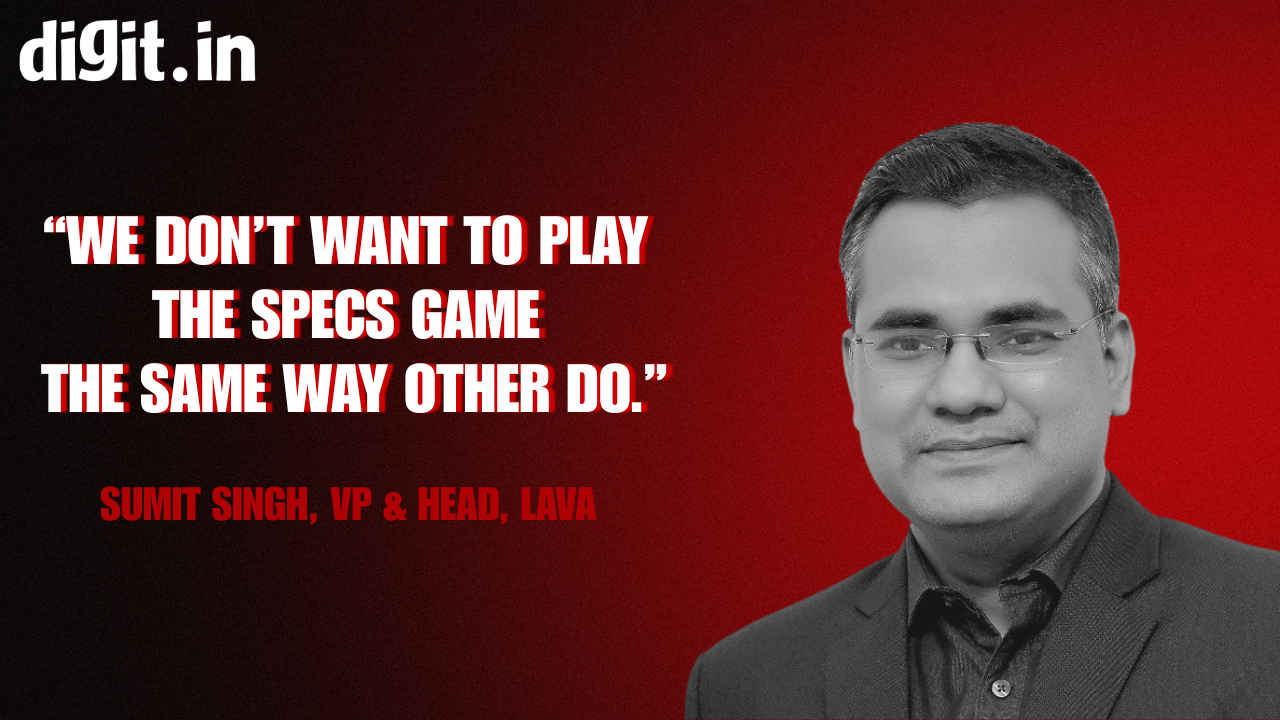

For years now, we have seen the Indian smartphone market being dominated by foreign brands like Xiaomi, Realme, Vivo, Samsung, Motorola, and the likes. This is especially true in the budget segment, where price often decides the winner. But now, homegrown brands, such as Lava, are hoping to find a spot for themselves in the crowded market and are betting big on affordable 5G smartphones. Lava is staging what it calls its “second act” and aiming to prove that an Indian company can not only survive but also scale in one of the world’s most cutthroat mobile markets.
 Survey
In an exclusive conversation with Digit, Sumit Singh, Product Head at Lava International Limited, spoke about the company’s renewed strategy. Lava is not just playing catch-up anymore. Instead, it is trying to make a space of its own in entry level and budget segments. This price band is seeing explosive growth as first-time 5G users look for reliable, future-ready phones without breaking the bank.
From survival to scale
Lava has had its ups and downs. Once seen as a challenger to global players, the brand almost faded into the background as foreign competitors flooded the market with aggressive pricing and flashy specs. Singh admits that the last few years have been about survival, keeping the brand relevant and alive in a market where dozens of local players couldn’t keep up.
But now, in 2025, that has changed. Lava is moving from survival to scale. The company is focusing on performance-driven phones with practical features rather than chasing spec-sheet gimmicks. Singh explains, “We understand that the Indian consumer wants value that lasts; reliable performance, a battery that doesn’t give up, and after-sales support they can count on. That’s where Lava is investing its energy.”
We even got in touch with Tarun Pathak, Research Director at Counterpoint Research, to validate the data-driven insights. He added, “Lava is regaining share in Indian smartphone market and was the fastest (156%) growing brand YoY in sub 10K and second fastest (96%) growing brand in the overall smartphone market in Q2 2025 as per Counterpoint Research. One of the key reason for the growth was aggressive portfolio in sub 20K especially the Blaze, Storm and Agni series by bringing features like fast charging, AMOLED display at competitive price points. However, apart from the product Lava has also successfully expanded its distribution reach with a focus on after sales ( free service at home) which has helped brand to gain both mind and the market share.”
Standing out in a sea of similarity
The challenge, of course, is clear. The budget 5G segment in India is one of the hottest contested spaces, dominated by brands such as Motorola, Vivo, and iQOO, all of whom have set the bar with aggressive pricing and spec-heavy offerings. For a brand like Lava, which is attempting to make a comeback, cutting through this clutter is not really a small task. But Singh insists that the company is approaching this not as a price war, but as a chance to redefine what an “Indian” smartphone can be.
“We don’t want to play the specs game the same way others do,” Singh tells us. “Our focus is on three things: India-first design and support, performance over hype, and building trust with our customers. These are areas where we believe we can win because they genuinely matter to Indian users.”
On the India-first front, Lava is doubling down on its “Made in India” positioning. Manufacturing, R&D, and design are increasingly being handled domestically, which gives the company a tighter grip on costs and quality control. “It’s not just about assembling phones here. We’re designing with Indian consumers in mind; their habits, their challenges, their expectations,” Singh adds.
Then comes the performance factor. Singh points out that many budget devices boast features that sound impressive on paper but are rarely used. “How many people really use a 200MP camera every day?” he asks rhetorically. “Instead, what most people want is a phone that doesn’t lag after six months, a battery that lasts through the day, and software that isn’t bloated. That’s where we’re putting our energy.”
The third pillar is the trust factor, and here Singh believes Lava has an opening. With other brands frequently facing questions about data practices, after-sales service, and customer care, Lava is positioning itself as a transparent, reliable alternative. “When people buy a Lava phone, they know exactly who’s making it and where. And if something goes wrong, we have a service network that is responsive and close to home,” he says.
They have used this philosophy with their latest mid-range bet, the Lava Shark series. Singh describes it as a product designed specifically with young Indian users in mind, particularly gamers and streamers who push their phones to the limit. “The Storm Shark is built to handle sustained heavy use. We’ve worked hard on thermal management so it doesn’t overheat during long gaming sessions. For us, it’s not about chasing a benchmark score, it’s about how the phone holds up in the real world.”
In his words, this is what sets Lava apart in what he calls a “sea of copy-paste devices.”
Why the Indian angle matters
The timing for Lava’s renewed push may be favourable. On one hand, the government continues to encourage local manufacturing and self-reliance under the “Make in India” initiative. On the other hand, consumers are becoming more conscious about supporting homegrown brands.
Singh believes Lava is uniquely positioned to benefit from this. “We’ve seen this shift in sentiment. People don’t just want a good phone; they want to feel good about the brand they’re supporting. Our Indian roots and our investments here resonate with that,” he says.
Another often-overlooked differentiator, Singh says, is after-sales service. “Specs sell a phone, but service keeps a customer. Buying a phone is one thing, but what happens after is just as important. That’s where Lava’s Indian roots help us serve better,” he notes, pointing to the company’s wide service network across Tier-2 and Tier-3 cities. For many Indian users, especially outside metro cities, quick and accessible service can outweigh an extra feature or two.
The road ahead
Of course, the path forward won’t be easy. Competing against foreign brands with deeper pockets, massive marketing spends, and sprawling ecosystems is a challenging task. Singh acknowledges this but remains confident. “We don’t have the same war chest as some global players, but we also don’t need to copy their playbook. Our goal is not to be everything to everyone, but to be the most trusted Indian alternative in the budget and mid-range segments.”
Lava’s bet on practical, performance-first devices comes at a time when Indian consumers are increasingly seeking value over loud marketing. The company’s focus on 5G in the sub-Rs30,000 segment, paired with its service-first approach, gives it a chance to stand out in a crowded field.
But the road ahead won’t be without hurdles. Competing with entrenched foreign brands on scale and perception is not a small task. Success will depend on whether Lava can consistently deliver devices that feel both reliable and aspirational to Indian buyers.


